Jason Munford is the principal of Barbour County↗ET Elementary School, the newly consolidated campus that will bring Pre-K through sixth grade students together under one roof this summer in Louisville, Alabama. Munford, who previously led Barbour County Intermediate School serving second through sixth graders, now oversees a campus that merges two formerly separate schools as the district responds to years of enrollment decline.
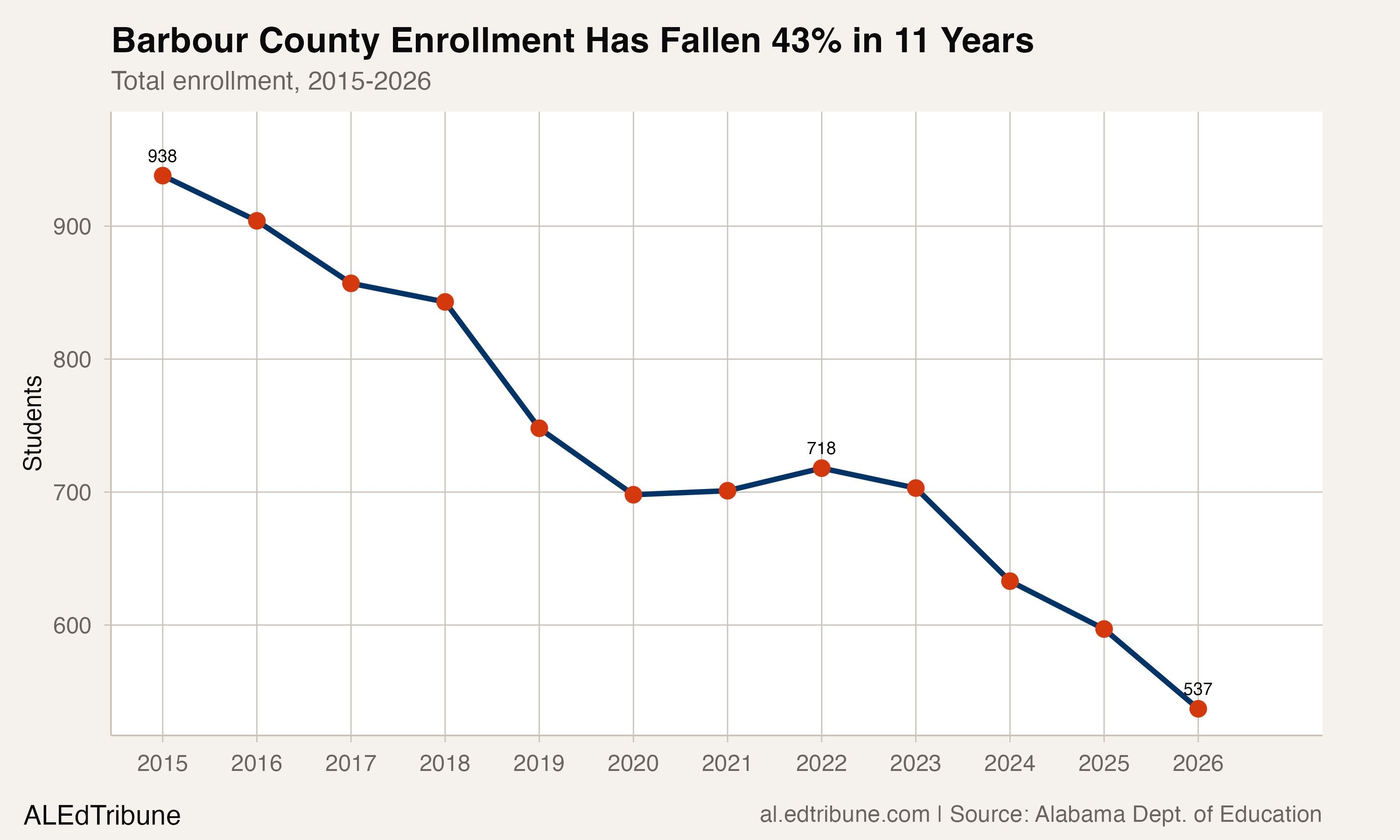
The consolidation is a response to math that has become unavoidable. On the state's report-card counts, excluding prekindergarten, Barbour County enrolled 860 students in 2014-15 and 597 in 2024-25, a 31% decline in 10 years, an average loss of about 26 students per year. The state's fall headcount, a separate report that includes prekindergarten, counted 575 students in 2025-26, the most recent school year in the state's published data, down 83 from 658 the year before. The primary school was operating with roughly 100 students.
Munford was introduced by the district in August 2023 as the new principal of Barbour County Intermediate School. Ms. Allen-Ingram said Munford and his staff "have made a significant impact in Barbour County Schools and deserve their recognition and many accolades."
The foundation Allen-Ingram built
Pamela Allen-Ingram, who is retiring as of June 30, 2026, served as principal of Barbour County Primary School, which covered Pre-K through first grade. She is currently principal of the Barbour County Pre-K and Alternative Education Program. Her years leading the youngest learners in the district shaped her conviction that early childhood education determines everything that follows.
"The Pre-K through first grade years are the most critical foundation for a child's academic success and confidence as a learner," Allen-Ingram said. "These early experiences shape how students view school, relationships, and themselves."
Her priorities centered on three areas: early literacy, social-emotional development, and family engagement. "When schools and families work together, students are more confident and better prepared to succeed," she said.
The emphasis on literacy aligns with gains the district has made under the Alabama Literacy Act. Superintendent Dr. Keith Stewart told WTVM that reading proficiency at the primary level rose from roughly 28% to 81%, a jump he cited as evidence that the district's academic trajectory is moving in the right direction even as enrollment falls.
Preparing for consolidation
The merger of the primary and intermediate campuses, announced in May 2025, will bring Pre-K through sixth grade students together at the intermediate school campus in Louisville, about 15 minutes from the former primary school site. The district expects the move to free resources for a full-time assistant principal and counselor, positions the smaller campuses could not justify individually.
Allen-Ingram said clear communication was central to the transition during her time leading the primary school. "Change can create uncertainty, so it was important that everyone felt informed, supported, and included throughout the process," she said. For staff, that meant aligning expectations and instructional practices across grade levels that previously operated in separate buildings. "Bringing teams together helped build a shared vision and ensured continuity for students as they moved through the grades on one campus."
A district under pressure
Barbour County sits in Alabama's Black Belt, with a school-age child poverty rate above 40% and a population that has been declining for decades. In the state's 2025-26 fall headcount, the school system is one of seven county school systems in the state with fewer than 1,000 students. That year, Barbour County Elementary School enrolled 298 students, including 25 in prekindergarten, and Barbour County High School enrolled 277.
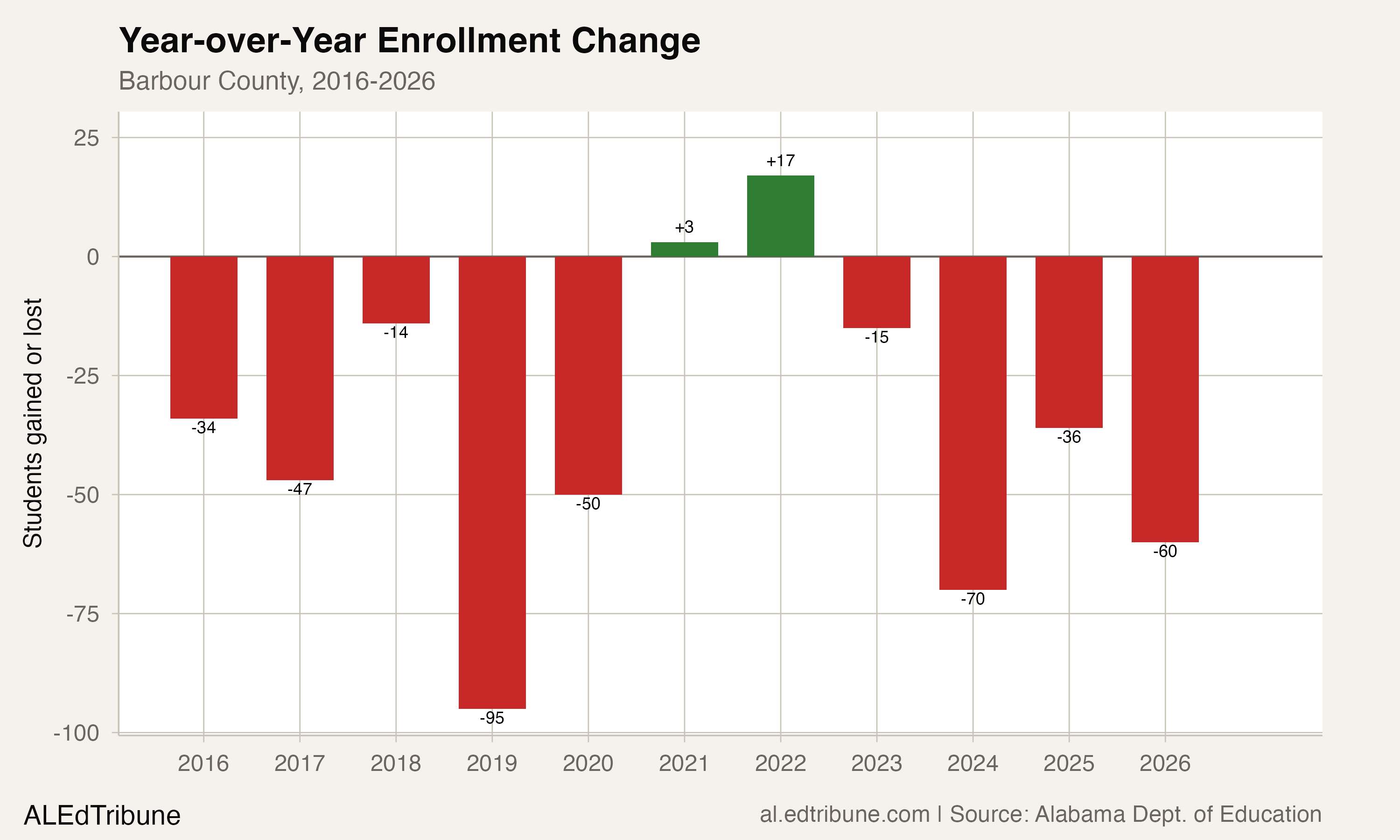
The enrollment decline has been steep and persistent. On the report-card counts, Barbour County grew in only three of the 10 years from 2014-15 to 2024-25: modest gains in 2020-21 and 2021-22, and a single student in 2024-25. From 2021-22 to 2024-25, the district lost 82 students. The fall headcount then showed a loss of 83 students in 2025-26 alone, about 13% in one year.
Chronic absenteeism compounds the enrollment challenge. In 2024-25, 48.5% of Barbour County students were chronically absent, the highest rate in Alabama, meaning nearly one in two students missed 18 or more days of school.
Sustaining the gains
Asked whether the district's reading proficiency improvements can hold as enrollment continues to shrink, Allen-Ingram pointed to systems rather than scale.
"Sustainability depends on maintaining those systems rather than relying on temporary initiatives," she said. "Smaller enrollment can actually provide opportunities to strengthen individualized instruction, deepen teacher collaboration, and ensure interventions are more responsive to student needs."
She added that continued professional development for teachers and protected instructional time will be essential. "I also believe supporting teachers with resources, collaboration, and professional learning is essential to making that vision a reality."
Enrollment counts come from the Alabama State Department of Education. Counts from 2014-15 through 2024-25 come from the state's report-card enrollment, with prekindergarten excluded because the state stopped publishing a prekindergarten count for Barbour County in 2024-25. The 2025-26 counts, and their comparison with 2024-25, come from the state's fall headcount, a separate report that counts students differently and includes prekindergarten, so this article compares years only within the same report.
Correction, November 23, 2026: An earlier version said Barbour County enrolled 938 students in 2014-15 and 537 in 2025-26, a 43% decline in 11 years averaging about 36 students per year; that only two years since 2014-15 saw gains; that the district lost 181 students in four years; that its 2025-26 loss of 60 students was the third-largest in the period; and that Barbour County Elementary and High enrolled 266 and 271 students. Those 2025-26 figures came from an average daily membership measure rather than a count of students, and the long-term comparisons joined two different state reports. The state's fall headcount shows 575 students in 2025-26, down 83 from 658 in 2024-25, with 298 at the elementary school and 277 at the high school. The article now measures long-term change on the state's report-card counts alone, excluding prekindergarten: 860 students in 2014-15 and 597 in 2024-25, a 31% decline, with gains in three of those 10 years. The third-largest-drop ranking compared the two reports and has been removed.
Detailed code that reproduces the analysis and figures in this article is available exclusively to EdTribune subscribers.
Discussion
Sign in to join the discussion.
Loading comments...