Christie Swinney describes the principal's job at Duncanville Middle School through the experience she wants students to have: feeling safe, knowing they matter and being challenged in class. Her priorities bring relationships and academic expectations together as she leads the Tuscaloosa County↗ET school.
"My top priorities are creating a safe, positive learning environment and building strong relationships with students, staff, and families," Swinney said in written answers to The ALEdTribune. "I want every student to feel supported, valued, and challenged academically."
Swinney confirmed her summer appointment in writing, and the school's administration page identifies her as principal. Alabama's directory previously listed Traci Fox Primm in the role. Swinney's answers describe what she wants to carry forward at Duncanville and where she wants to concentrate her attention.
What drew her to Duncanville
Asked about her path into the role, Swinney emphasized the people she would work with and her interest in students' development during middle school. She described her experience in education as preparation to combine high expectations with compassion and a commitment to student success.
"What drew me to Duncanville Middle School was the opportunity to make a positive difference in the lives of students, staff, and families," she said. "I have a passion for education and believe that middle school is a critical time in a student's development."
Her assessment of the school she inherited was warm and specific to its culture. "Duncanville has a phenomenal school culture and rich tradition," she said. That is the starting point she chose for her account of the transition: a community she is pleased to join, with relationships she wants to strengthen.
Her expectations extend to the adults in the building. "I also want our staff to feel appreciated and empowered while maintaining high expectations for teaching, learning, and student behavior," Swinney said. In her description, supporting teachers and setting expectations for students belong in the same conversation.
The school behind those priorities
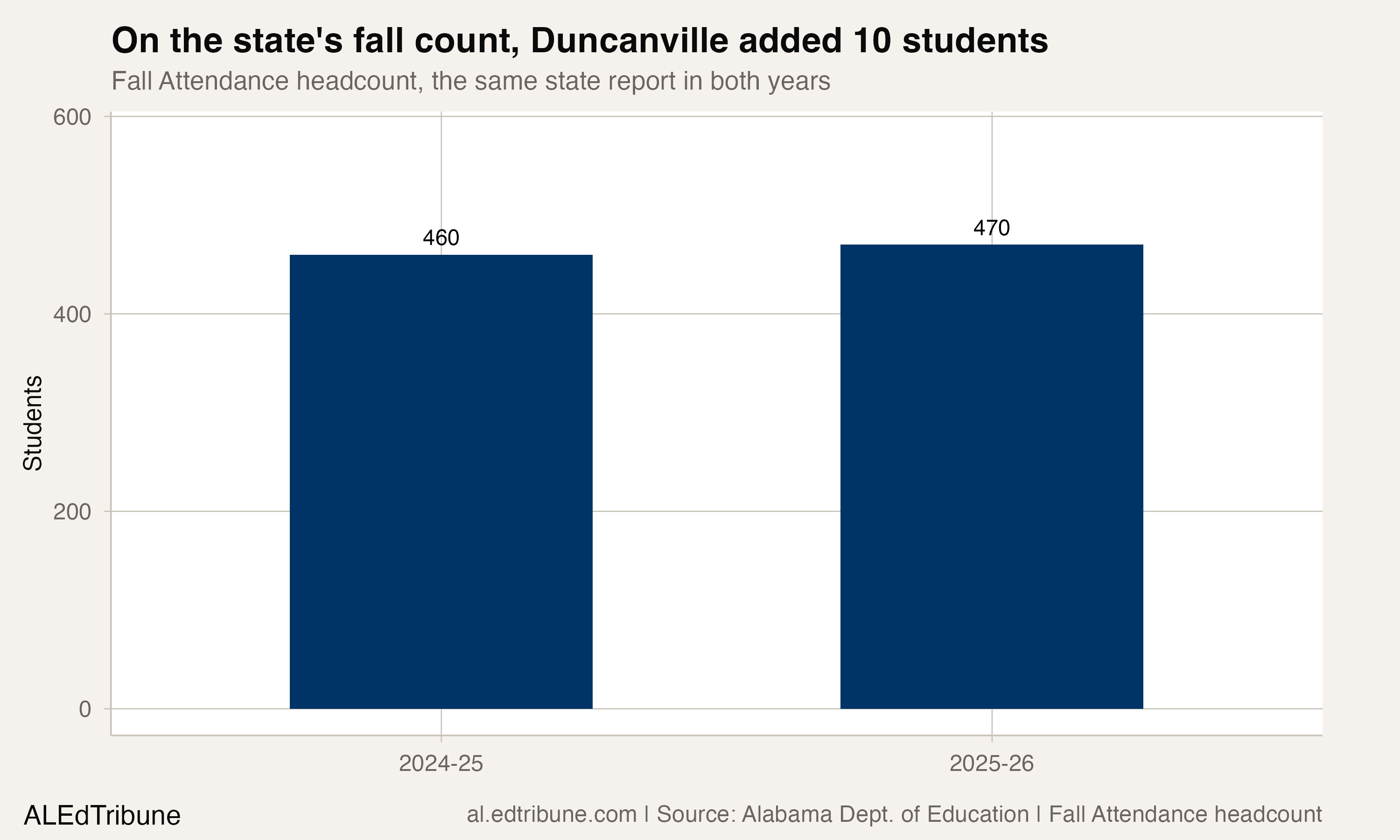
Duncanville Middle enrolled 470 students in 2025-26, last school year and the most recent year in Alabama's published enrollment data. On the state's fall headcount, the same count in both years, that was up from 460 in 2024-25, an increase of 10 students, or 2.2%. The increase describes the school before Swinney's appointment; it does not measure an effect of her leadership.
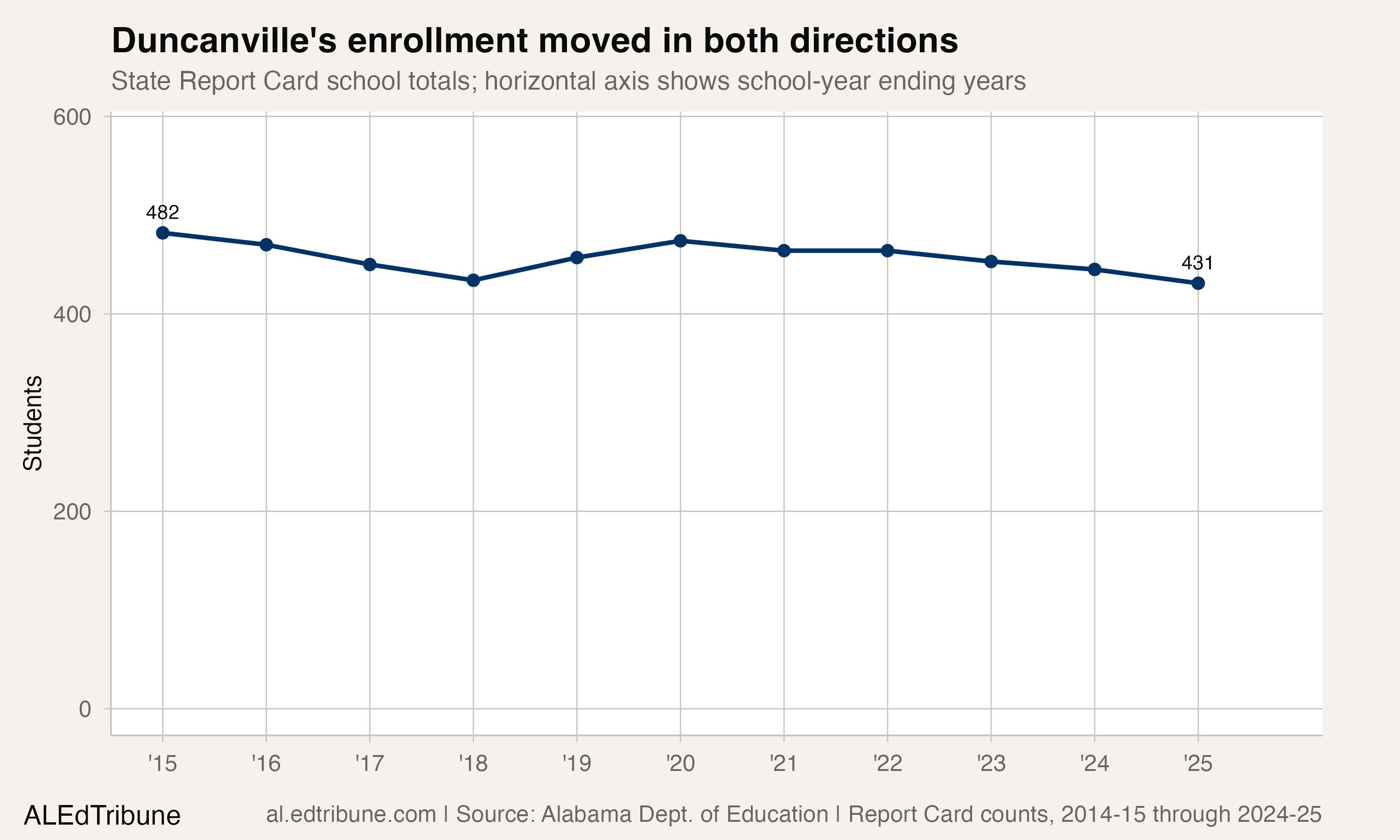
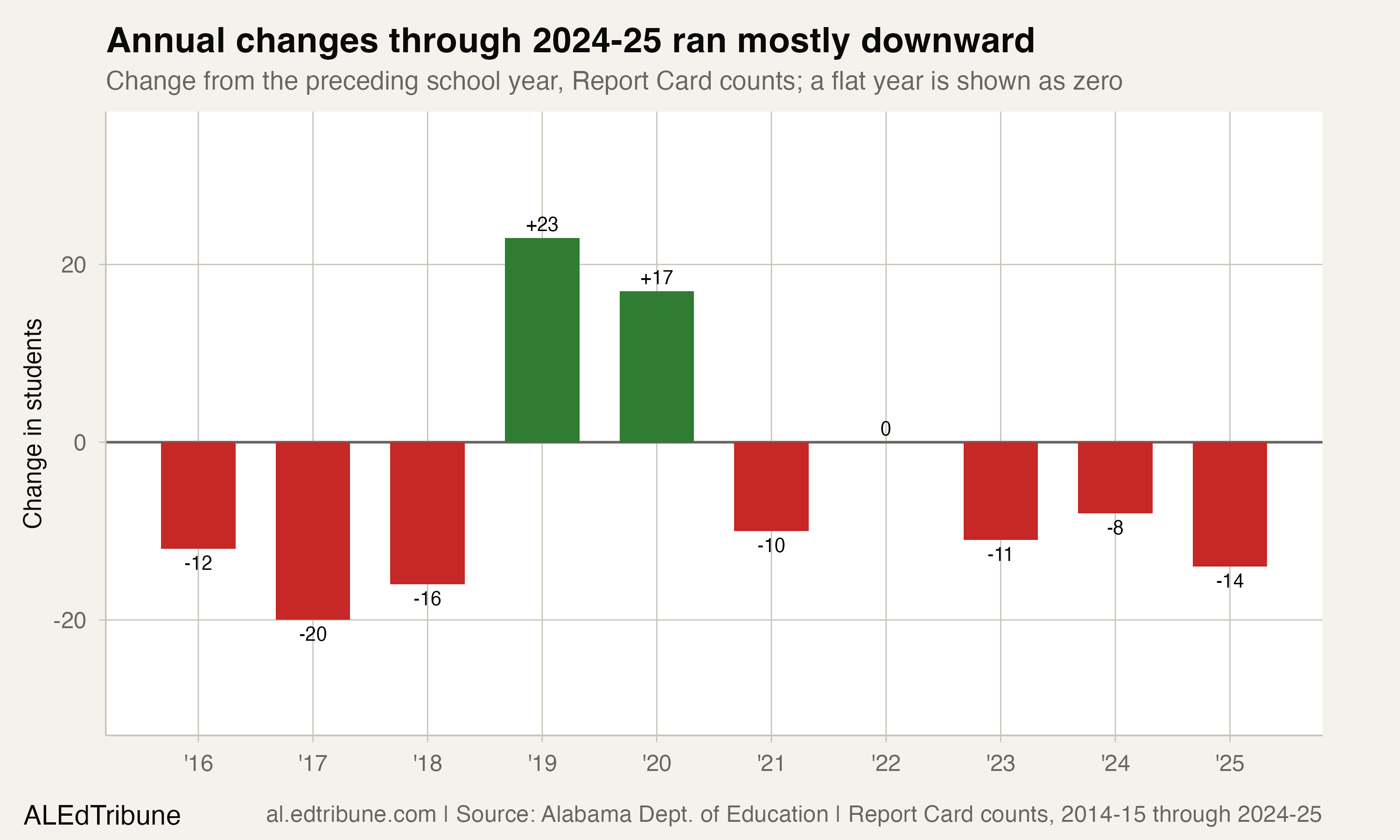
The state's longer record comes from a different report, its annual Report Card counts, which run through 2024-25 and are not directly comparable with the fall headcount. On that record, Duncanville counted 482 students in 2014-15 and 431 in 2024-25, 51 fewer, or 10.6% lower. The years in between included both increases and decreases.
For Swinney's interest in staffing and support programs, enrollment supplies a measure of the students assigned to the school. It cannot establish whether staffing is sufficient, which interventions a student needs or how often a student attends. Those questions require evidence beyond an enrollment count.
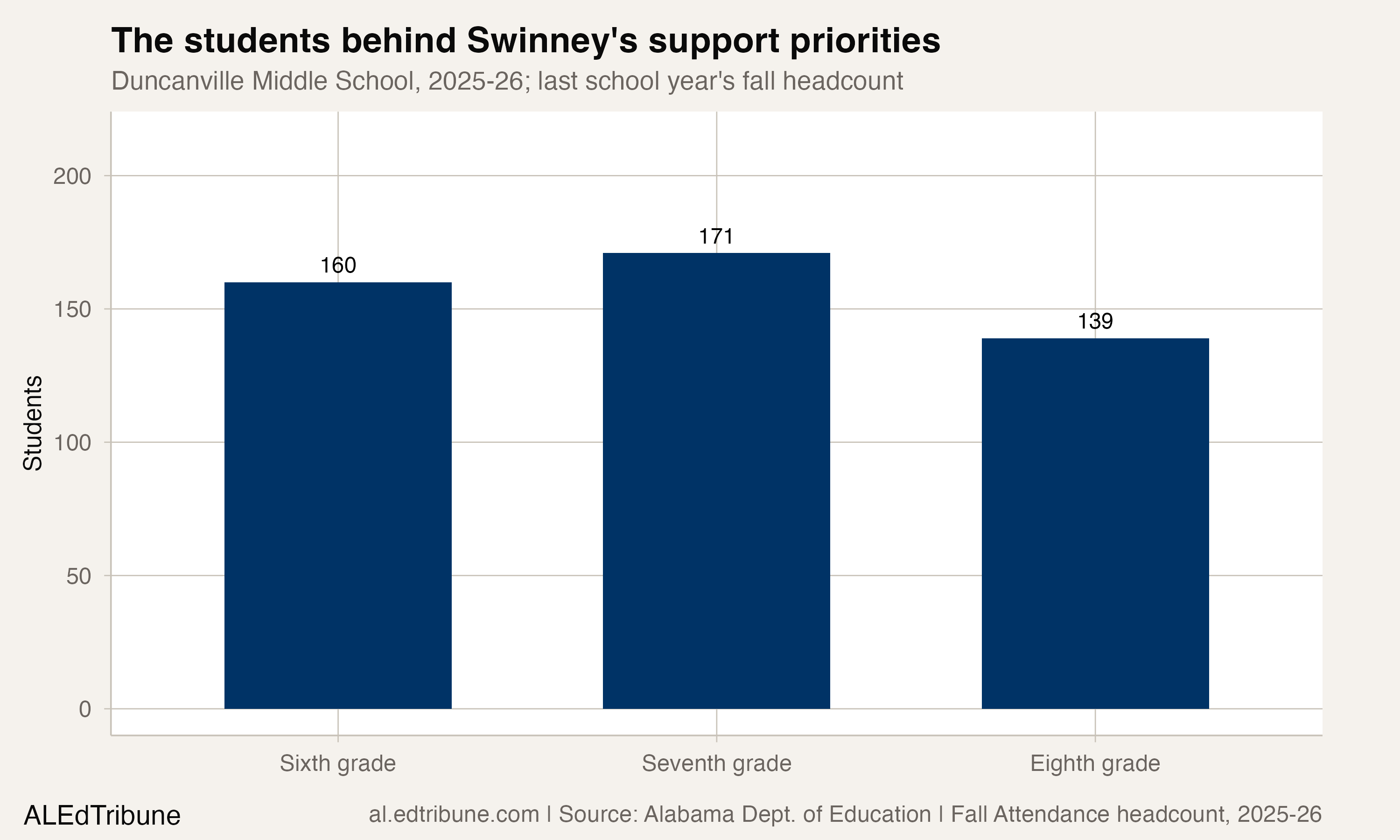
The grade breakdown shows the groups her staff is supporting. On last school year's fall headcount, Duncanville reported 160 sixth graders, 171 seventh graders and 139 eighth graders. These are separate groups of students counted in the same school year, rather than a record of a single group moving through school.
The county system's fall headcount was 19,670 students in 2025-26. Duncanville accounted for 2.4% of that enrollment. That places the school within the wider system without treating its share of students as a share of staffing or resources.
Attendance and interventions
Swinney's account of the work ahead moves from school climate to practical support. She said Duncanville is focusing on students' academic, behavioral and social-emotional needs, with attention to the people and programs needed to meet them.
"One of our priorities is ensuring we have the appropriate staffing, resources, and support programs in place to help every student succeed," she said.
She also named attendance and academic interventions directly. "We are also focused on improving student attendance, strengthening academic interventions, and maintaining a safe and welcoming school environment," Swinney said.
Those are statements of direction. Her answers do not identify a staffing vacancy or announce a particular intervention, and the enrollment record cannot show whether attendance or learning has improved. The distinction leaves families with an accurate account of her priorities while keeping the results of that work open to future reporting.
The Tuscaloosa County Board of Education makes meeting agendas and minutes available to the public and says its meetings and work sessions are open. That offers families a public route to follow district decisions alongside the school priorities Swinney has described.
For now, her message returns to the daily experience of students and staff. She wants students supported and academically challenged, and teachers appreciated and empowered. Attendance and interventions give that broad aim practical places to begin: helping students be present for instruction and making support available when they need it.
Enrollment counts come from the Alabama State Department of Education. Figures for 2024-25 and 2025-26 are the state's fall headcount; the 2014-15 through 2024-25 trend uses the state's Report Card counts, a separate report. The two are not compared with each other. The school serves grades 6 through 8 and has no prekindergarten enrollment. The figures describe published school-year counts, not live enrollment.
Detailed code that reproduces the analysis and figures in this article is available exclusively to EdTribune subscribers.
Discussion
Sign in to join the discussion.
Loading comments...