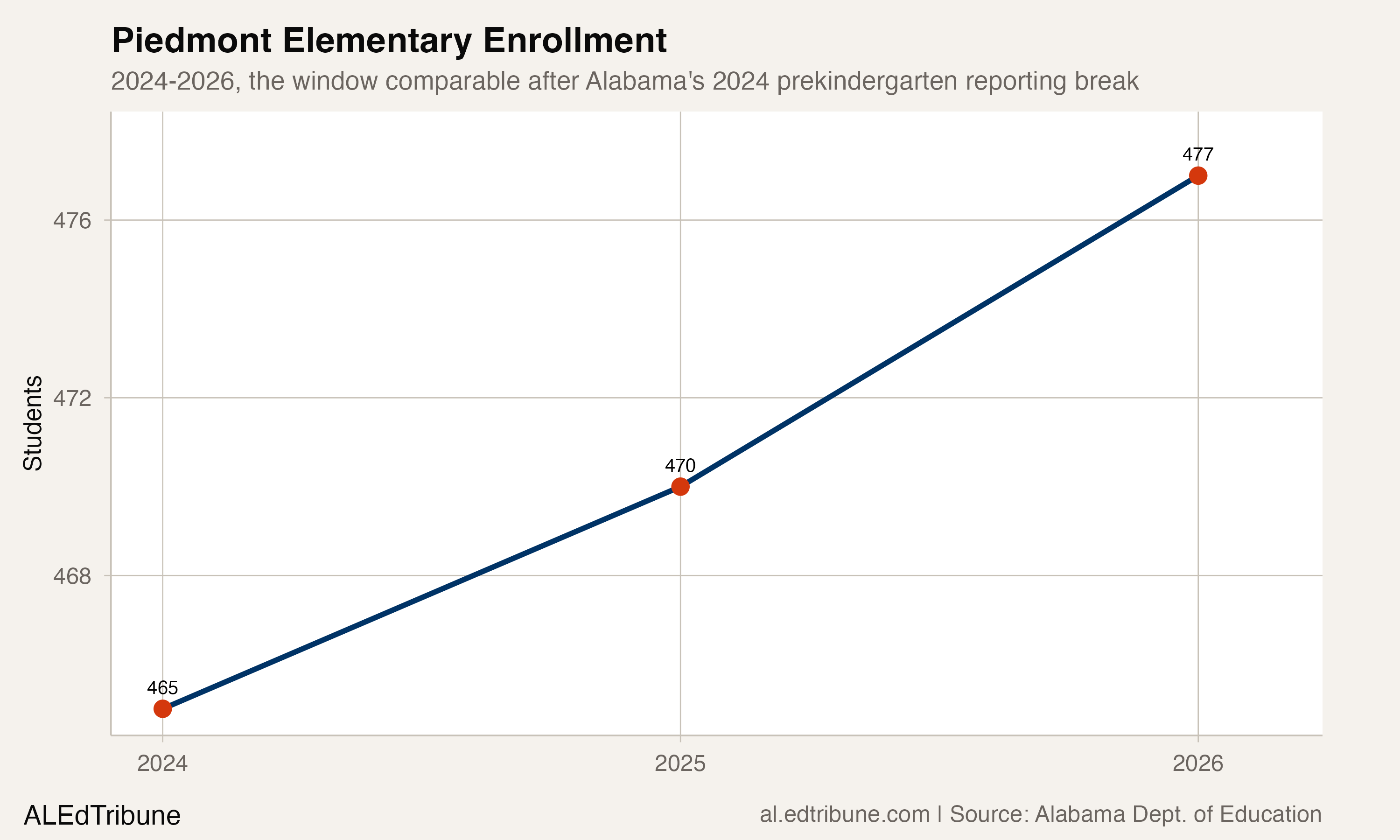
Michele Downey did not have to learn her way around Piedmont Elementary School this summer. She was already inside the building, working as its assistant principal, when the district moved her into the principal's office on July 1. She now leads a campus that the state counted at 477 students in 2025-26, a school that has added students in each of the last two years while Piedmont City↗ET, the district around it, has not.
"My path to the principal's office has truly been a journey of learning and growing alongside students and teachers," Downey wrote in response to questions from The ALEdTribune. "I've spent 22 years in education, and I have been part of the Piedmont City School System since 2004."
An internal promotion, not an outside hire
Downey's own account of her career maps a route through nearly every level of the district she now helps lead. "During that time, I've had the opportunity to teach at the middle school, upper elementary, and high school levels, as well as serve as an elementary assistant principal," she wrote. She confirmed the handoff itself in a short note on June 22, signed with her outgoing title as the school's assistant principal. She was replacing Brigett Stewart, effective July 1.
That continuity shapes how she talks about the assignment. "Being at Piedmont Elementary feels especially meaningful because this community has been such an important part of my journey in education," she wrote. "I know the people, the pride, and the commitment that make Piedmont special, and I am honored to now serve as principal of PES."
A school growing against the grain
The enrollment data backs up the sense of momentum in her answers, though the state's own reporting changes limit how far back that comparison can honestly run. Alabama's enrollment file dropped prekindergarten counts from every school's total starting in 2024, so the only years that measure the same thing at Piedmont Elementary are 2024, 2025 and 2026. Over that span, the school added 12 students, climbing from 465 to 477, a 2.6% increase across two straight years of gains.
That growth stands out because almost nothing else nearby is growing. Piedmont City enrolled 996 students in 2025-26, three fewer than in 2024, a 0.3% decline, and Alabama's statewide enrollment fell 0.6% over the same two years. The district ranked 126th of 155 Alabama districts by enrollment that year. Piedmont Elementary's own share of that district has widened even as the district shrank, from 46.5% of Piedmont City's enrollment in 2024 to 47.9% in 2025-26.
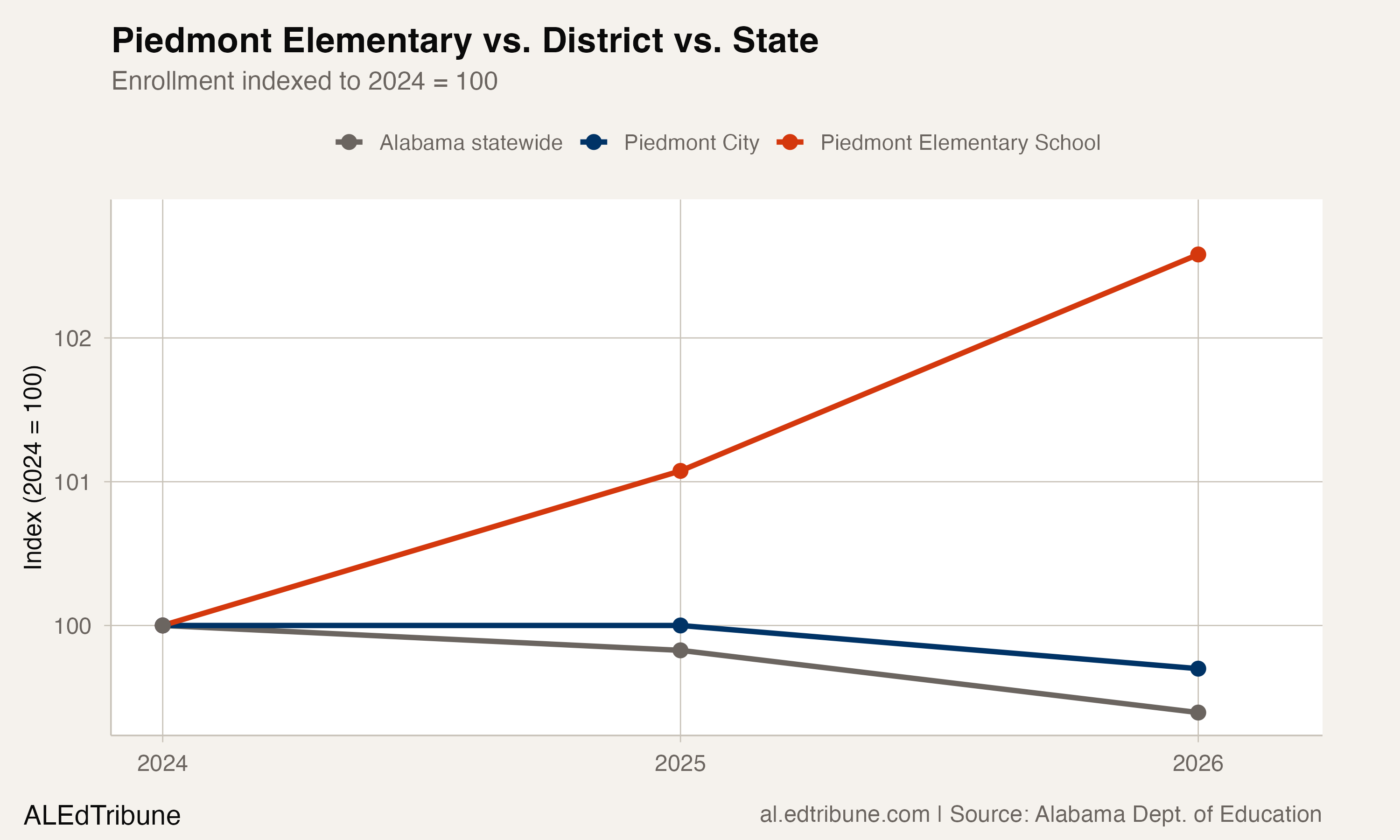
A single elementary school pulling away from a flat district and a shrinking state, over just two comparable years, is not enough data to call a durable trend. It is enough to say that whatever is drawing families to Piedmont Elementary right now, the same pull is not showing up in the rest of the district or in Alabama as a whole.
A renovation, a rebuilt staff, and a foundation year
Downey's own explanation for the moment does not lean on the enrollment numbers. It leans on the building itself. "This first year is unique because we are also transitioning into a renovated school facility," she wrote. "There is a great deal of excitement surrounding the new space, but there are also many moving pieces as we work through the final stages of the renovation and make the building feel like home for our students and staff."
She is doing that with a partly new team. "We have also welcomed several new staff members and are focused on building a strong, cohesive team," she wrote. Her framing for the year is deliberately modest in scope. "I see this first year as a foundation-building year," she wrote. "We are taking a close look at what is working, identifying opportunities for growth, and building systems that will serve our students and teachers well for years to come."
That patience shows up in her instructional priorities too. "My first priority is to build upon the strong culture and foundation that already exists at Piedmont Elementary," she wrote. "We have dedicated teachers, staff, and families who have worked hard to create a school where students feel safe, supported, challenged, and excited to learn." On instruction specifically, she wrote, "I want us to be very intentional about using student data to understand what students know, where they need support, and how we can strengthen instruction." She added, "I also want to emphasize collaboration among teachers, particularly across grade levels, so that we are building consistency and strong academic foundations as students move through our school."
Piedmont Elementary's own grade pipeline gives that cross-grade goal something concrete to work with. The school's kindergarten class stood at 96 students in 2025-26, well above its fifth-grade class of 80, a ratio of about 1.2 kindergartners for every fifth-grader that year. If that entering group holds together as it moves up, the coordination Downey described between grade levels will matter more with each passing year, not less.
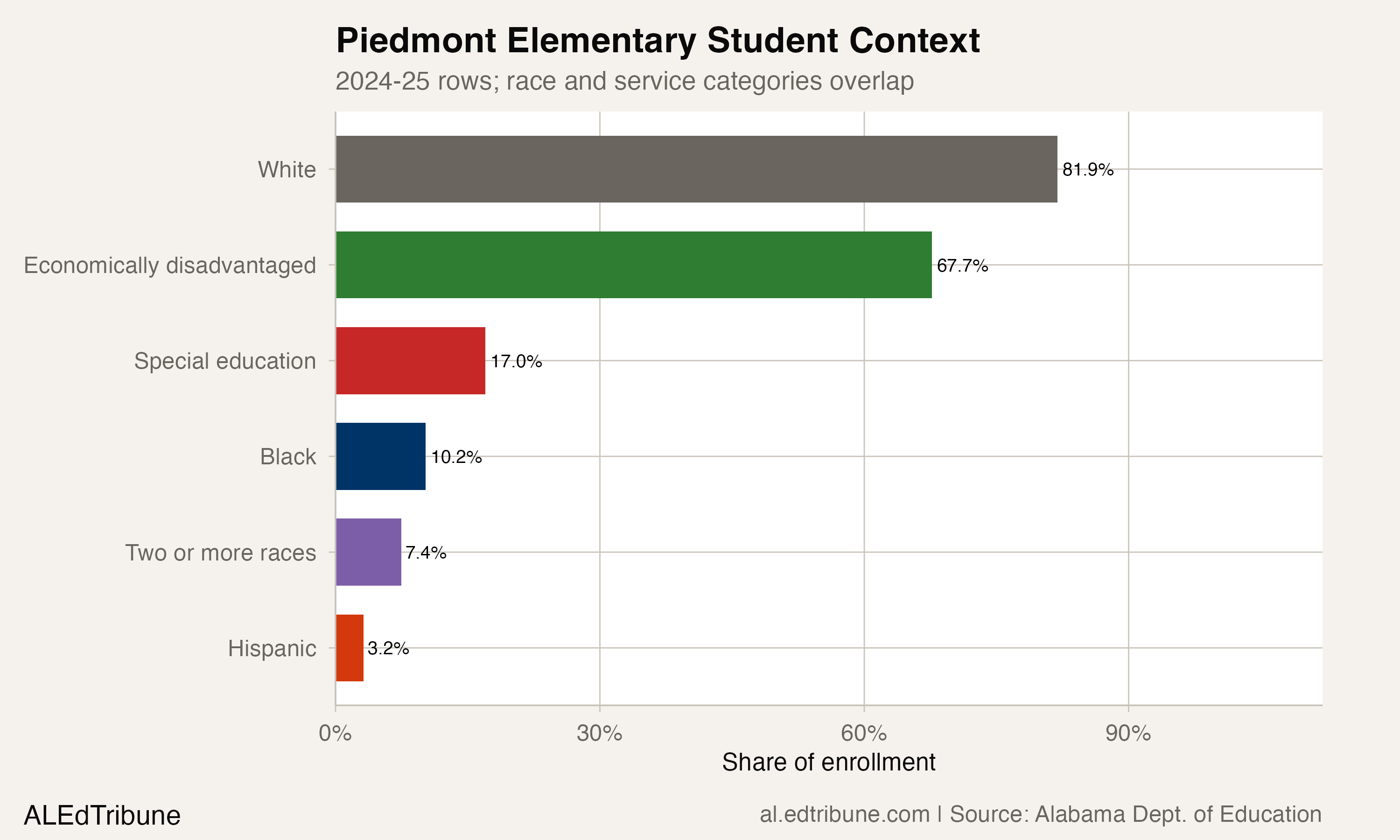
The school's 2024-25 rows, the most recent year Alabama published a full demographic breakdown before a federal reclassification change altered how race and ethnicity are reported, show a student body that is 81.9% white and 10.2% Black, with 67.7% of students economically disadvantaged and 17.0% receiving special education services. Race and service categories overlap with each other in the state's reporting, so none of those figures should be read as parts of a single whole.
What families should expect
Downey framed her goal for the year around the students themselves rather than around any single initiative. "My goal is to help make PES a place where every student feels valued, supported, and empowered to reach his or her full potential," she wrote. She closed her answers the same way she opened them, pointing back to the people already in the building: "Most importantly, I want our students and staff to know that they belong here, that their work matters, and that we are all working together toward the same goal: helping every student reach his or her full potential."
For a principal moving from the front office next door rather than from another town, that continuity is not a talking point. It is close to the whole pitch: the renovation will finish, the new staff will settle in, and the enrollment line that has moved the school's way for two years running will either keep moving or it will not. Downey is betting her first year on the idea that a school families already trusted with an assistant principal will trust just as easily with a principal who never really left.
Enrollment counts come from the Alabama State Department of Education. Prekindergarten is excluded from every count and comparison in this article; Alabama's enrollment file carries a separately reported prekindergarten count through 2023 and stops publishing it in most schools' totals starting in 2024, so comparing years across that boundary would show a change in what was counted as though it were a change in how many children enrolled.
Detailed code that reproduces the analysis and figures in this article is available exclusively to EdTribune subscribers.
Discussion
Sign in to join the discussion.
Loading comments...