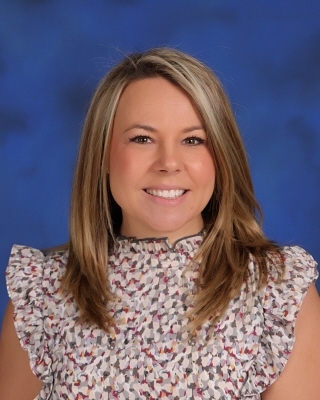
Heather Roe does not need a tour of the building she now leads. She did her leadership internship at Robert E. Lee Elementary, then served there as assistant principal and preschool director. This year she takes over as principal of the school where she trained to lead, a campus the state counted at 779 students in kindergarten through sixth grade in 2025-26, just over half of Satsuma City↗ET's enrollment.
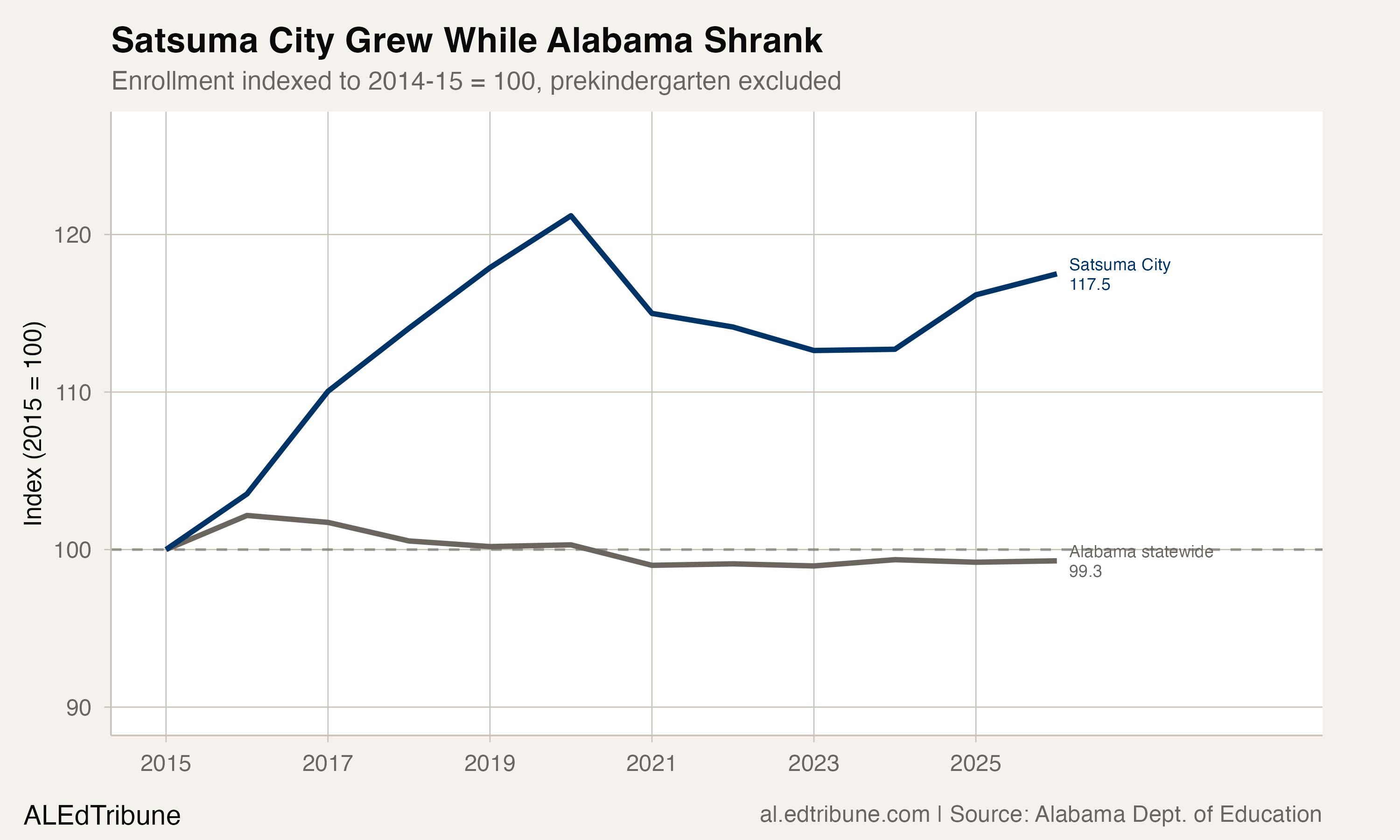
She steps into the role at a school, and a district, that have been moving in the opposite direction from the rest of Alabama. On the state's report-card counts, Satsuma City grew from 1,274 students in 2014-15 to 1,480 in 2024-25, up 206 students, or 16.2%, while statewide enrollment fell 0.8% over the same 11 reporting years. The state's fall headcount, a separate report, counted 1,505 students in the district in 2025-26, up 6 from the year before.
"As a former Gator myself, I was immediately drawn to the core values of excellence and high expectations in Satsuma City Schools," Roe wrote in response to questions from The ALEdTribune. "I believe we should see each child, know each child, and grow each child."
A career built toward this room
Roe began her career as an English Language Arts teacher at Murphy High School in Mobile, according to WKRG News 5. She later taught at Satsuma High School, where she was named Teacher of the Year. After completing her leadership internship at Lee Elementary, she became the school's assistant principal and preschool director.
She succeeds Suzanne Bahr, who retired at the end of the school year after a long career at Lee. Bahr arrived as a second-grade teacher and later became principal. Superintendent Dana Price told WKRG that Bahr "has provided outstanding leadership and will leave Lee Elementary in a strong position."
For Roe, the succession is personal. "Mrs. Bahr served as an incredible mentor from the time I was doing my leadership internship to my last day of being an assistant principal," she wrote. "She included my voice on decisions and coached me to grow as an administrator. To this day, we are close friends and speak often."
What did the mentorship leave behind? "She taught me to center my leadership approach on relationships, growth, high expectations, and joy," Roe wrote. "Because of her influence in my life, I will carry the belief that every child has potential and every staff member has a purpose. It is my job to provide an optimal environment for their strengths to flourish."
The school she inherits
Lee Elementary is the larger of Satsuma City's two schools. The building serves prekindergarten through sixth grade, according to Roe, while Satsuma High School houses the upper grades. The state's fall headcount counted 36 prekindergarten students at Lee in 2025-26, but the state's earlier report-card counts include prekindergarten only in some years, so the counts in this article describe the kindergarten through sixth grade part of the building rather than everyone in it. On that basis the report-card counts show the campus adding 132 students from 2014-15 to 2024-25, a 20.8% increase from its 634-student starting point. The 779-student count is from 2025-26, the most recent year in Alabama's published enrollment data. Roe keeps her own head count for this fall, on the school's full prekindergarten through sixth grade basis, and the state will not publish a 2026-27 figure until next year, so nothing here matches what the building is counting today.
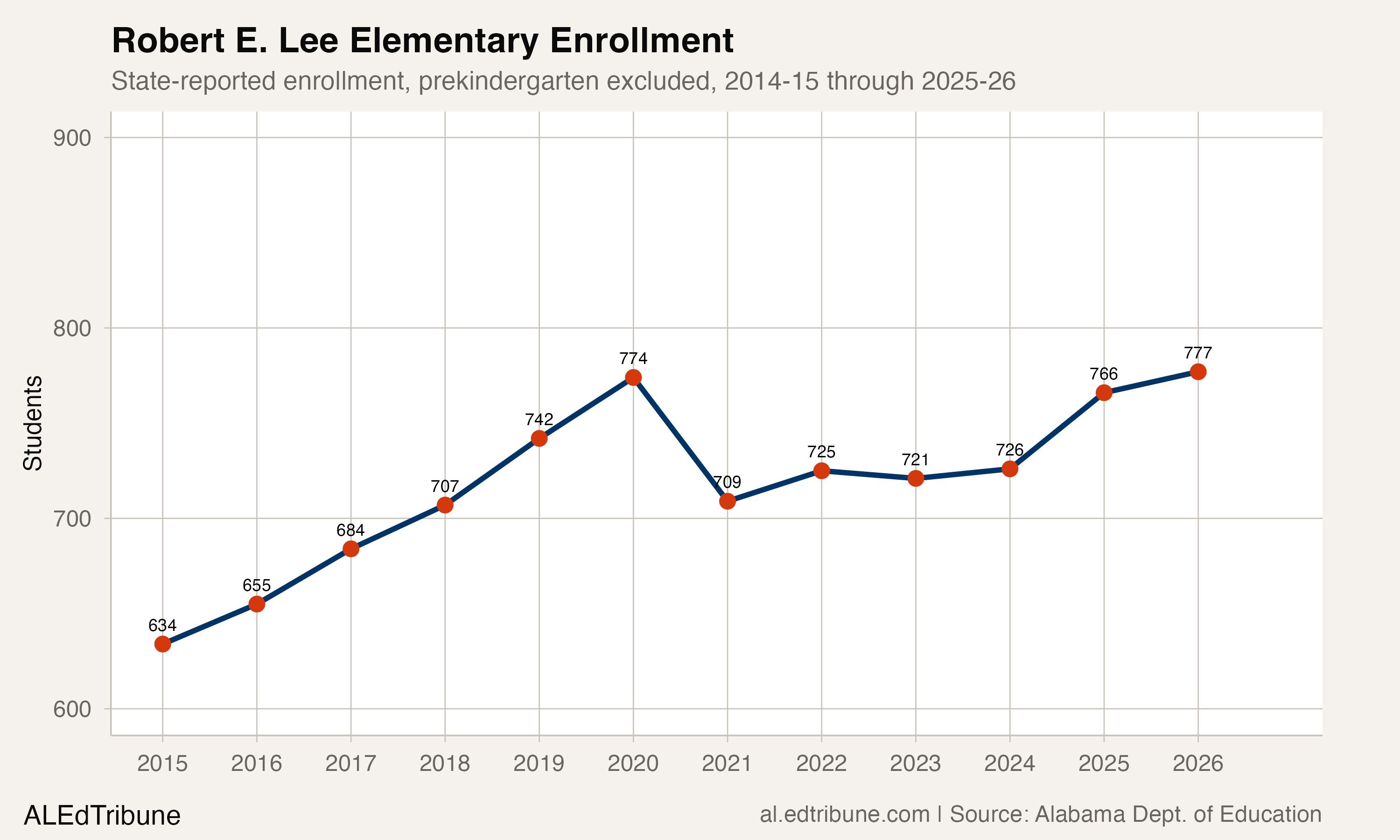
The growth has not been a straight line. Lee climbed steadily through the second half of the 2010s, lost ground in 2020-21, sat in a narrow band for the three years after that, and then added students in each of the last two.
The district shows a similar shape. Satsuma City reached 1,544 students in 2019-20, gave back ground through 2022-23, and has added students in every year since.
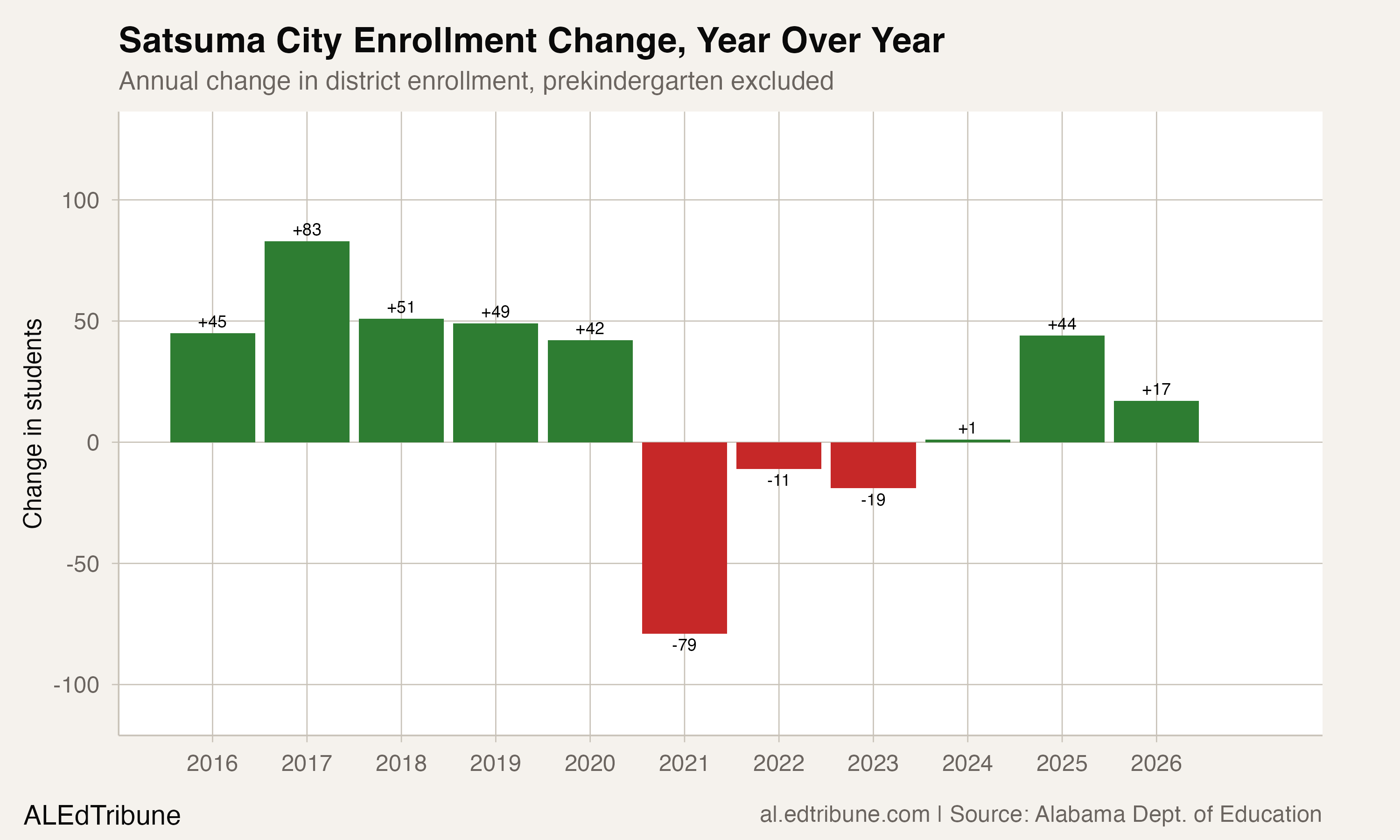
The bars show the pattern year by year: five consecutive gains through 2019-20, a sharp loss the following year, two smaller losses after that, and growth in each of the last three years.
That trajectory is unusual in Alabama, where statewide enrollment has drifted slightly down. Indexed against 2014-15 on the state's report-card counts, Satsuma City sat 16.2% above its starting point in 2024-25 while the state sat just below its own.
A growing elementary school is a specific kind of leadership assignment. Every added kindergarten section ripples into staffing, classroom space, and the daily logistics of arrival and dismissal. Roe's stated priorities map directly onto that work.
Three goals, in her words
Asked what families should know first, Roe pointed to continuity, not reinvention. The school will keep working on what she called its "three main school improvement goals": strengthening academic achievement, developing staff, and providing safe, clean, and welcoming facilities.
"We are proud of the progress we have made over the past six years," she wrote, a window that spans Bahr's principalship and her own tenure in the front office. "We are on a mission to grow, learn, and succeed this year. I cannot wait to see what we can accomplish together!"
The through-line in her answers is the school community itself. "Lee Elementary's staff and families work together to achieve excellence for our children, and I am immensely grateful for a chance to serve as a leader in those efforts," she wrote.
Roe's tribute to her mentor, given to WKRG in April, sounded the same notes: "Mrs. Bahr has been an incredible mentor and example to me. I have learned so much from the way she leads with vision, humor, compassion, and high expectations."
The test of a mentorship is what happens after the mentor leaves. At Lee Elementary, that experiment starts with the first bell of the 2026-27 school year, in a building that closed out the previous year with more students than the year before.
Enrollment counts come from the Alabama State Department of Education. Prekindergarten is excluded from every count and comparison in this article. The state folds prekindergarten into its published totals in some years and leaves it out in others, and carrying it across those years would show a change in what was counted as though it were a change in how many children enrolled. Counts from 2014-15 through 2024-25 come from the state's report-card enrollment. The 2025-26 counts, and their comparison with 2024-25, come from the state's fall headcount, a separate report that counts students differently, so this article compares years only within the same report.
Correction, November 23, 2026: An earlier version said the state's enrollment file carried no prekindergarten count for any Alabama school in 2025-26, and reported 777 students at Lee Elementary and 1,497 in Satsuma City that year. Those 2025-26 figures came from an average daily membership measure rather than a count of students. The state's fall headcount shows 779 kindergarten through sixth grade students at Lee, plus 36 in prekindergarten, and 1,505 in the district. Because that headcount is a different report from the state's earlier counts, the article now measures long-term change from 2014-15 to 2024-25, when Satsuma City grew 16.2% and Lee Elementary grew 20.8% while statewide enrollment fell 0.8%. The earlier version's figures of 17.5%, 22.6% and 0.7%, and its statement that 2025-26 was Lee's highest count on record, compared the two reports directly and have been removed.
Detailed code that reproduces the analysis and figures in this article is available exclusively to EdTribune subscribers.
Discussion
Sign in to join the discussion.
Loading comments...