
Dr. Carmen Drinkard wants every Holt High School student to have a reason to feel connected to school. After moving from assistant principal to principal this summer, she is putting club participation, service and consistent attendance at the center of that work.
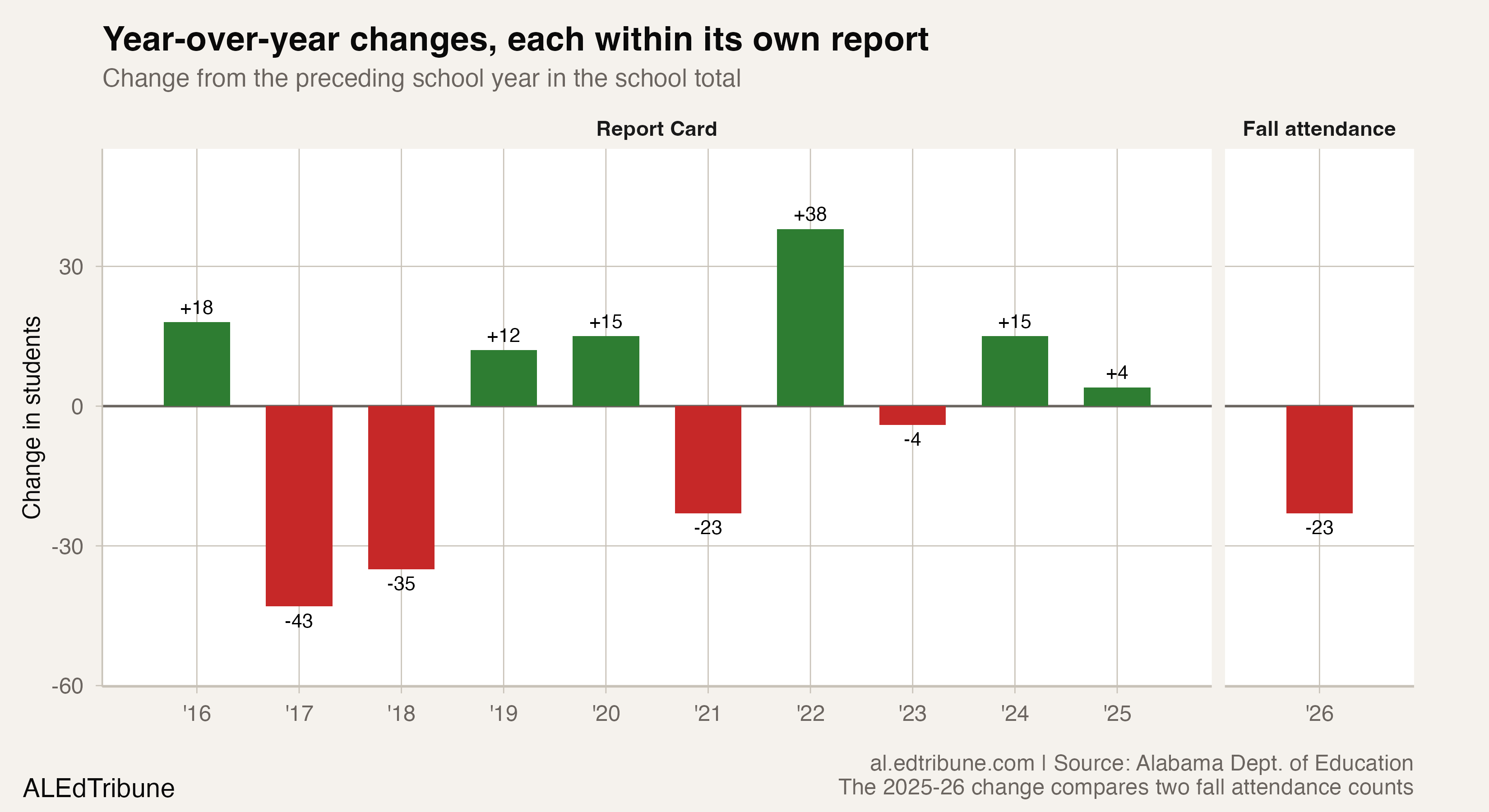
The Tuscaloosa County↗ET school recorded 433 students in 2025-26, last school year and the most recent year in Alabama's published enrollment data. On the state's fall attendance count, that was 23 fewer than the 456 recorded the year before, a 5.0% decline. For Drinkard, the immediate question is how students experience their time in the building.
"I believe every student should feel known, valued, and connected to our school, and every staff member should feel supported in the important work they do," she wrote in an email answering questions from The ALEdTribune.
Leading a school she already knows
Drinkard confirmed that she became principal in July after serving as Holt's assistant principal. Her school biography describes a career that includes high school science teaching, dual-credit English and history instruction, and earlier work as an assistant principal and Early College High School dean.
Those jobs connect classroom instruction with school leadership. Her written answers about Holt, however, begin with the people she has worked alongside rather than with a list of positions.
"My years at Holt have taught me that this school is full of potential, resilience, and people who genuinely care about our students," Drinkard wrote. "I have seen firsthand what can happen when teachers, staff, families, and community partners work together toward a common goal."
She described academic and cultural progress during her time at the school. That is her assessment of the work she has seen; enrollment totals alone cannot establish improvement in learning or school culture.
Her reason for seeking the principal's role was to continue that work. "When the opportunity came to lead Holt, I saw it as a chance to build on the progress we have made, continue strengthening our school culture, and help every student find a place where they belong and an opportunity to succeed," she wrote.
The students behind the engagement goal
Alabama publishes school enrollment in two reports that count differently, so this profile reads each one on its own terms.
The state's Report Card counts, which run through 2024-25, describe a school whose student count has moved in both directions. Holt reported 431 students in 2014-15 and 428 in 2024-25, but the years between ranged from a low of 371 in 2017-18 to a high of 449 in 2015-16. Similar endpoints do not mean the school had an unchanged student body throughout that period.
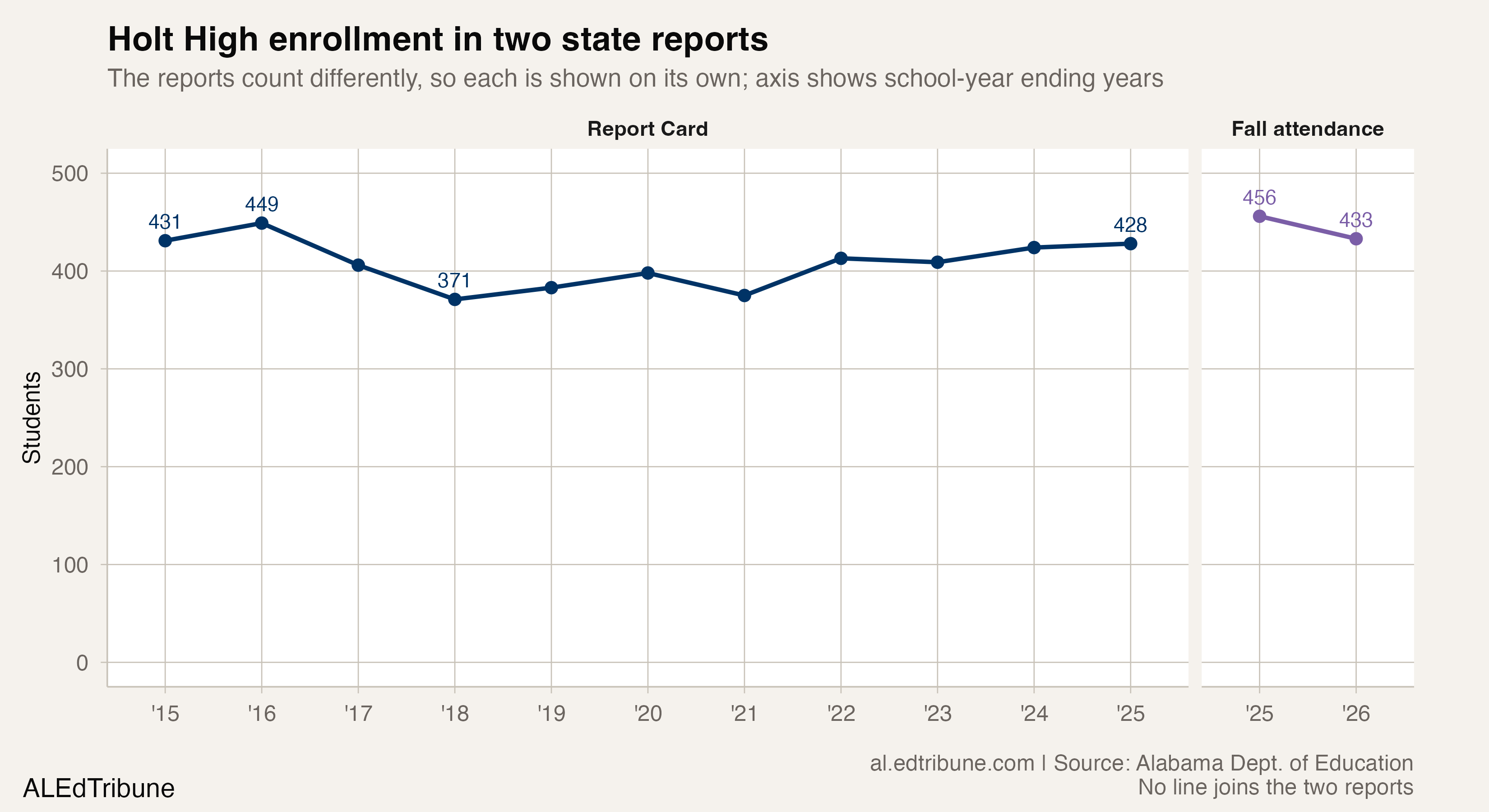
The fall attendance report, the source for the 2025-26 figure, is the one to use for last year's change. On that basis Holt went from 456 students in 2024-25 to 433 in 2025-26. That history provides scale for Drinkard's goal of reaching every student. It does not measure whether students attended regularly, participated in activities or felt connected to an adult.
Holt accounted for 2.2% of Tuscaloosa County's published enrollment of 19,670 last school year. The district total includes 764 pre-K students, while Holt's published total reports none, so the share is a guide to scale rather than a like-for-like comparison. That share describes the school's place within the district, not a share of staffing or funding. The figures also predate Drinkard's start as principal and should not be read as results of her leadership.
The grade counts give another view of the students her engagement plans are intended to reach. Last school year, Holt recorded 117 ninth graders, 106 tenth graders, 114 eleventh graders and 96 twelfth graders.
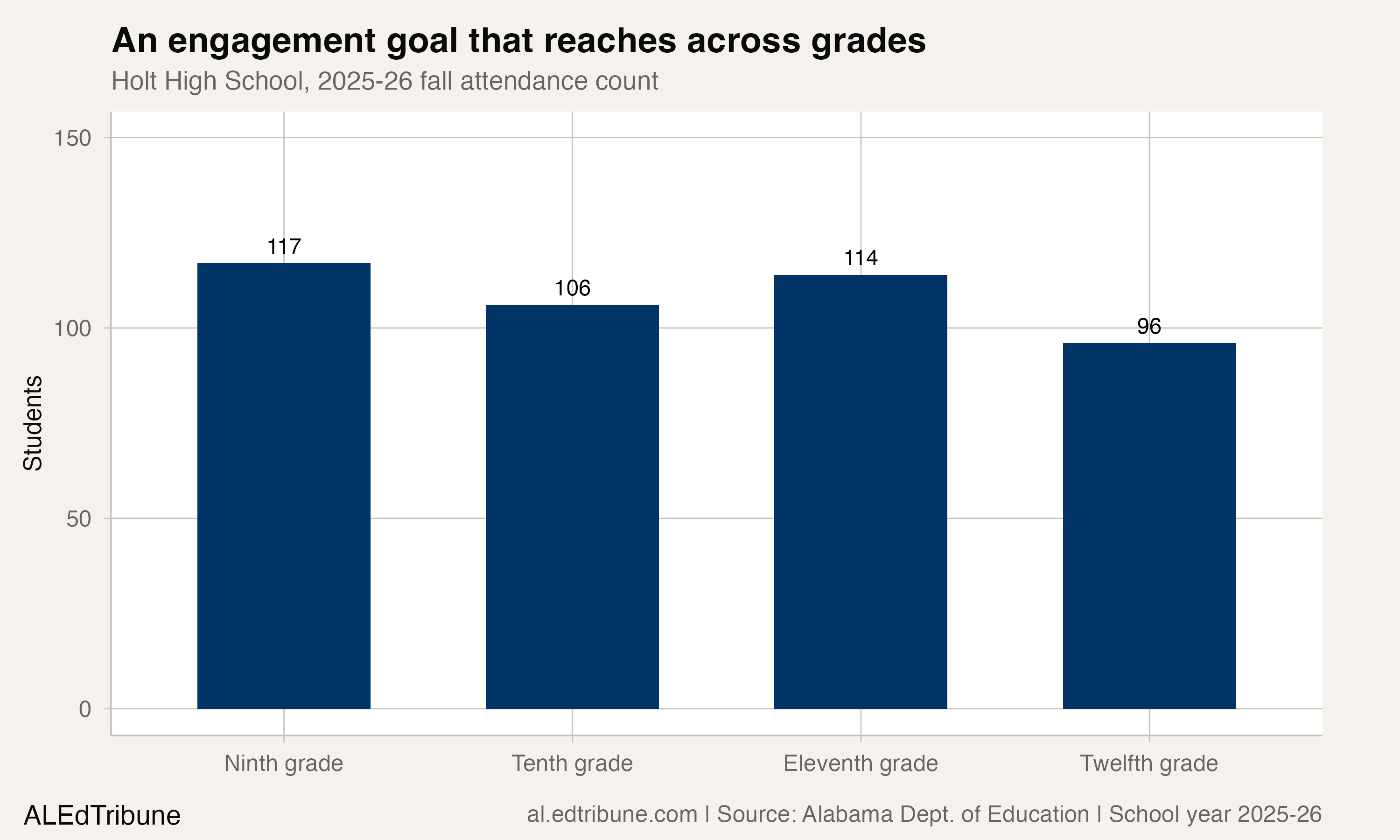
These are separate grade groups in the same school year. The difference between the entering and graduating grades does not track individual students through high school or establish a dropout count.
A place to participate and serve
Drinkard described club and extracurricular participation as an emphasis for all students. In her answers, participation also carries a service purpose: students would have opportunities to support the school, its feeder schools and the wider community.
She identified IMPACT Clubs as a way to make those connections. "We are also focused on making sure every student has a connection to our school through our IMPACT Clubs, which provide opportunities for students to explore their interests, develop leadership skills, and serve others," she wrote.
Her description sets out what she wants the clubs to offer. It does not establish how many students participate or whether participation has changed attendance. Those are different questions from the enrollment counts.
The relationship she wants with staff follows the same approach. "I want students, families, and staff to see a leadership approach built on relationships, high expectations, and a genuine commitment to growth," Drinkard wrote.
Attendance as access to the work
Asked which student needs most concerned her, Drinkard joined academic growth, consistent attendance and engagement in the same answer.
"Attendance is a critical part of that work because students cannot benefit from instruction and relationships when they are not present," she wrote.
She also emphasized differences in what students need. "Our responsibility is to build relationships, identify barriers, and provide the support and encouragement each student needs to reach their potential," she wrote.
Families can follow the district's broader decisions through the Tuscaloosa County Board of Education's public meetings, agendas and minutes. Drinkard's answers focus on the daily school experience: being present, finding an activity and receiving support when a barrier gets in the way.
For the principal, the intended result is a shared sense of membership. "Ultimately, I want people to recognize that we are working together to create a school where everyone feels a sense of belonging and takes pride in being an Ironman," she wrote.
Enrollment counts come from the Alabama State Department of Education. Figures for 2024-25 and 2025-26 come from the state's fall attendance count, and the longer history from its Report Card counts; the two are never compared with each other. The grade breakdown uses last school year's fall attendance counts. Enrollment measures student counts, not daily attendance or club participation.
Detailed code that reproduces the analysis and figures in this article is available exclusively to EdTribune subscribers.
Discussion
Sign in to join the discussion.
Loading comments...