State Superintendent Eric Mackey put it plainly in October: "They're just gone." He was talking about roughly 2,100 students who were enrolled in Alabama public schools last year and simply did not return. No transfer paperwork, no homeschool filing, no private school record. They vanished from the rolls.
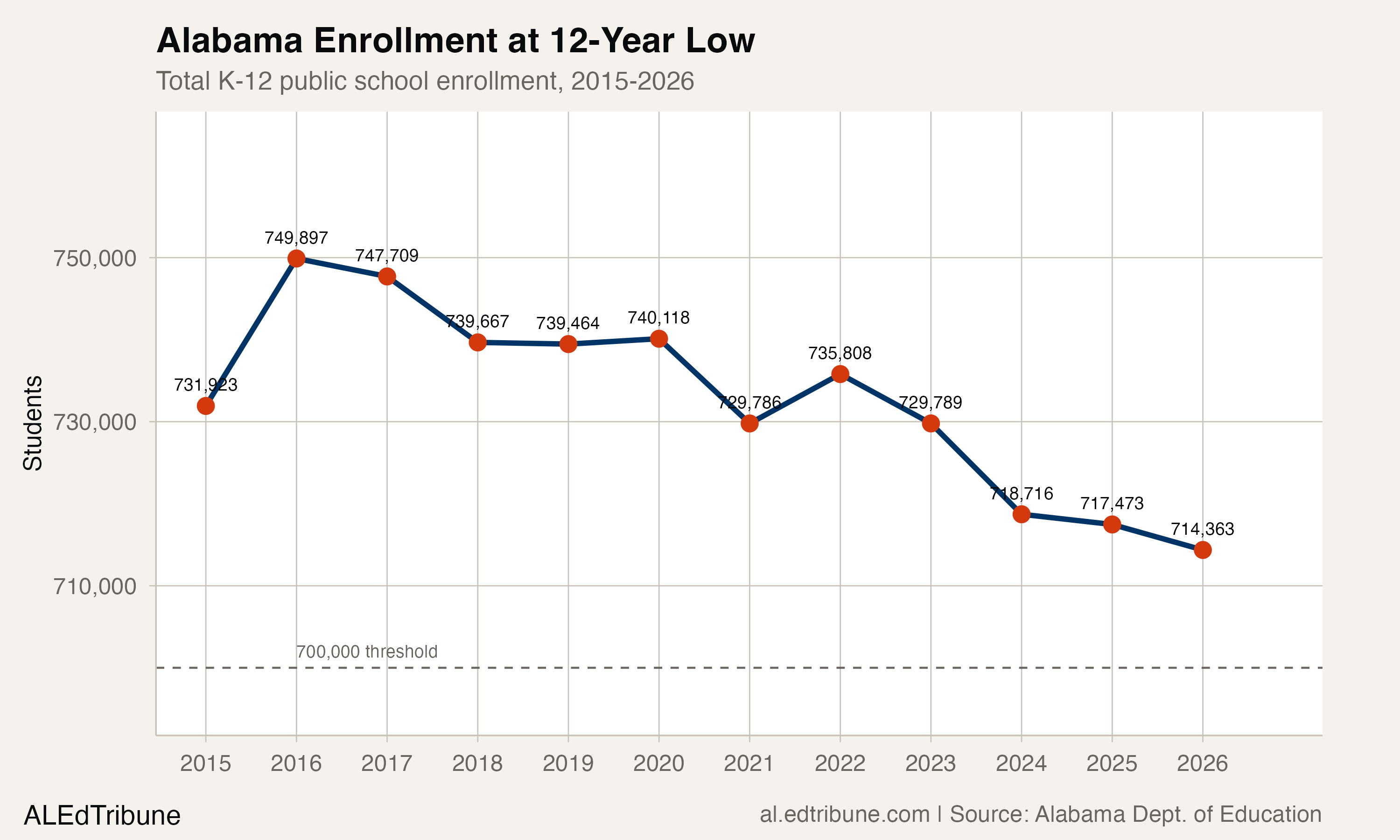
Alabama's total K-12 public school enrollment fell to 714,363 in 2025-26, the lowest point in at least 12 years of state data. The drop of 3,110 students from the prior year extends a four-year decline streak that has erased 21,445 students since 2021-22. At the current pace of loss, approximately 5,361 students per year over the past four years, enrollment will fall below 700,000 before the decade ends.
The state that grew, then didn't
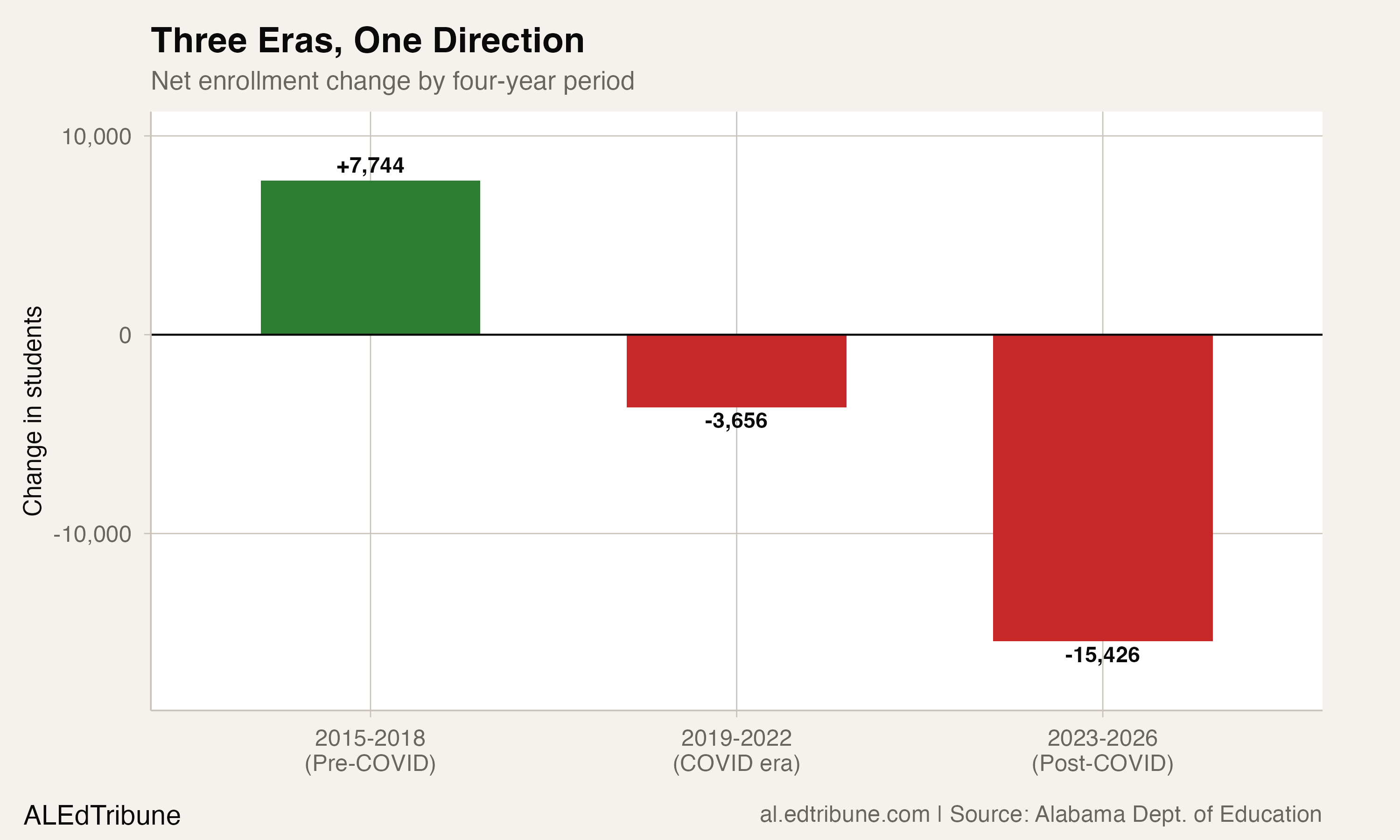
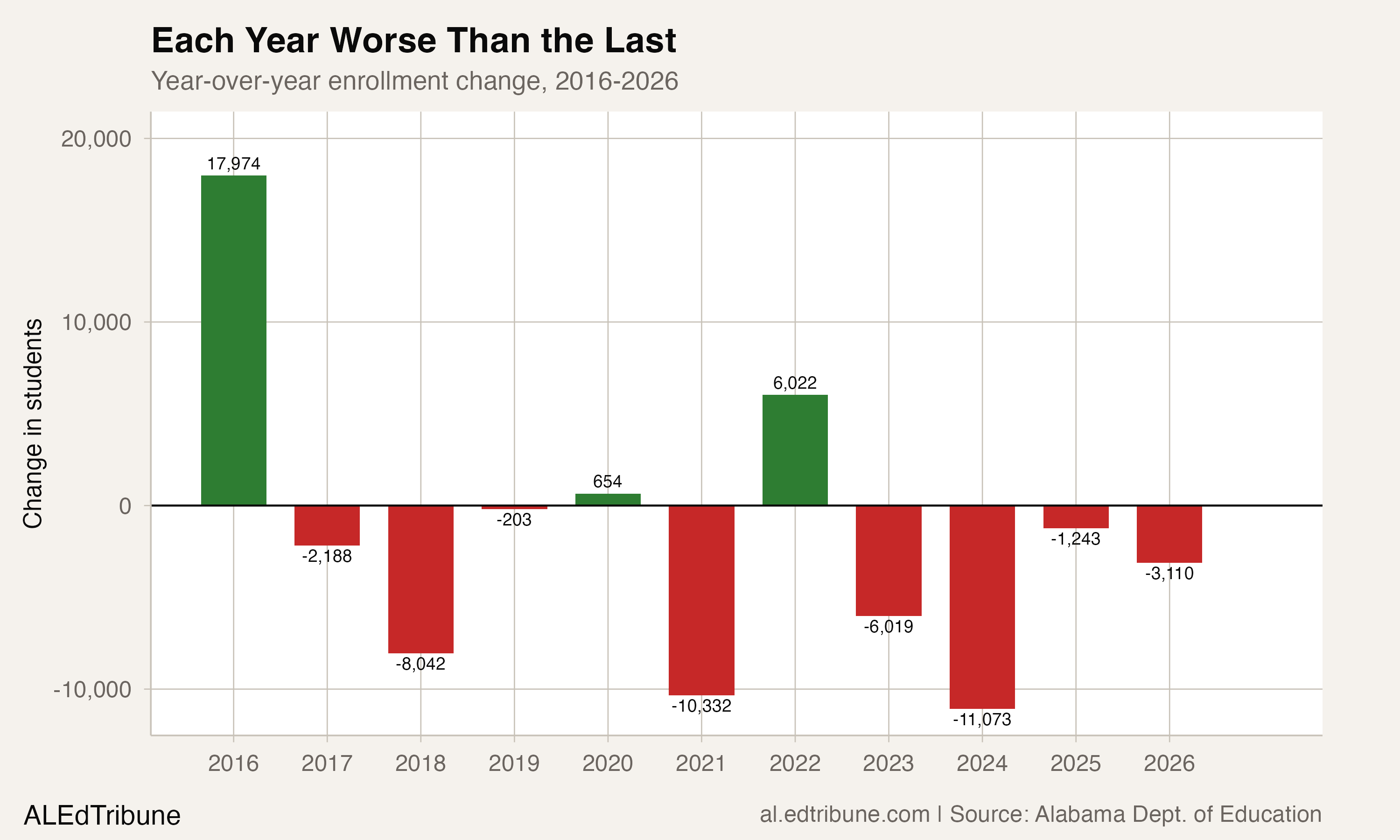
Alabama's enrollment story breaks cleanly into three eras. From 2014-15 to 2017-18, the system added 7,744 students, peaking at 749,897 in 2015-16. From 2018-19 to 2021-22, it lost 3,656, a modest contraction centered on the pandemic year. Since 2022-23, the losses have quadrupled: 15,426 students gone in four years, with the single worst year being 2023-24, when enrollment fell by 11,073.
The year-over-year pattern is volatile but directionally unmistakable. Seven of the past nine years have been negative. The two exceptions, 2019-20 (+654) and 2021-22 (+6,022), were pandemic-adjacent bounces that did not hold.
Three forces, one direction
No single factor explains the decline. At least three forces are compounding simultaneously.
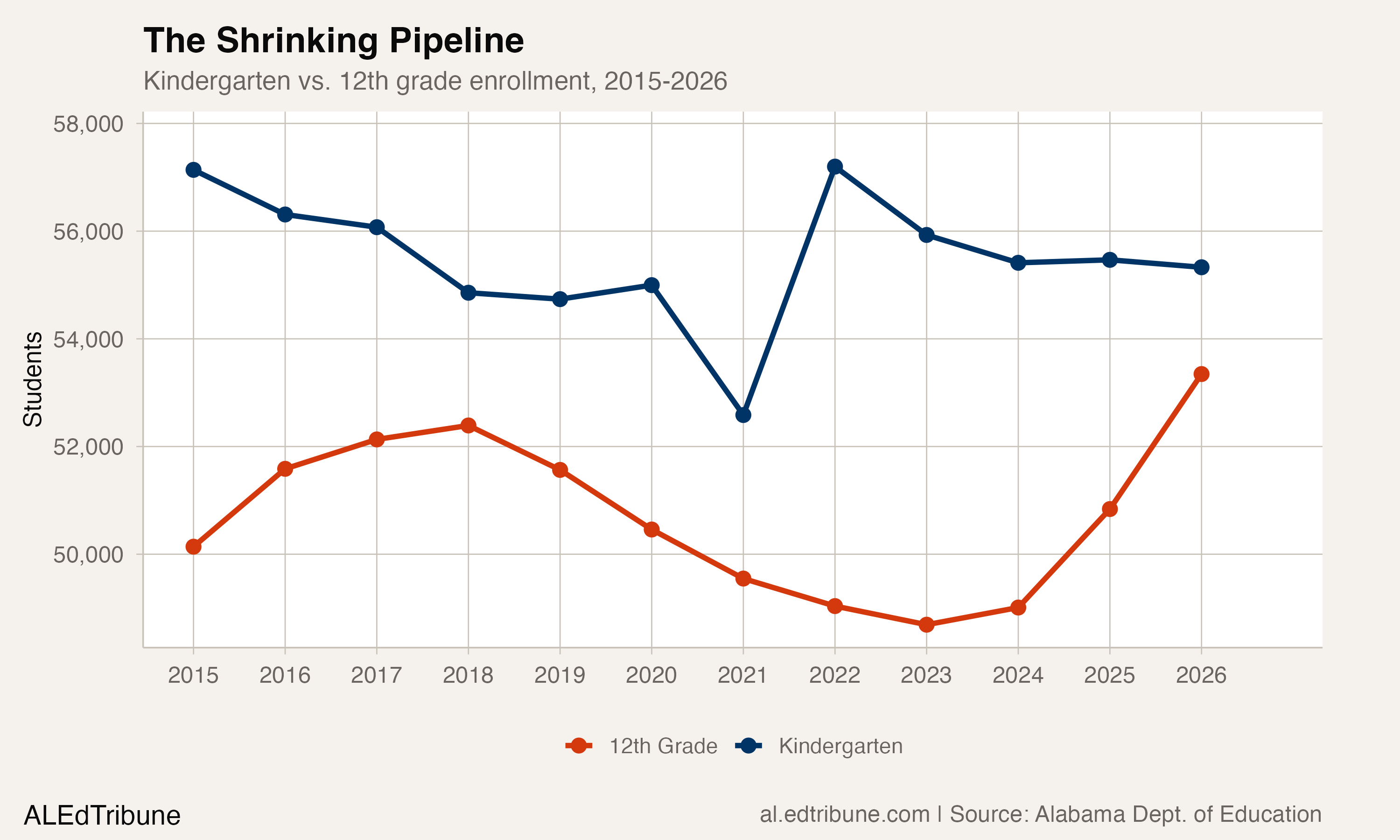
The most fundamental is demographic. Alabama's deaths have exceeded its births every year since 2020, with 59,273 deaths against 57,541 births in 2023-24 alone. The state's median age approaches 40. Kindergarten enrollment, the leading indicator of the enrollment pipeline, has fallen from 57,138 in 2014-15 to 55,329 in 2025-26, a decline of 3.2%. Meanwhile, 12th grade enrollment has grown 6.4% over the same period, from 50,140 to 53,346. The kindergarten-to-12th-grade ratio has compressed from 114 to 103.7. More students are graduating out the top of the pipeline than entering at the bottom.
The second force is school choice. The CHOOSE Act, Alabama's education savings account program signed into law in March 2024, drew approximately 3,032 students out of public schools in its first year, according to a PARCA analysis of state data. That accounts for roughly half of the 2025-26 decline. Nearly 24,000 students received ESAs for the current year, though about three-quarters were already in private schools. The Legislature increased the program's appropriation to $180 million and is considering making it universal, which could accelerate public school losses in coming years.
The third is immigration enforcement. Mackey told reporters that superintendents across the state said "a lot" of the missing students appeared to be Hispanic, though schools cannot legally ask about immigration status. In Birmingham, the Hispanic and Immigrant Center of Alabama reported that fear was keeping families home.
"There is a concern among families as to the safety of their children, and thus what we're seeing and we're hearing is a reluctance to send some of these students to school." -- Carlos Aleman, CEO of the Hispanic and Immigrant Center of Alabama, The Birmingham Times
The statewide data is ambiguous. A new federal reporting form that allows students to select multiple racial identities shifted about 52,000 students from "Hispanic" to "two or more races" in 2025-26, making it impossible to isolate actual Hispanic enrollment changes from reclassification effects. State officials said the raw number of students checking the Hispanic box increased by about 1,000, but the classification noise makes the true trend unclear.
The geography of loss
The losses are not evenly distributed. Mobile County↗ET, the state's largest district, has shed 4,958 students since 2021-22, a decline of 9.6% in four years. From its 2015-16 peak of 58,529, Mobile has lost 11,829 students, a 20.2% contraction. Birmingham City↗ET has lost 6,248 from its peak, a 24.5% decline. Montgomery County↗ET is down 6,171, or 19.9%.
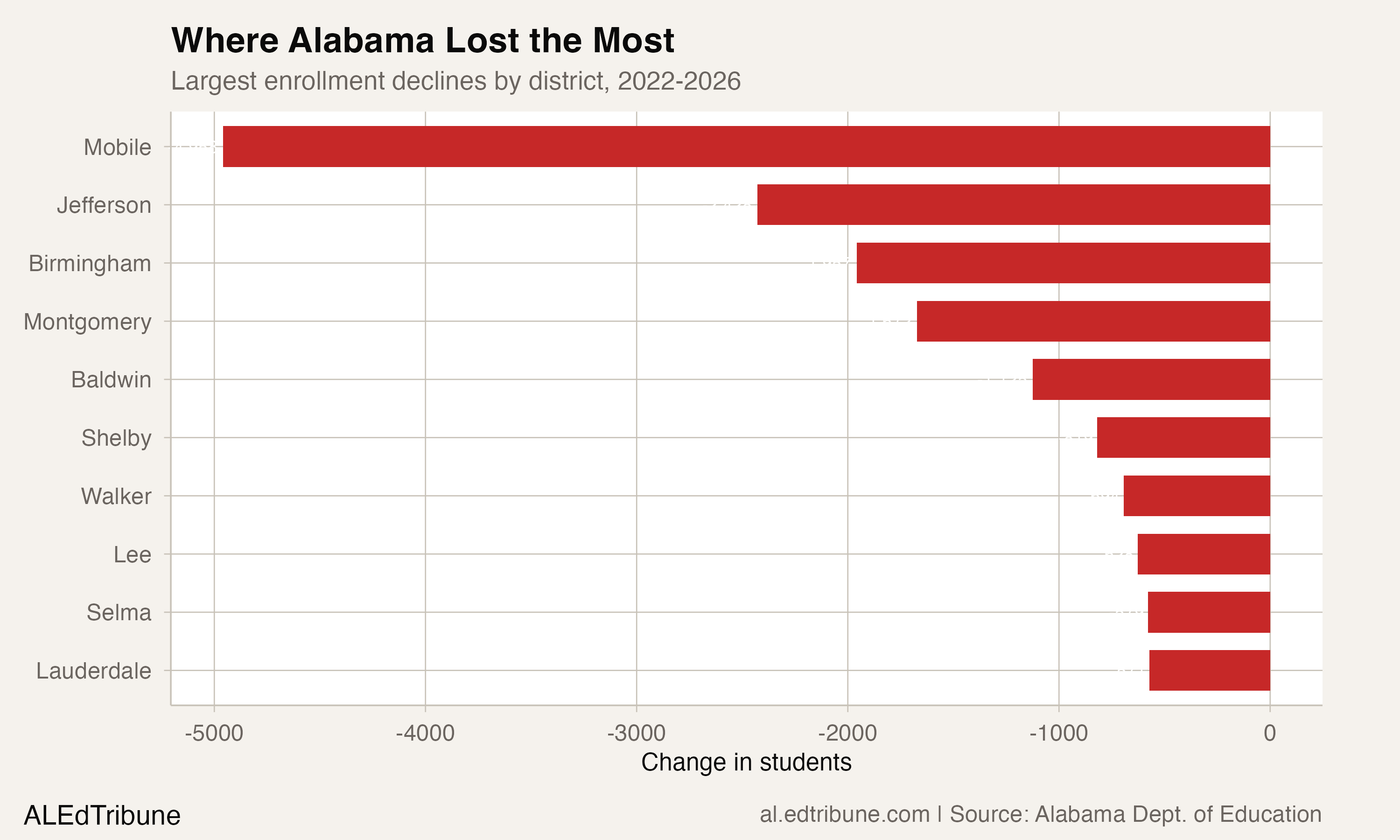
Nine districts have been declining for 11 consecutive years, the full span of the year-over-year data. Six of them are in or near the Black Belt: Selma City↗ET, Perry County↗ET, Sumter County↗ET, Lowndes County↗ET, Macon County↗ET, and Wilcox County↗ET. Perry County has lost 57.7% of its enrollment since 2014-15, falling from 1,730 to 731. Sumter is down 52.4%, from 1,695 to 806. These are districts where the school system is often the largest employer, and each lost student carries a proportional cut to state funding.
Only 31 of 141 districts with comparable data, or 22%, have recovered to their pre-pandemic enrollment levels. In 2025-26, 86 of 153 districts declined, while 65 grew.
What 500 to 700 fewer teachers means
The fiscal consequences are already materializing. Mackey told WBRC that the enrollment decline translates to 500 to 700 fewer teaching positions in the next budget cycle.
"Teacher jobs are tied to student enrollment, so this is about, this is between 500-700 teacher jobs that'll disappear next year as we work on the next budget cycle." -- Dr. Eric Mackey, State Superintendent, WBRC
The problem is structural. Alabama's Foundation Program, the funding formula that converts student counts into teacher units and teacher units into dollars, has been unchanged since 1995. Lawmakers enacted the RAISE Act in 2025, adding weighted funding on top of the Foundation Program beginning in 2025-26 for English learners, students entitled to special education services, and students in high-poverty districts.
For districts already near the edge, a decline of a few dozen students can force the consolidation of classrooms, the closure of a school, or the elimination of an elective program. In rural Black Belt counties where enrollment has been falling for a decade or more, the question is not whether these cuts will happen but how many more years the district can absorb them.
The question for 2027
The most honest answer to why Alabama's enrollment is falling is: all of the above, and we cannot precisely apportion how much of the decline belongs to each factor. Birth rates explain the pipeline compression. The CHOOSE Act explains about 3,000 of the 2025-26 losses. Immigration enforcement appears to explain some of the missing students, but the reclassification of racial reporting makes the magnitude impossible to pin down from the enrollment data alone.
The question for the next school year is whether the CHOOSE Act's expansion to potentially universal eligibility compounds the demographic decline or merely accelerates a transition that was already underway. If 24,000 ESA recipients become 40,000 or more, and three-quarters of them continue to be students already in private schools, the marginal public school impact may remain modest. If the ratio shifts and more public school families opt out, the 700,000 threshold could arrive ahead of schedule.
Alabama has not been above 740,000 students since 2019-20. Fifty-one of its 155 districts are at their lowest enrollment on record. At some point, a decline stops being a trend and becomes the new baseline.
Detailed code that reproduces the analysis and figures in this article is available exclusively to EdTribune subscribers.
Discussion
Sign in to join the discussion.
Loading comments...