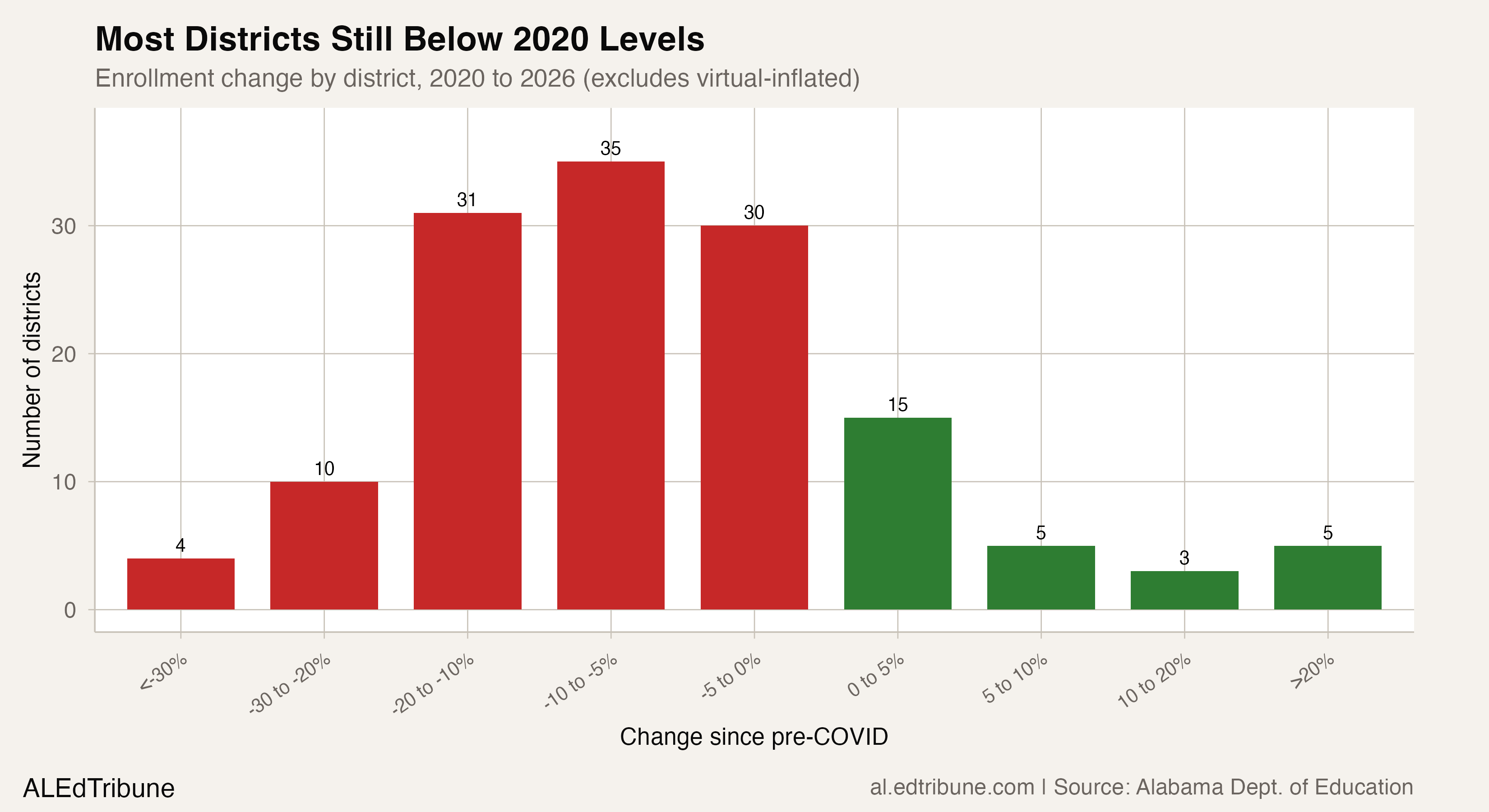
Five years after the pandemic emptied classrooms across Alabama, the students have not come back. Of 138 districts with comparable enrollment data from before COVID through 2025-26, just 28 have returned to their fall 2019 levels. That is a recovery rate of 20.3%.
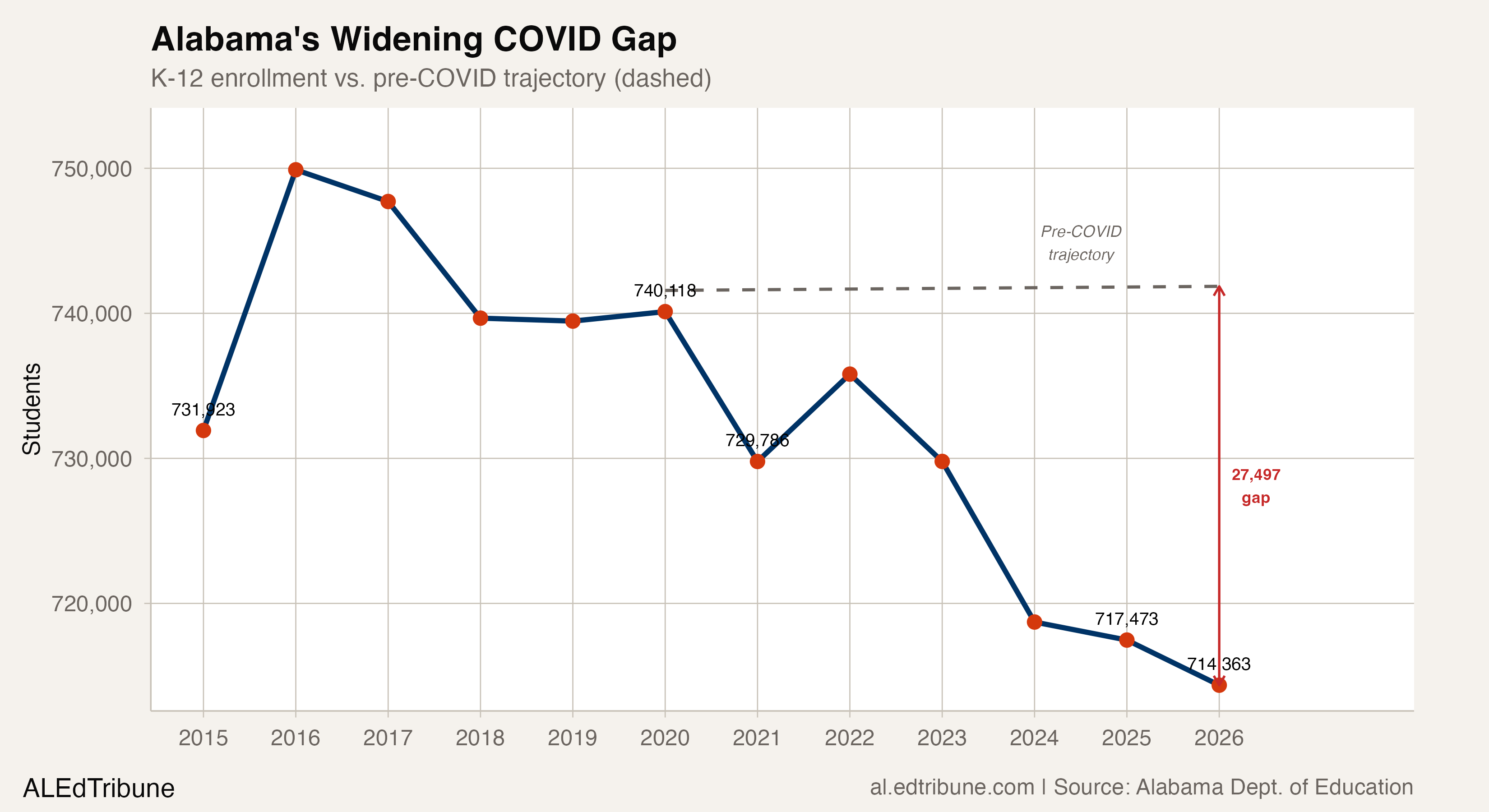
The state as a whole has fared worse than any individual recovery statistic suggests. Alabama enrolled 740,118 K-12 students in the 2019-20 school year (the last pre-COVID fall count). By 2025-26, that figure had fallen to 714,363, a loss of 25,755 students, or 3.5%. The pandemic did not cause a temporary dip followed by a rebound. It marked the beginning of a sustained decline that has now lasted four consecutive years.
The false recovery of 2022
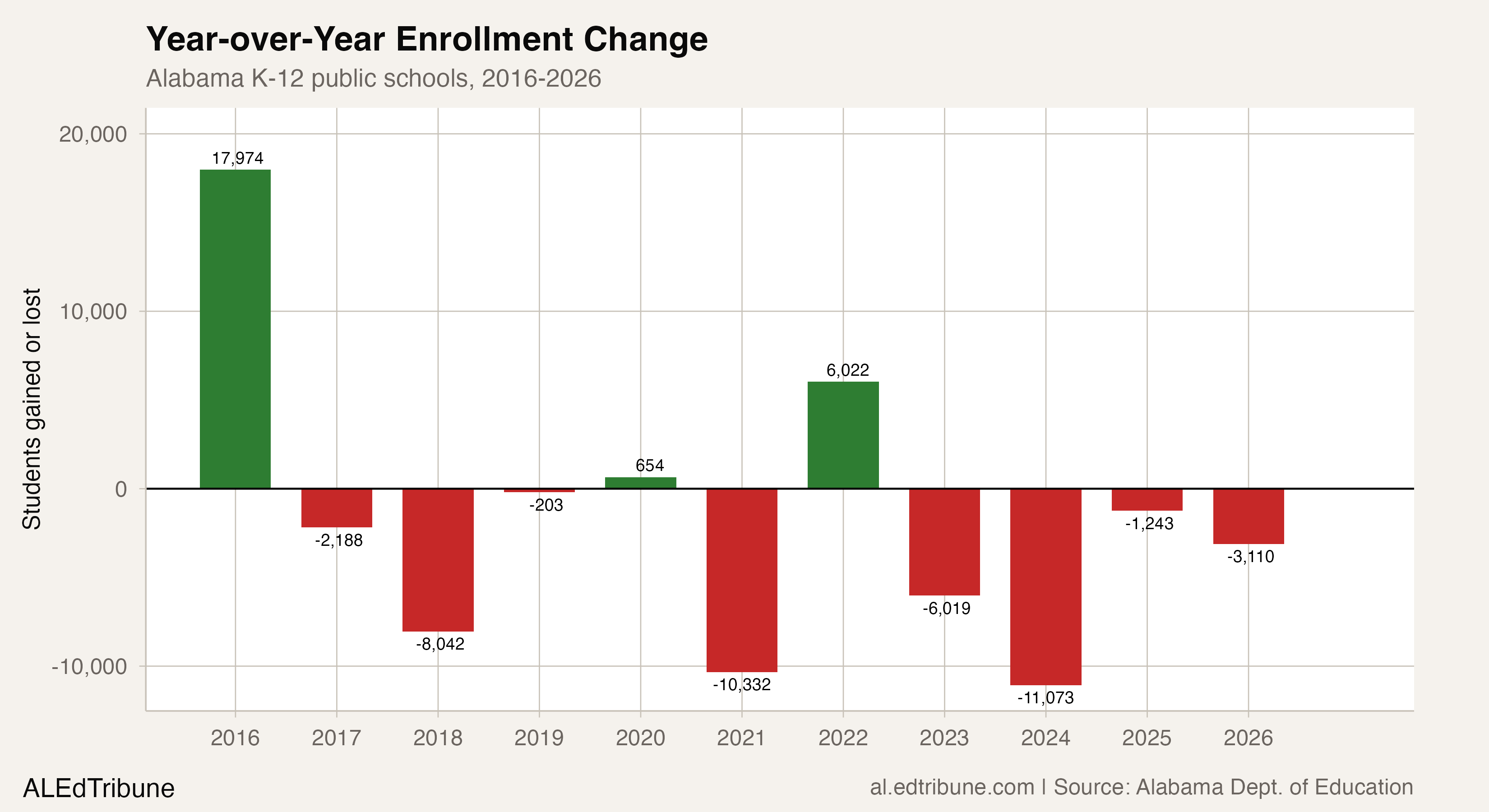
Alabama's year-over-year pattern tells a story of one brief reprieve surrounded by losses. After COVID drove enrollment down by 10,332 students in 2020-21, the state clawed back 6,022 in 2021-22. That single year accounts for the entirety of Alabama's post-pandemic recovery. Every year since has brought another decline: 6,019 lost in 2022-23, then 11,073 in 2023-24 (the largest single-year drop in the dataset), followed by 1,243 in 2024-25 and 3,110 in 2025-26.
The 2022 rebound, in other words, was not the start of recovery. It was an interruption in a downward slide.
Had pre-pandemic trends held, Alabama would have enrolled roughly 741,860 students in 2025-26 (based on the 2015-2020 linear trajectory). The actual count of 714,363 leaves the state 27,497 students below that projection, a gap that has widened every year since 2022.
Three cities, 14,495 missing students
The largest raw losses are concentrated in Alabama's urban cores. Mobile County↗ET has lost 7,314 students since its pre-COVID count, a 13.5% decline. Birmingham City↗ET is down 3,665 students (16.0%), and Montgomery County↗ET has lost 3,516 (12.4%). Together, these three districts account for 14,495 of the state's 25,755-student shortfall, or 56.3%.
Jefferson County↗ET, which surrounds Birmingham, lost another 3,254 students (8.9%), bringing the Big Four total to 17,749.
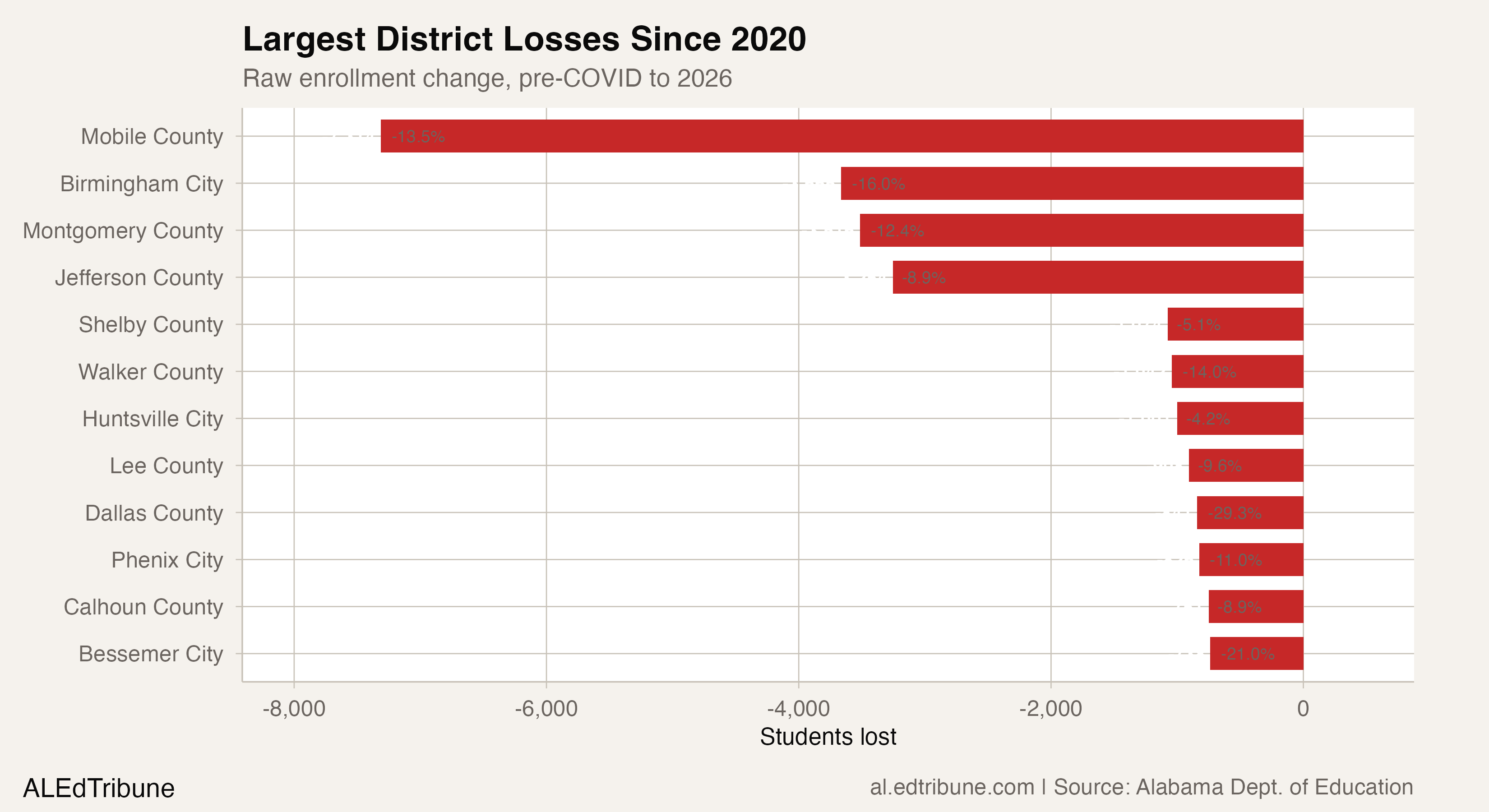
The losses extend deep into smaller systems. Dallas County↗ET has lost 29.3% of its enrollment since 2020. Selma City↗ET is down 25.5%. Walker County↗ET lost 1,042 students, a 14.0% decline. These are districts that were already operating on thin margins.
Where the students went
State Superintendent Eric Mackey offered a blunt accounting in October 2025. Of the 5,800 students Alabama's public schools lost that year, approximately 3,000 enrolled in private schools or homeschool programs using education savings accounts through the CHOOSE Act, the voucher-like program signed into law in March 2024. Another 2,100 students simply vanished from enrollment records.
"We know we have about 2,100 kids that were enrolled last year that have just disappeared. They're just gone." -- WBRC, Oct. 2025
Mackey reported that local superintendents identified a majority of the unaccounted students as Hispanic, though federal privacy law prohibits schools from inquiring about immigration status. The CHOOSE Act's first-year impact was more modest than its appropriation suggested: of approximately 24,000 ESA recipients, roughly 10,000 were already attending private schools, and another 9,000 were already homeschooled. Only about 3,000 transferred out of public schools, according to state data.
The CHOOSE Act's second year could have a larger effect. Lawmakers have discussed making the program universal despite tight Education Trust Fund budgets, which would open eligibility beyond the current income-tiered structure.
But the CHOOSE Act alone does not explain the scale of the post-COVID shortfall. The 25,755-student gap accumulated over five years. Birth rate declines, interstate migration, and a persistent post-pandemic shift toward homeschooling and private schooling all contributed. Alabama's natural population change turned negative in 2024, with deaths exceeding births by 2,200, a demographic headwind that enrollment data is only beginning to reflect.
The virtual school mirage
The three districts that appear to have staged the most impressive post-COVID recoveries are, on closer inspection, artifacts of virtual school enrollment that did not exist before the pandemic.
Limestone County↗ET grew from 11,030 to 16,633 students (50.8%), but nearly half of its current enrollment consists of Alabama Connections Academy students. Eufaula City↗ET surged from 5,367 to 8,619 (60.6%), with Alabama Virtual Academy accounting for roughly three-quarters of its headcount. Chickasaw City↗ET more than doubled, from 1,549 to 3,387 (118.7%), largely through Alabama Destinations Career Academy.
Remove these three districts and the recovery rate drops from 22.0% to 20.3%. The virtual enrollment these districts carry is real in the sense that students are receiving instruction, but it inflates the host district's numbers in ways that obscure the underlying trend. As Mackey told Alabama Daily News: "Virtual school is a good fit for some young people...but it's not for everybody."
The funding cliff behind the enrollment cliff
Enrollment decline does not just mean empty desks. Alabama's Foundation Program allocates teacher units based on student headcounts from the 20-day count following Labor Day. Fewer students means fewer units, which means fewer teachers funded by the state.
"Between 500-700 teacher jobs will disappear next year as we work on the next budget cycle." -- State Superintendent Eric Mackey, WBRC, Oct. 2025
More than half of Alabama's school districts faced teacher unit reductions in 2025-26. The cuts fell hardest on small and rural systems, particularly in the Black Belt. Selma City lost 10% of its teacher units (from 143 to 128). Sumter County dropped 9% (from 54 to 50). Linden City lost 9% (from 23 to 21). These are districts where state funding constitutes the overwhelming majority of operating budgets.
Recovery by district size
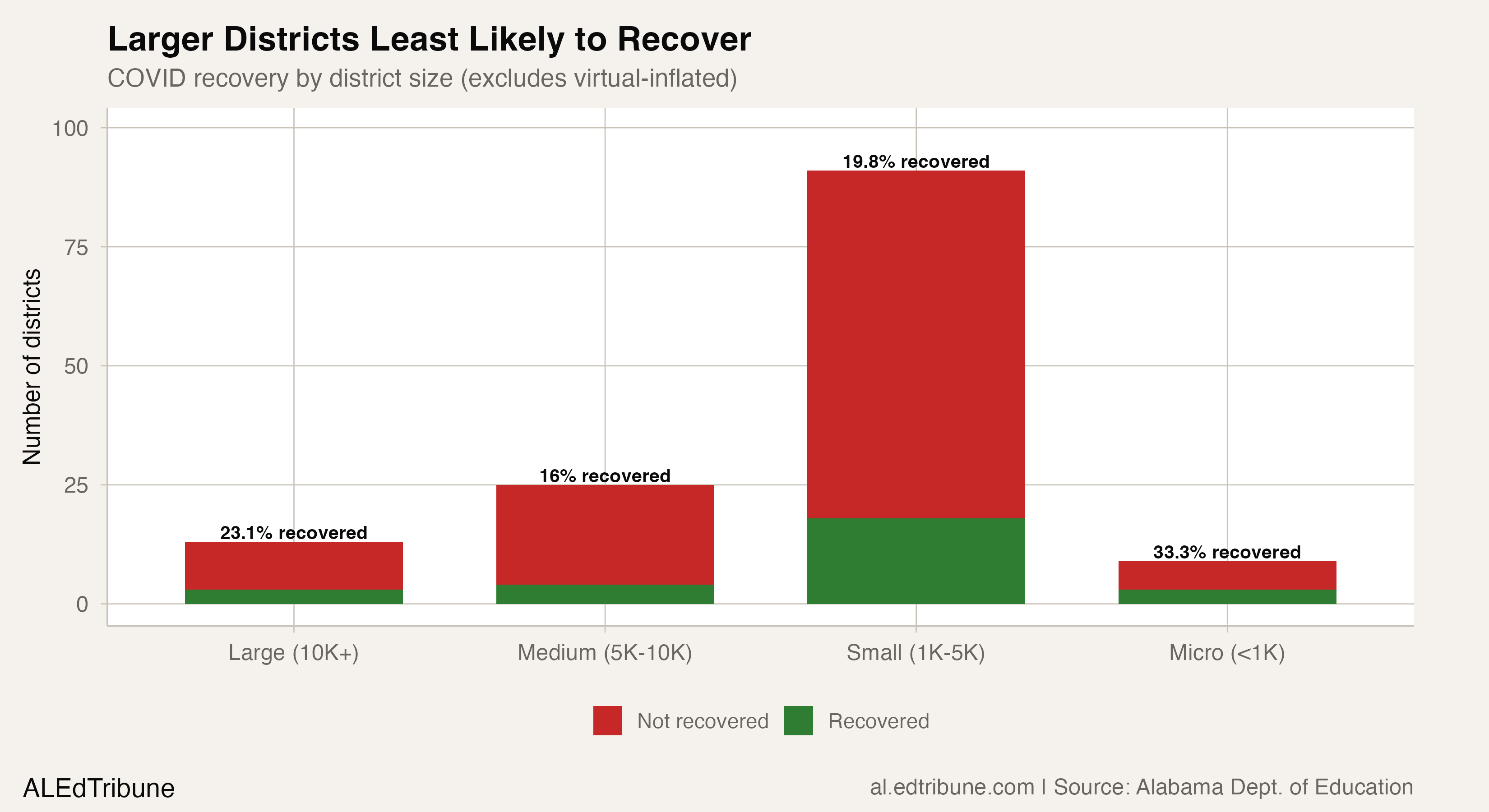
Medium-sized districts (5,000-10,000 students) have the lowest recovery rate at 16.0%, with only four of 25 returning to pre-COVID levels. Small districts (1,000-5,000) recovered at 19.8%, and large districts (10,000+) at 23.1%. The handful of micro districts under 1,000 students fared best at 33.3%, though the sample is small (three of nine).
Among the districts that did recover without virtual school inflation, several share a common profile: fast-growing suburban communities in the Tennessee Valley or the Auburn-Opelika corridor. Madison City↗ET gained 1,336 students (11.6%). Athens City↗ET added 1,101 (25.1%). These are places where new housing construction is pulling families from neighboring counties, not places where the pandemic's effects have been reversed.
Athens City has been building to keep pace. According to Superintendent Beth Patton, the district opened a new 260,000-square-foot high school in 2019, a new elementary campus in 2023, and expanded its intermediate school with eight classrooms and a gymnasium in 2025. A second new elementary school, Julian Newman Elementary, opened the same year with capacity for more than 700 students. The district is now searching for land to build yet another school. "We are excited about the future and believe the best is yet to come," Patton said.
What the next count will show
The 2026-27 school year will be the CHOOSE Act's second cycle. When income limits lift in 2027-28, the pull on public enrollment could accelerate. The 2,100 students who disappeared from rolls in 2025-26 without formal transfers represent a category that enrollment data cannot fully explain. Whether those families left the state, shifted to unreported homeschooling, or left the country, the seats they occupied will not be funded in 2026-27.
Alabama's four-year decline streak has now erased all of the 2016 enrollment spike and then some, pushing the state to its lowest K-12 headcount since before 2015. For superintendents in Mobile, Birmingham, and Montgomery, the question is no longer when recovery will arrive. It is how to operate school systems built for 25,000 more students than they serve.
Detailed code that reproduces the analysis and figures in this article is available exclusively to EdTribune subscribers.
Discussion
Sign in to join the discussion.
Loading comments...