In this series: Alabama 2025-26 Enrollment.
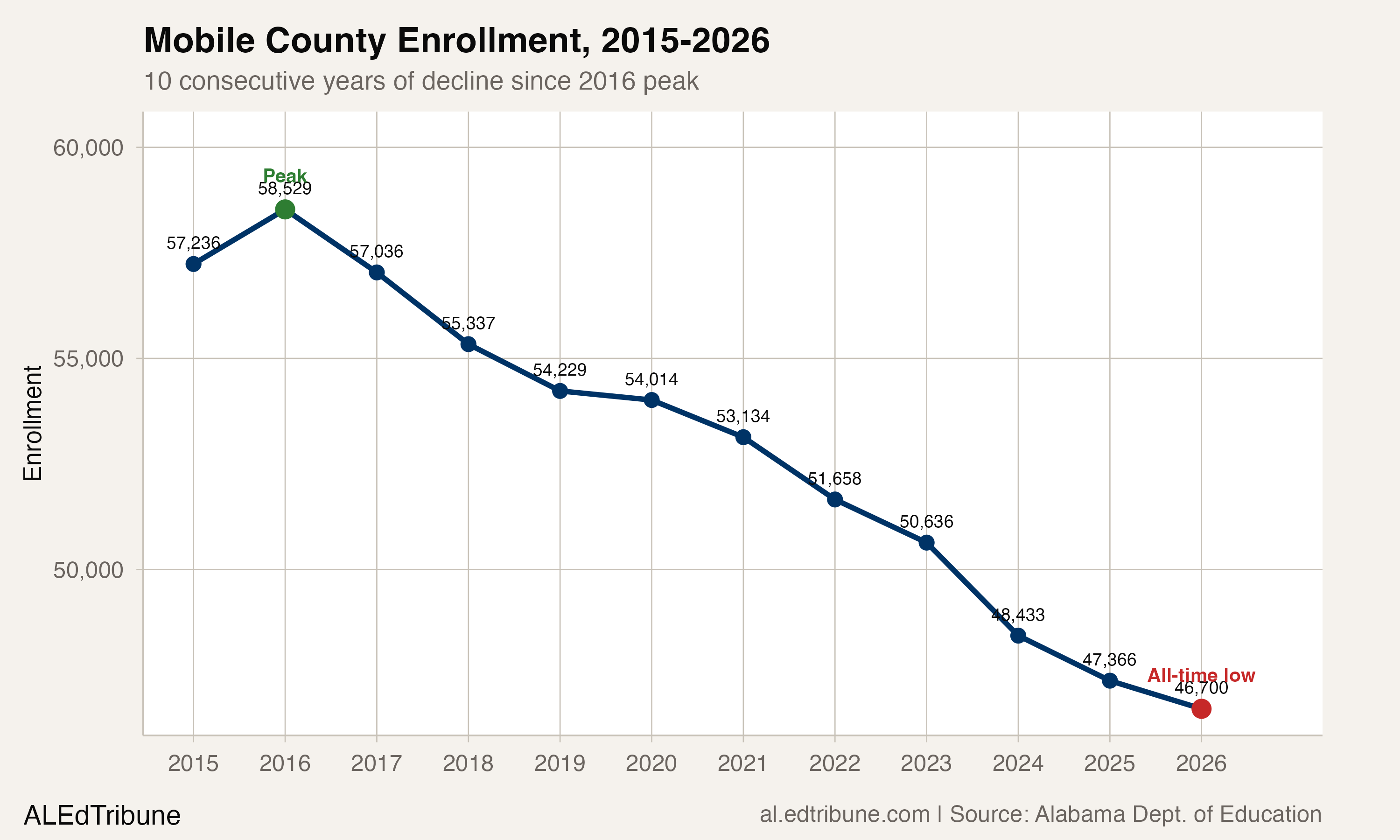
Mobile County↗ET enrolled 46,700 students in 2025-26. That is 11,829 fewer than the 58,529 it enrolled in 2015-16, a loss of 20.2% in a decade. No other district in Alabama has shed more students in raw numbers over the same period. And no year in the 10-year streak, not even the mildest one, produced a gain.
The district remains the state's largest, but the gap is narrowing. Mobile's share of Alabama's total public school enrollment has slipped from 7.8% to 6.5% since 2015. At the average rate of loss over the past decade, 1,183 students per year, the district will fall below 45,000 within two years.
Ten years without a single gain
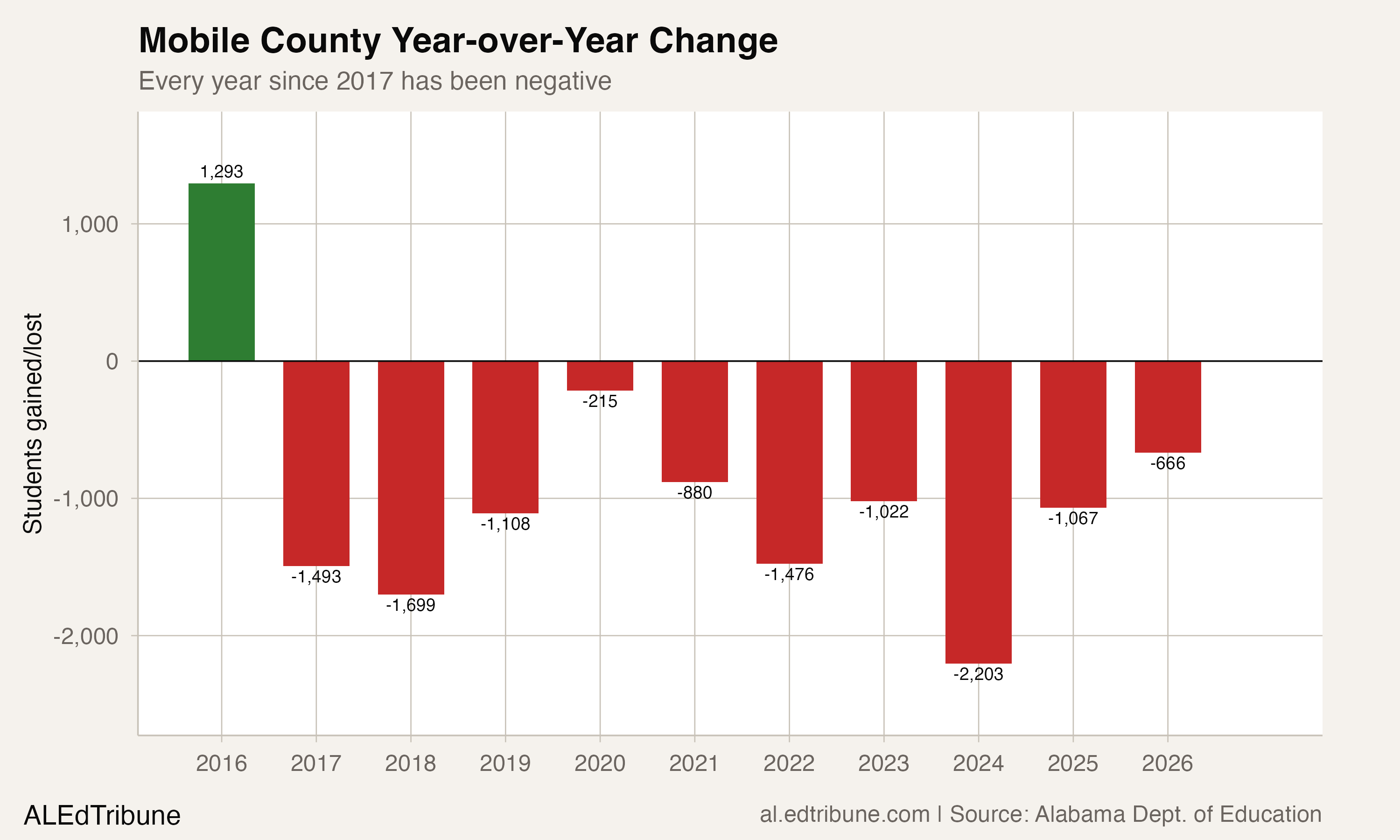
The decline has been remarkably consistent. Even the "best" year in the streak, 2019-20, saw a loss of 215 students. The worst was 2023-24, when Mobile shed 2,203 students, a 4.4% single-year drop that erased more students than some Alabama districts enroll in total.
Before the streak began, Mobile was growing. The district added 1,293 students in 2015-16, pushing enrollment to its data-era peak. Then the reversal began immediately: a loss of 1,493 in 2016-17, followed by 1,699 in 2017-18. The early losses alone exceeded 3,000 students in two years.
The pace has not followed a straight line. Losses moderated around the pandemic, when Mobile lost a relatively mild 215 students in 2019-20 and 880 in 2020-21. But after 2021, the decline reaccelerated. The three-year stretch from 2022 through 2024 erased 4,701 students, nearly 40% of the entire decade's losses compressed into three years.
Not just Mobile, but Mobile most of all
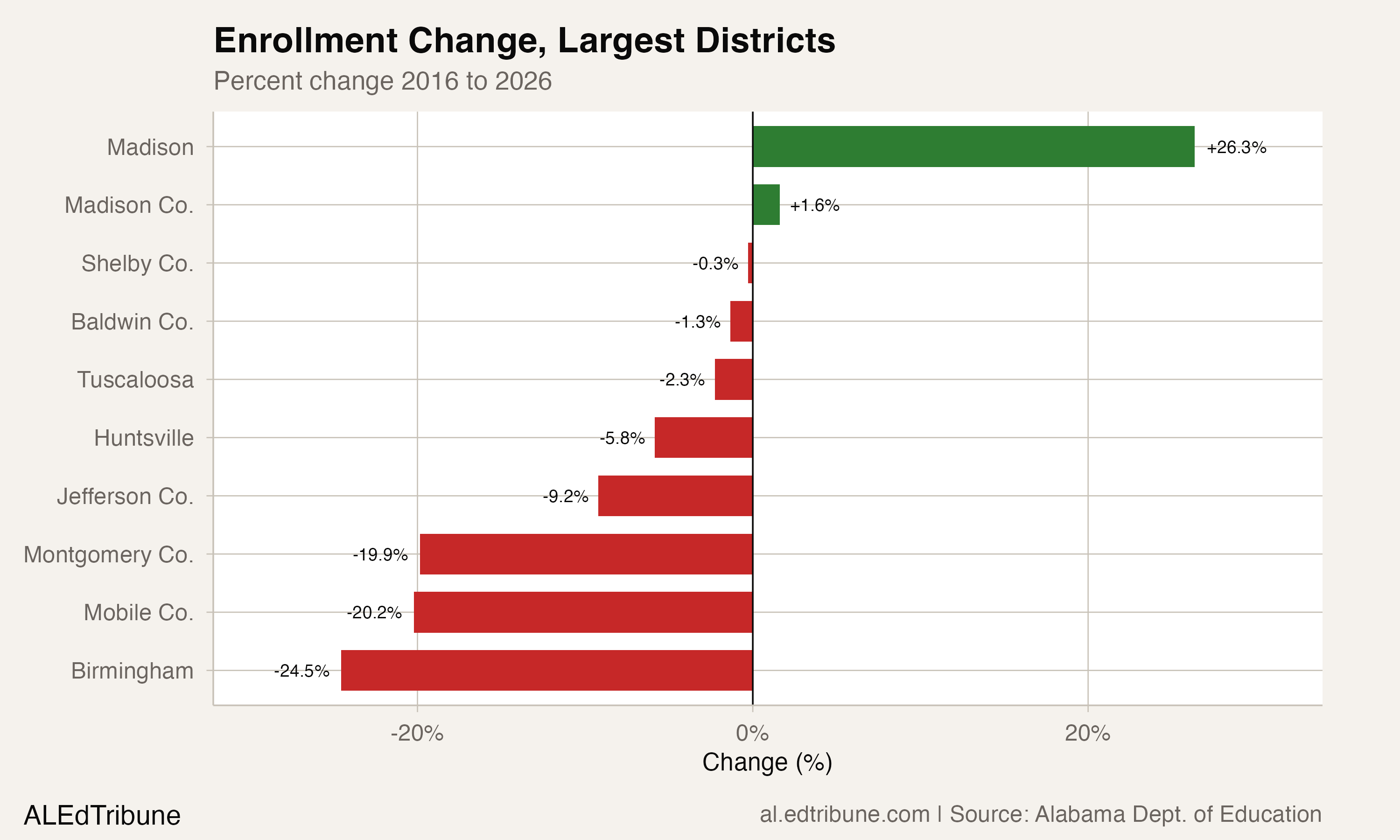
Mobile is not alone among Alabama's large districts in losing students. Birmingham has lost 24.5% of its enrollment since 2016. Montgomery County has lost 19.9%. Jefferson County, the state's second-largest, is down 9.2%.
But Mobile's losses are the largest in absolute terms. The 11,829 students it has lost since 2016 nearly match Birmingham's losses (6,248) and Montgomery's (6,171) combined. Only two of the state's 10 largest districts have grown over the same period: Madison City, up 26.3%, and Madison County, up 1.6%. Both are in the Huntsville metro area, a region buoyed by aerospace and defense employment that has attracted families while the rest of the state shrinks.
Fewer white students, fewer Black students
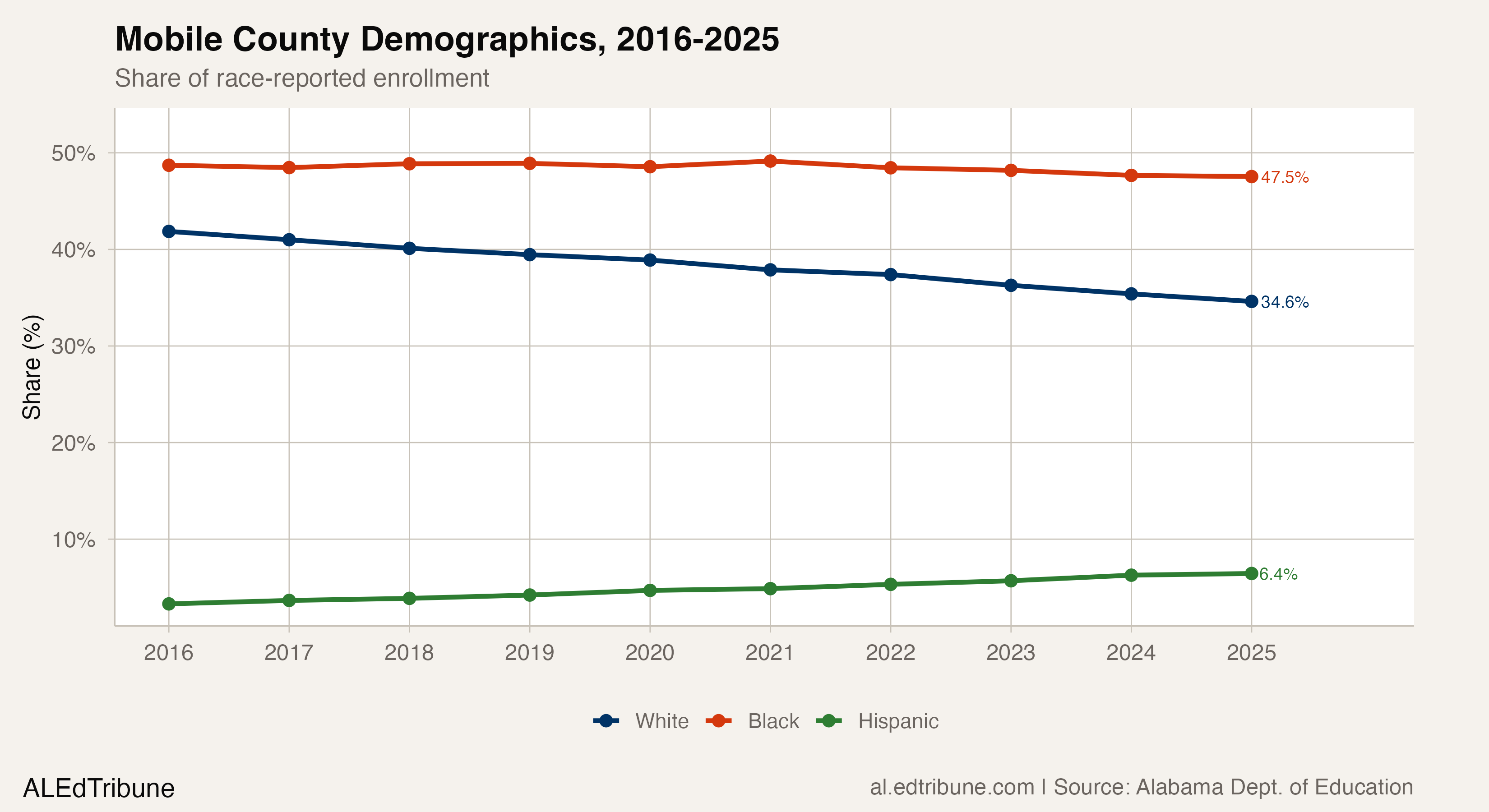
Demographic data, available through 2024-25, shows that Mobile's losses are not concentrated in one racial group. Both white and Black enrollment have fallen substantially. White enrollment dropped from 25,338 to 17,525 between 2016 and 2025, a loss of 7,813 students (30.8%). Black enrollment fell from 29,484 to 24,070, a loss of 5,414 (18.4%).
The two groups are shrinking at different rates, which has shifted the district's composition. White students made up 41.9% of Mobile's race-reported enrollment in 2016; by 2025, that share had dropped to 34.6%. Black students held relatively steady as a share, slipping from 48.7% to 47.5%.
Hispanic enrollment is the one growth area. Mobile enrolled 3,262 Hispanic students in 2025, up from 1,995 in 2016, a gain of 63.5%. But the absolute numbers are small relative to the losses in other groups. Hispanic students have gone from 3.3% to 6.4% of enrollment, but their 1,267-student increase replaces only a fraction of the 13,227 students lost across white and Black enrollment.
Multiracial enrollment has also grown, from 1,265 to 3,558, though some of that growth reflects reclassification rather than new arrivals, as families select multiple racial categories on updated federal reporting forms.
Where the students went
Several forces are pulling students out of Mobile County Public Schools simultaneously, making it difficult to attribute the decline to a single cause.
The most direct is population stagnation. Mobile County's population has barely moved in 16 years, growing just 0.05% from 413,328 in 2010 to an estimated 413,527. A flat population with a declining school-age share, driven by lower birth rates nationally, means fewer children entering the pipeline each year.
Alabama's CHOOSE Act, which took effect for the 2025-26 school year, added a new exit ramp. The education savings account program provides $7,000 per student for private school tuition or other educational expenses. Statewide, roughly 3,032 public school students received CHOOSE Act scholarships after leaving public schools in 2025-26, out of 23,429 total recipients. Three-quarters of recipients had already been enrolled in private schools. The program's county-by-county impact on public enrollment is not yet broken out in public data, but Mobile County, as the state's largest district, is likely absorbing a disproportionate share of the departures.
A third factor is harder to measure. State Superintendent Eric Mackey told Alabama Daily News that roughly 2,100 students statewide had disappeared from enrollment records entirely, with no documentation of transferring to a private school or homeschooling. "They are not on the radar anywhere," Mackey said. "They did not show up for school public or private." Superintendents initially reported that most of these missing students were Hispanic, though Mackey later clarified that the state actually gained 300 Hispanic students year over year.
A shrinking slice of a shrinking pie
Mobile's decline is outpacing the state's. Alabama as a whole has lost 4.7% of its enrollment since 2016, falling from 749,897 to 714,363. Mobile has lost 20.2% over the same period, more than four times the state rate. The result is a steady erosion of Mobile's share of state enrollment, from 7.8% to 6.5%.
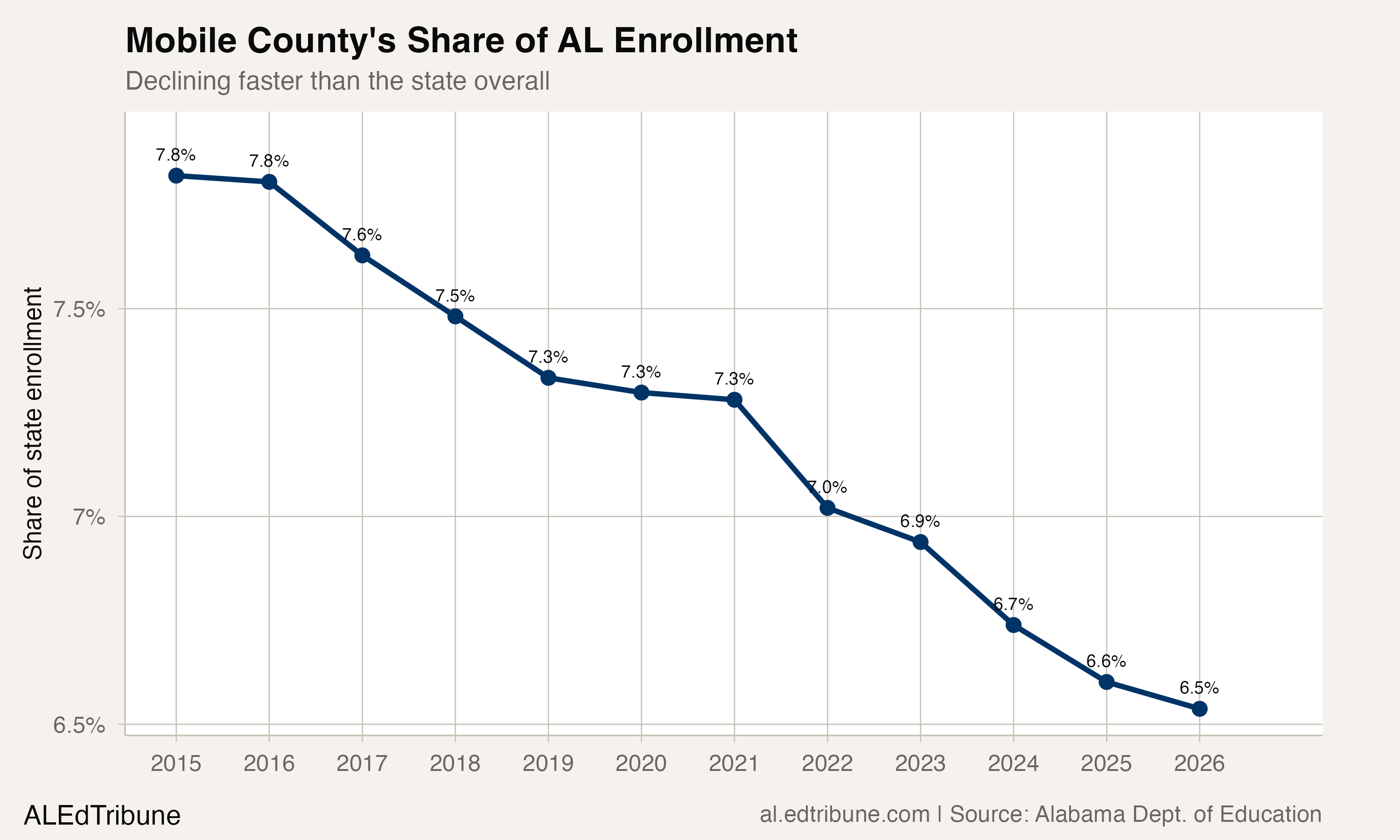
That shrinking share carries fiscal weight. Alabama distributes state education funding through the Foundation Program, which allocates resources based on student counts. Fewer students means fewer state dollars, even as fixed costs for building maintenance, transportation routes, and administrative staff do not shrink at the same rate. Mobile's 2024-25 budget fell to $804 million, a 17.5% drop from the prior year's $975 million, driven largely by the expiration of federal COVID relief funding that had masked the enrollment decline's fiscal impact for several years.
What comes next
The CHOOSE Act's first-year effect is now baked into the 2025-26 numbers, and the 666-student loss Mobile recorded in 2025-26 is the second-mildest in the streak, behind only the 215-student dip in 2019-20. Whether that moderation holds or represents a one-year pause before deeper losses resume will depend on how many additional families use the ESA program in year two, whether Alabama's projected 500 teacher position reductions statewide fall disproportionately on large declining districts, and whether Mobile's flat population continues to translate into fewer school-age children.
The district's kindergarten pipeline offers a clue. If incoming cohorts remain smaller than graduating ones, the structural math guarantees further decline regardless of policy changes. Mobile enrolled 57,236 students when this dataset begins in 2014-15. It now enrolls 46,700. The question is no longer whether the decline will continue, but how far it goes before the district stabilizes at a fundamentally different size.
Detailed code that reproduces the analysis and figures in this article is available exclusively to EdTribune subscribers.
Discussion
Sign in to join the discussion.
Loading comments...