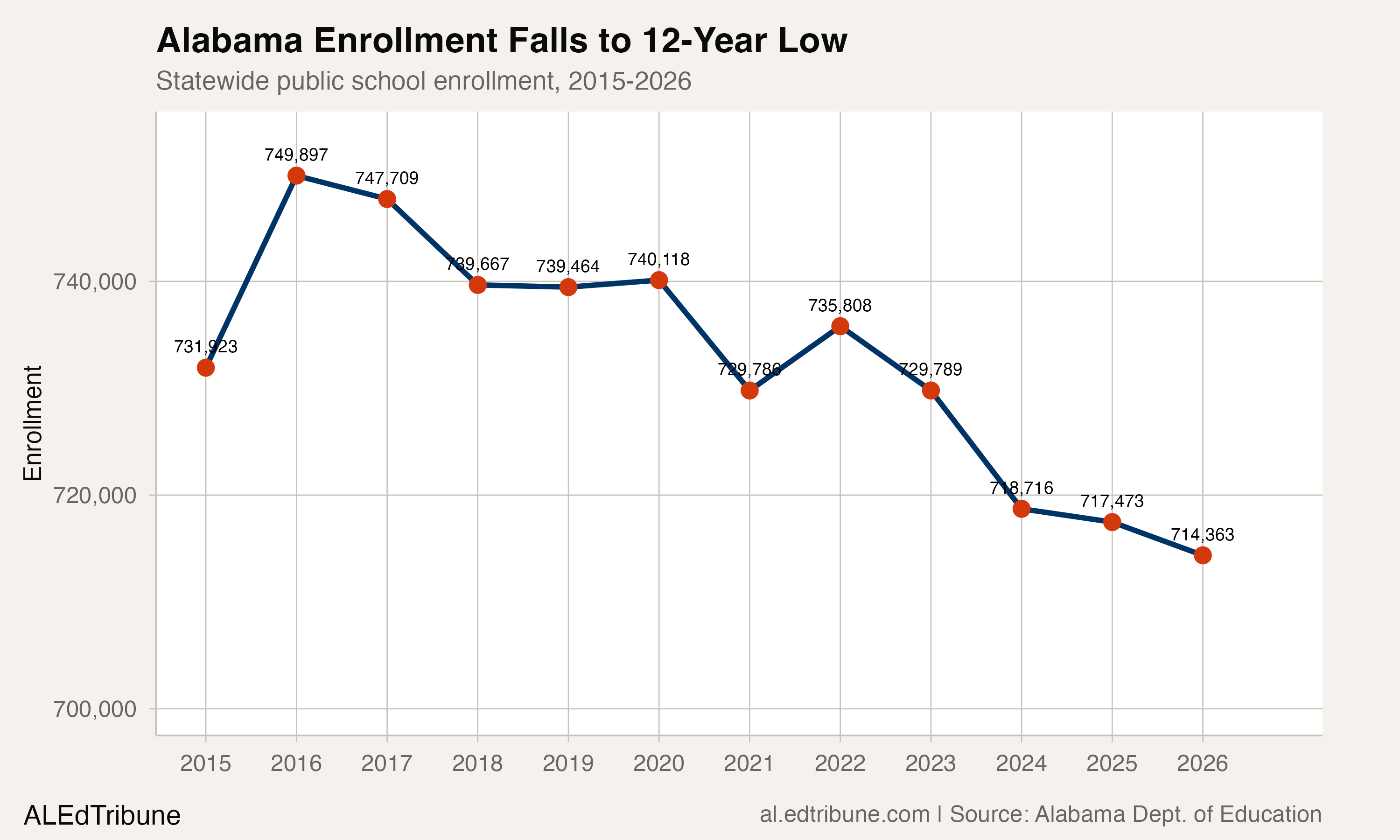
The four largest school districts in Alabama have never enrolled fewer students than they do right now. Mobile County↗ET, Jefferson County↗ET, Montgomery County↗ET, and Birmingham City↗ET all hit record lows in 2025-26, a distinction they share with 47 other districts across the state. In total, 51 of Alabama's 153 multi-year districts are at their lowest enrollment in at least 12 years of data. They collectively serve 255,066 students, more than a third of the state's public school population, and every one of them is shrinking.
The 51 districts at record lows enroll 35.7% of Alabama's students. The 24 districts at record highs enroll 10.1%. The arithmetic is stark: the declining districts are, on average, far larger than the growing ones.
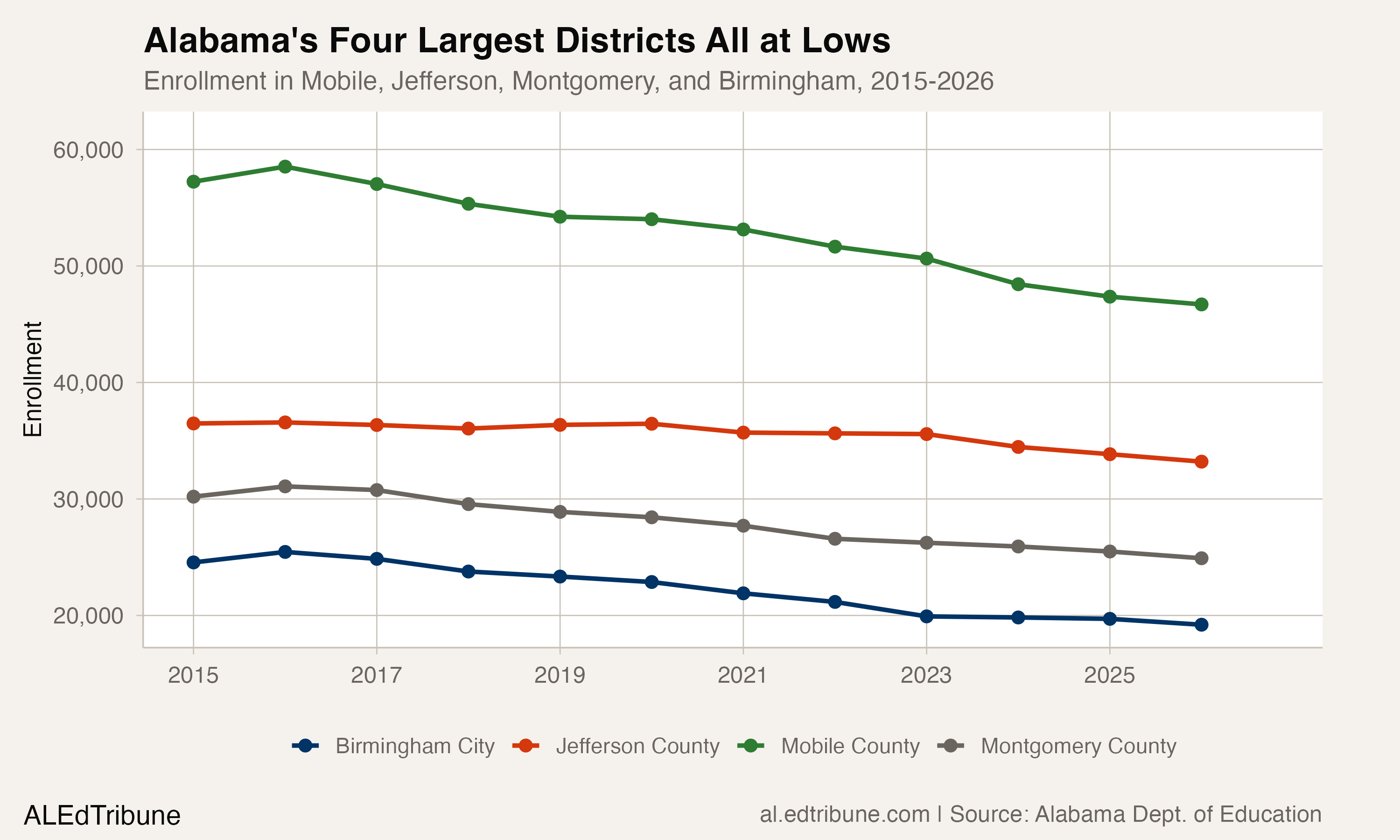
The big four keep falling
Alabama's enrollment trajectory is a story that begins at the top. Mobile County, the state's largest district, peaked at 58,529 students in 2016 and has declined every year since, reaching 46,700 in 2025-26. That is a loss of 11,829 students, a 20.2% drop over a decade.
Birmingham City has lost even more proportionally: 24.5% since its 2016 peak, falling from 25,454 to 19,206. Montgomery County is down 19.9%, from 31,082 to 24,911. Jefferson County's decline is smaller at 9.2%, but at 33,204 students, it still lost 3,367 from its peak.
Combined, these four districts have shed 27,615 students since 2016. That is more than the entire current enrollment of Montgomery County.
The scale matters because Alabama's Foundation Program funding formula allocates teacher units based on student enrollment. State Superintendent Eric Mackey estimated that the statewide enrollment decline would eliminate 500 to 700 teaching positions in the next budget cycle. Districts that are already at record lows face the sharpest cuts. Selma City↗ET lost 10% of its state-funded teacher units in a single year, dropping from 143 to 128. Sumter County↗ET lost 9%, from 54 to 50.
The deepest losses are in the Black Belt
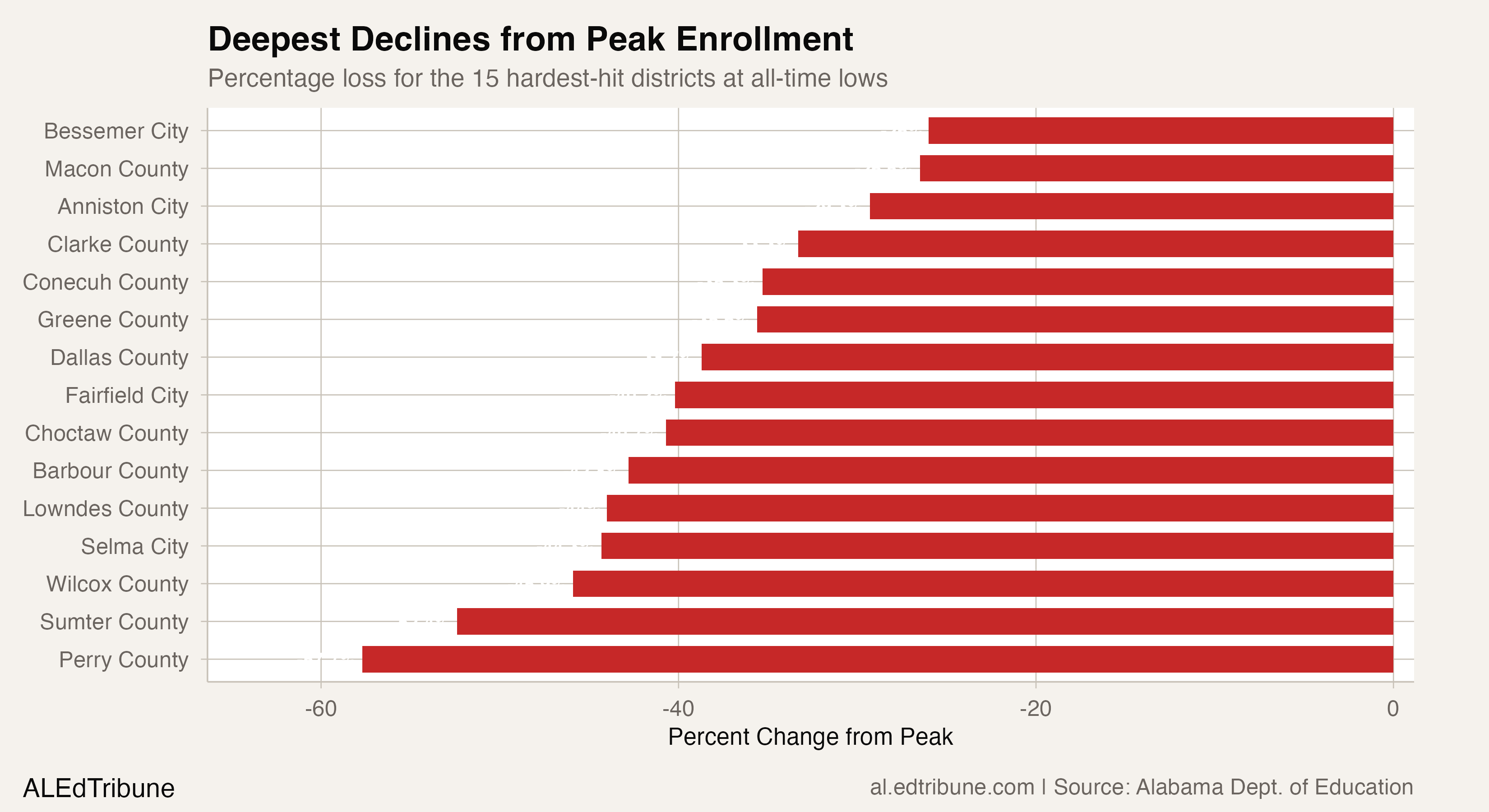
The 15 districts with the steepest percentage declines from their peaks read like a map of Alabama's Black Belt, the band of majority-Black, high-poverty rural counties stretching through the state's midsection. Perry County↗ET has lost 57.7% of its students since 2015, falling from 1,730 to 731. Sumter County is down 52.4%. Wilcox County↗ET has lost 45.9%. Selma City has lost 44.3%.
These are not enrollment dips. They are existential declines in communities where the school system is often the largest employer and the last functioning public institution. A district that loses half its students does not simply cut half its budget. Fixed costs for buildings, transportation routes, and administrative staff do not scale linearly with enrollment. What remains is a system trying to operate a full district infrastructure on half the revenue.
The Black Belt's enrollment crisis is driven by population out-migration that has been documented for decades. Working-age residents leave for employment in Birmingham, Huntsville, Montgomery, or out of state entirely, and the families that remain tend to be older or without school-age children. A 2025 PARCA analysis found that Alabama's deaths now exceed its births, a demographic shift that compounds the out-migration effect in rural counties where in-migration provides no offset.
Who is actually growing?
Twenty-four districts hit all-time highs in 2025-26, but the list requires careful reading. The three largest "growth stories" are inflated by statewide virtual schools that are administratively housed within those districts. Limestone County's 91.9% growth is half Alabama Connections Academy (8,307 of 16,633 students). Chickasaw City's 263% growth is 70.8% Alabama Destinations Career Academy.
Strip out the virtual school enrollments and the genuine growth districts are a mix of suburban satellites and charter schools. Madison City↗ET, the largest non-virtual grower at 12,876 students, has gained 32.3% by absorbing families moving to the Huntsville metro's tech-driven economy around Redstone Arsenal. Pike Road City↗ET, a small suburb southeast of Montgomery, has grown 142% by pulling families out of the Montgomery County system it borders.
The charter schools at record highs are mostly young: LEAD Academy, Legacy Prep, and i3 Academy have existed for fewer than six years, so their "all-time highs" reflect short histories rather than sustained growth trajectories.
Three forces, and a fourth
The enrollment decline has no single cause, but three forces are clearly operating simultaneously.
The first is demographic. Alabama's birth rate has been falling for over a decade. The state's natural population change turned negative during the pandemic, meaning more Alabamians die each year than are born. The children entering kindergarten today come from smaller birth cohorts than the high schoolers graduating out.
The second is the CHOOSE Act, Alabama's education savings account program signed into law in 2023. In its first year, roughly 3,000 students who had been in public schools used CHOOSE Act funds to move to private education. That is a measurable but modest share of the 5,800-student total decline. The Public Affairs Research Council of Alabama found that about three-quarters of the 23,429 CHOOSE Act recipients were already enrolled in private schools, meaning the program's net public-school impact was far smaller than its headline enrollment figure.
The third is the ongoing urban-to-suburban migration pattern visible in the big four's declines. Birmingham loses students to Hoover, Vestavia Hills, and Homewood. Montgomery loses students to Pike Road and Elmore County. Mobile loses students to Baldwin County. This is not a new dynamic, but it is accelerating: the combined suburban ring around Birmingham (Hoover, Vestavia Hills, Homewood, Trussville, Mountain Brook) enrolled roughly 27,000 students in 2026 while Birmingham City enrolled 19,206.
A fourth factor is harder to quantify. Of the 5,800 students who left Alabama's public schools in 2025-26, State Superintendent Mackey acknowledged that roughly 2,100 "just disappeared" with no record of transferring, withdrawing for homeschool, or enrolling elsewhere. "The address we have on file is not correct anymore," Mackey said. Immigration enforcement and family mobility both contribute to students becoming invisible to enrollment systems, but the state cannot distinguish between these causes in its data.
The scatter tells the story
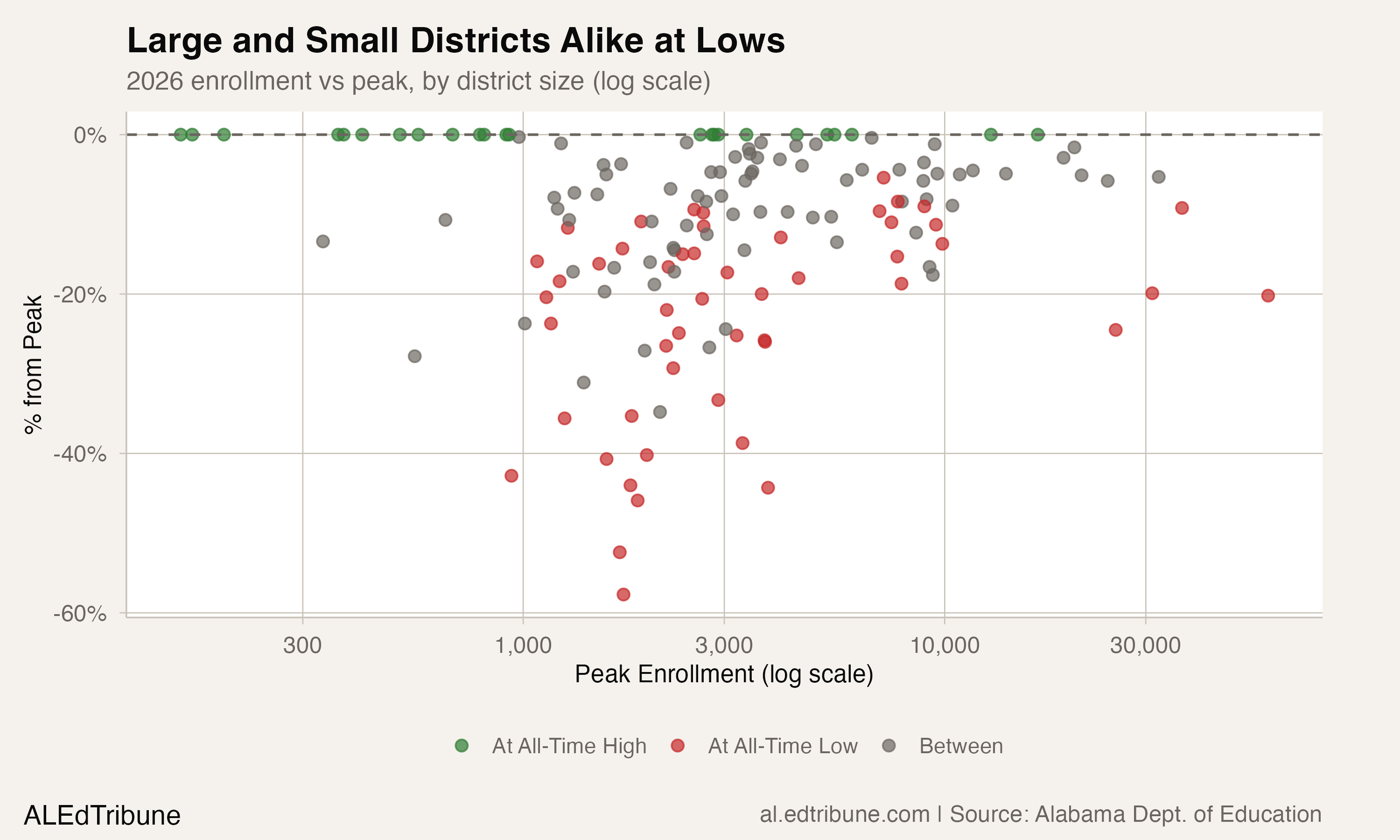
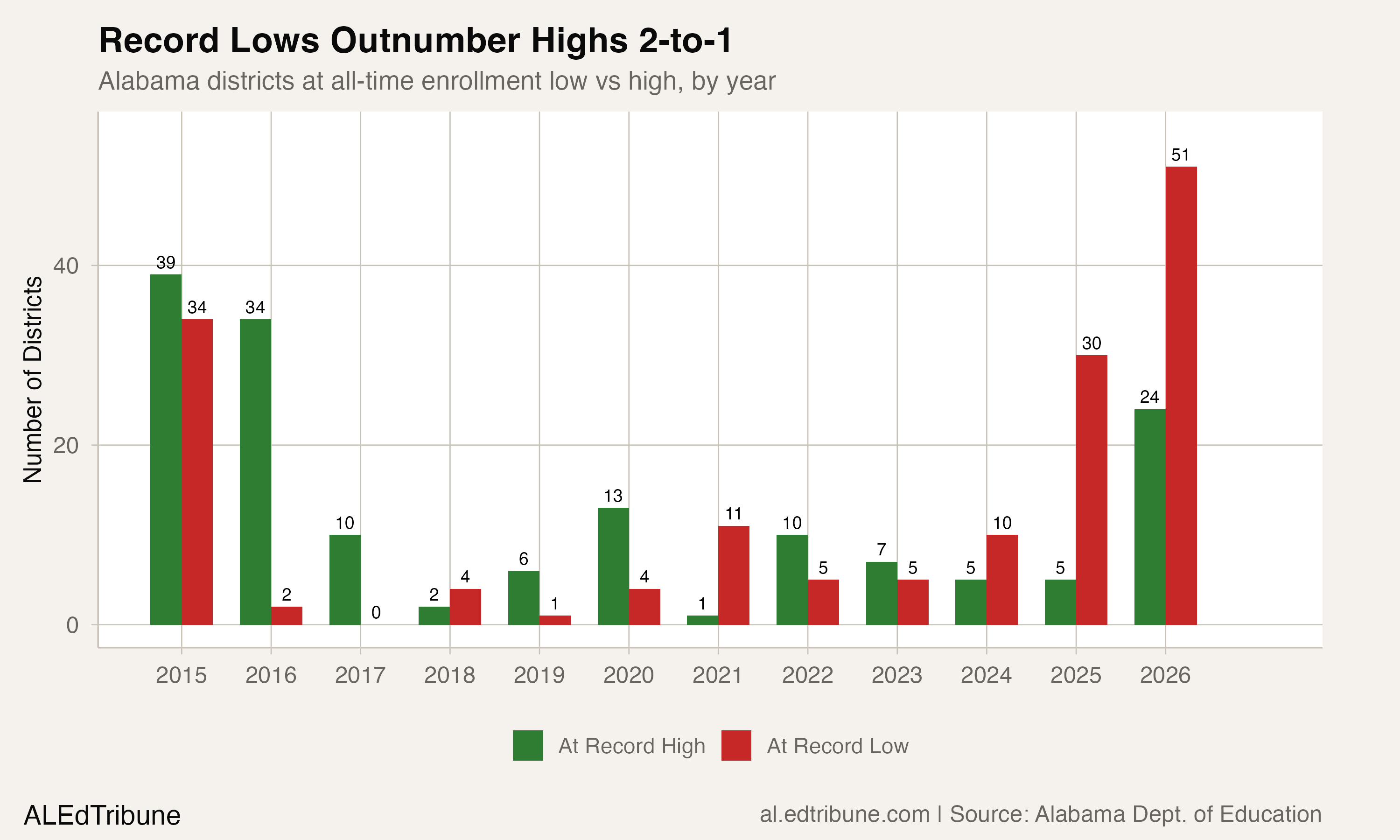
What makes 2026 different from prior years is the breadth of the decline. In 2017, zero Alabama districts were at all-time lows. By 2021, 11 were. In 2025, the number jumped to 30. In 2026 it reached 51. The progression from 30 to 51 in a single year is the largest one-year increase in the data.
The scatter plot reveals something the aggregate counts obscure: the all-time lows are not concentrated in a single district type. Small rural systems, midsized county districts, and the state's largest urban systems are all represented. A 700-student Black Belt county and a 46,700-student coastal metropolis are in the same statistical category. Whatever is driving enrollment downward, it is not selective about geography or scale.
The districts that sit "between" their extremes, plotted in gray, are running out of room. Many are 10% to 20% below their peaks and trending toward their own record lows. If current trajectories hold, the 2027 count could approach 60 or more.
What comes next
The question Alabama faces is whether any of its growth sources can offset the structural decline. The CHOOSE Act is set to expand to universal eligibility in 2027-28, removing the current income cap and opening the program to all Alabama families. With funding already at $250 million, the outflow from public to private schools is likely to grow beyond the 3,000 students who left in its first year. The state's charter sector, though growing, remains small at roughly 1% of total enrollment. And the demographic headwinds, fewer births, aging rural populations, continued out-migration from the Black Belt, show no sign of reversing.
For the 51 districts at all-time lows, the enrollment number is not abstract. It determines how many teachers the state will fund, how many bus routes a county can operate, and whether a school building stays open. In Perry County, where enrollment has fallen below 750 students in a system that once served more than 1,700, the question is not whether the trend will reverse. It is how long the district can sustain the infrastructure of a school system at half its designed capacity.
Detailed code that reproduces the analysis and figures in this article is available exclusively to EdTribune subscribers.
Discussion
Sign in to join the discussion.
Loading comments...