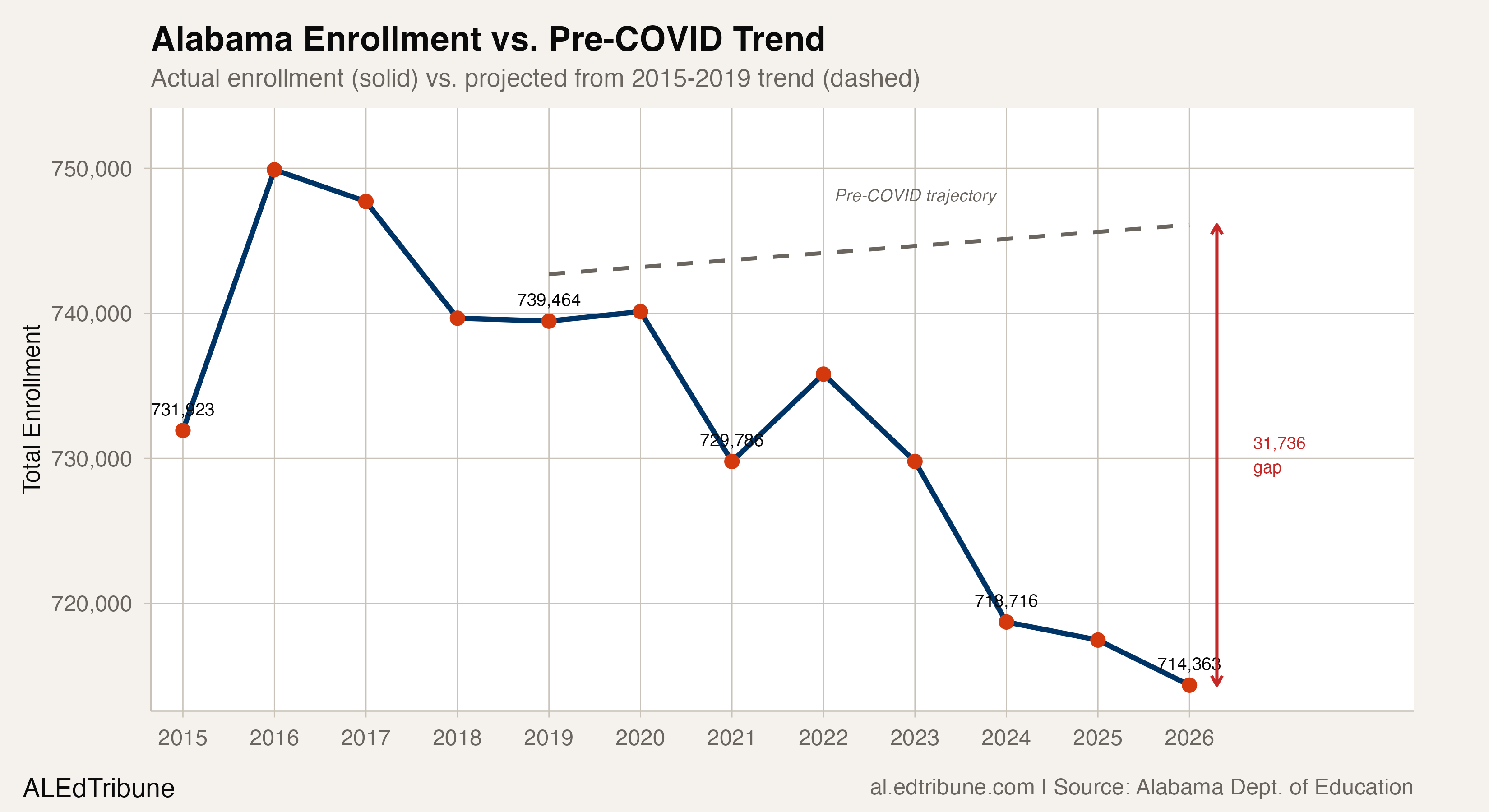
Alabama's public schools enrolled 740,118 students in 2019-20. That was roughly where they had been for half a decade: fluctuating within a narrow band, never gaining or losing more than a percentage point in any direction. A linear projection through the 2015-2019 data produces a nearly flat trajectory, essentially forecasting enrollment would hold steady around 740,000.
If that trajectory had continued through the pandemic and beyond, Alabama would have 746,099 students in 2025-26. Instead it has 714,363. The gap between where Alabama was headed and where it actually landed is 31,736 students, and it has widened in five of the seven post-pandemic years.
A gap that only runs one direction
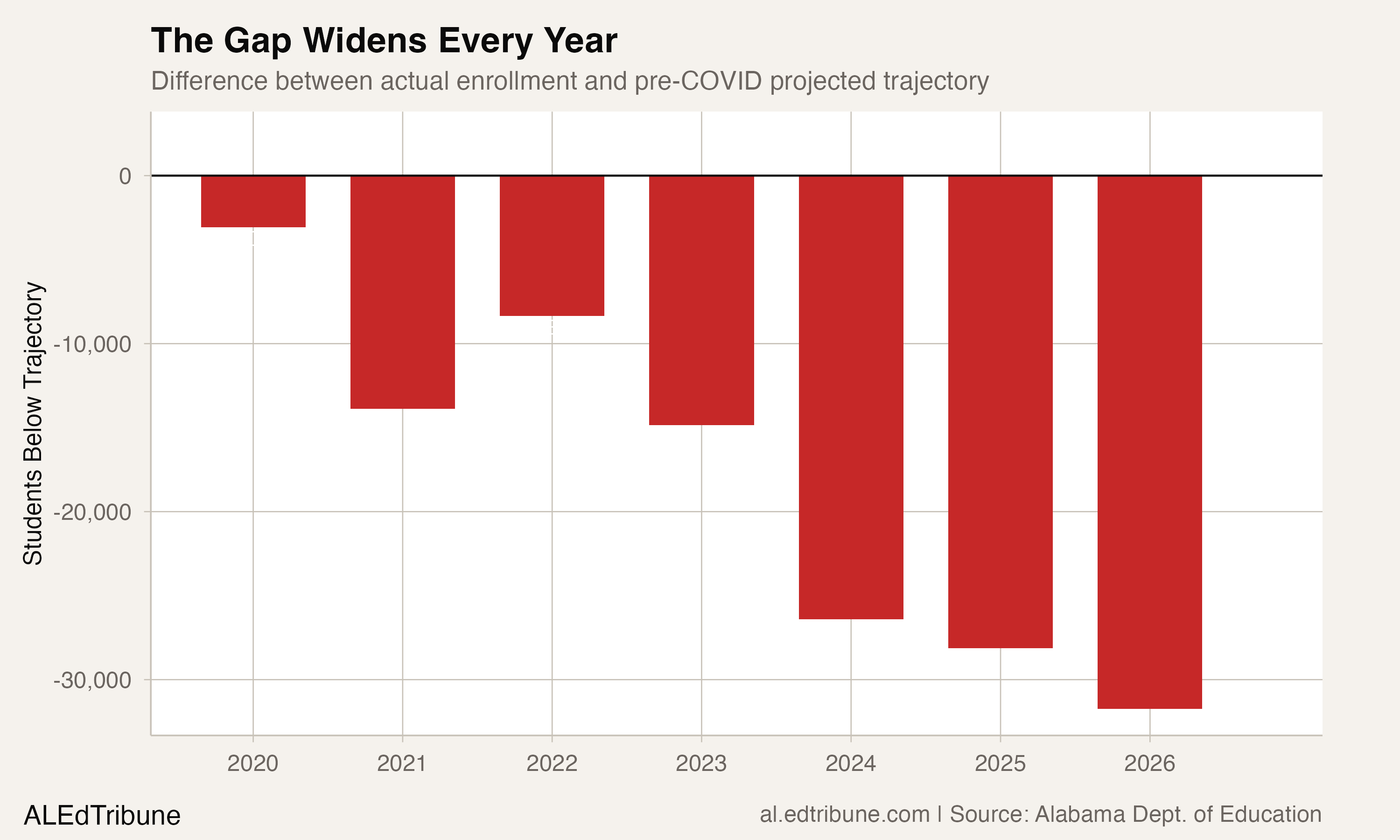
The divergence started small. In 2019-20, the gap between actual and projected enrollment was just 3,070 students. COVID blew it open: by 2020-21, the gap had quadrupled to 13,887. The 2021-22 school year brought a partial rebound, narrowing the gap to 8,350 as families returned to classrooms.
That was the last good news.
Since 2022, the gap has widened relentlessly. It jumped to 14,854 in 2022-23, then nearly doubled to 26,412 in 2023-24. By 2025-26 it had reached 31,736, or 4.3% below the projected trajectory. Each year Alabama falls further behind the line it was on before the pandemic arrived.
The year-over-year enrollment changes tell the same story from a different angle. After losing 10,332 students during the pandemic's first year, Alabama clawed back 6,022 in 2021-22. It has lost students in every year since. The 2023-24 loss of 11,073 was the largest single-year decline in the dataset, exceeding even the COVID year itself. The losses in 2024-25 (-1,243) and 2025-26 (-3,110) were smaller in absolute terms, but they came on top of a base that was already deeply eroded.
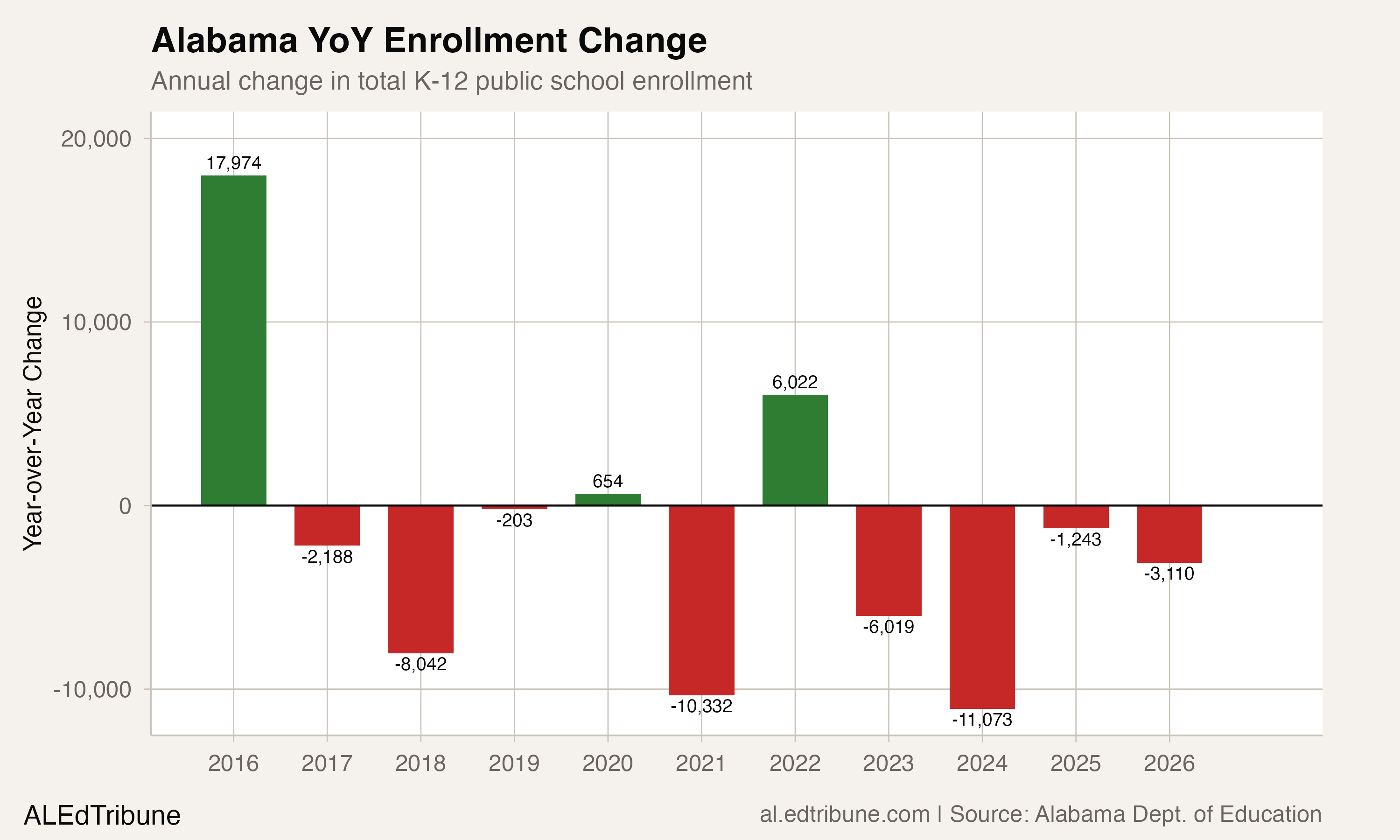
Alabama is now in a four-year decline streak, with enrollment at its lowest point in the 12-year dataset: 714,363. That is 35,534 fewer students than the 2015-16 peak of 749,897, a 4.7% decline.
Five districts account for most of the damage
The losses are not evenly distributed. Of 141 districts with data spanning 2020 to 2026, 110 lost enrollment, or 78%. But five districts account for 73.1% of the total state loss of 25,755 students since 2019-20.
Mobile County↗ET leads: 7,314 students lost since 2019-20, a 13.5% decline. Birmingham City↗ET lost 3,665 (16.0%). Montgomery County↗ET lost 3,516 (12.4%). Jefferson County↗ET lost 3,254 (8.9%). Shelby County rounds out the top five at 1,074 (5.1%).
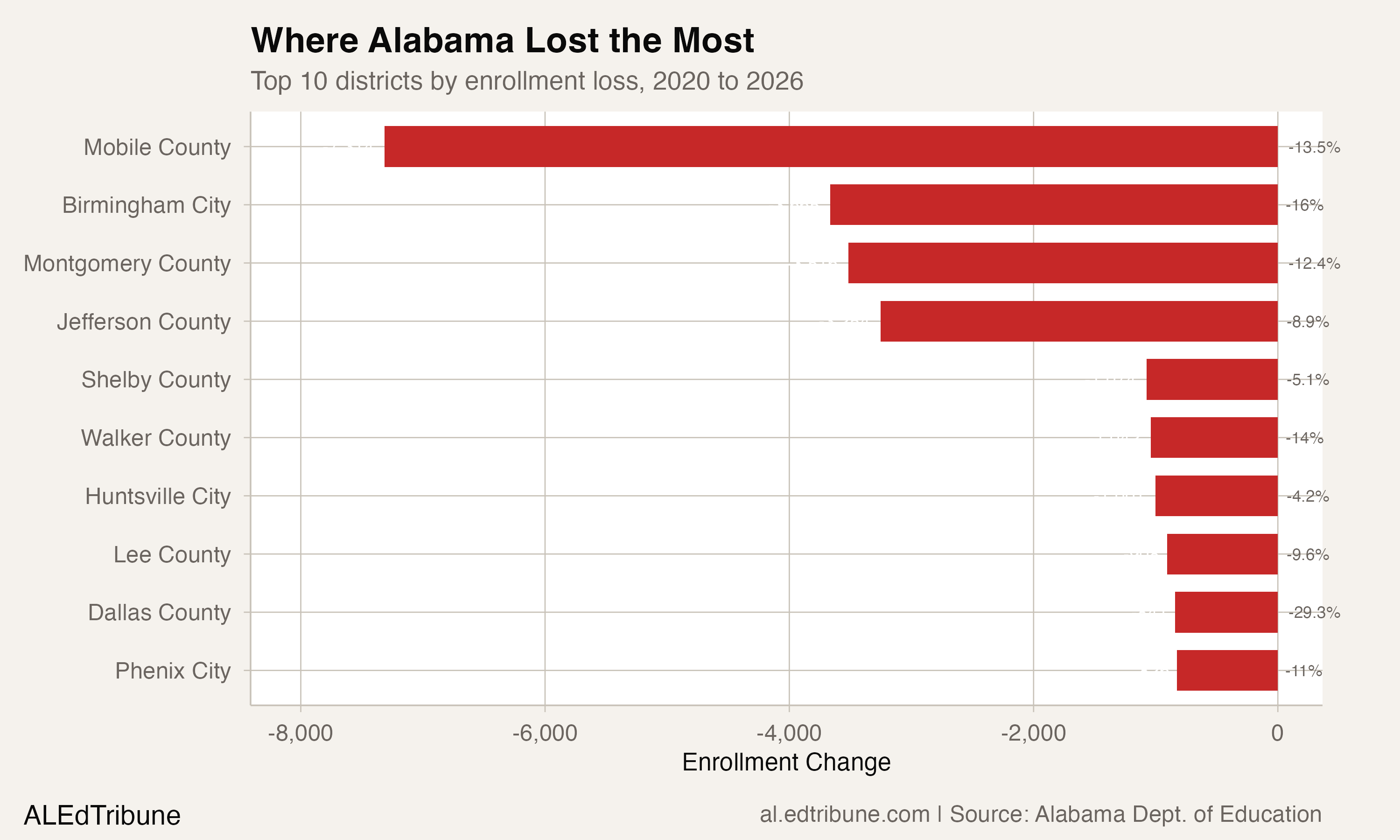
The concentration of losses in Alabama's largest urban and suburban systems reflects a pattern visible across the South: big-district families have more exit options, whether private schools, charter schools, homeschooling, or migration to smaller systems nearby. Dallas County↗ET, with 2,032 students remaining, has lost 29.3% of its enrollment since 2019-20, the steepest percentage decline among the top losers.
Where the students went
Three forces are pulling students out of Alabama's public schools, and they are difficult to untangle.
The CHOOSE Act, Alabama's education savings account program, launched in the 2025-26 school year. Of roughly 24,000 students awarded ESA funds, approximately 3,032 had previously attended public schools. That accounts for roughly half of the 2025-26 decline but only a small fraction of the cumulative 31,736 trajectory gap. Most CHOOSE Act recipients, about two-thirds, were already in private schools or homeschool programs before the program existed.
A second, murkier factor is the disappearance of students whose families appear to have left the state or withdrawn from formal schooling without notifying their districts. State Superintendent Eric Mackey told WSFA that of the 5,800 students who did not return in 2025-26, roughly half enrolled in private schools or homeschooling. The other half remains unaccounted for.
"We do believe that there is a group of students out there that may be homeschooling, but have not been accounted for because they haven't actually gone to their local school board and withdrawn and indicated that as their preference." -- State Superintendent Eric Mackey, WSFA, Oct. 2025
Superintendents across the state have reported that many of the unaccounted students are Hispanic. A new federal reporting form that allows students to select multiple racial identities has made it harder to parse what portion of the apparent Hispanic enrollment decline reflects actual departures versus reclassification. PARCA's analysis found reported Hispanic enrollment fell from 12% to 4% of students between 2024-25 and 2025-26, a drop of 56,196 students on paper. But the "two or more races" category surged by 52,627 students over the same period, absorbing most of the apparent decline. Alabama actually gained about 300 Hispanic students in net terms, according to the final count.
The third factor is demographic. Alabama's birth rates fell starting with the 2008 recession and never recovered. Deaths have outnumbered births for three consecutive years. Smaller kindergarten cohorts have been feeding into the pipeline for over a decade, and there is no rebound on the horizon.
Beyond recovery
The language of "COVID recovery" implies a return to normal. Alabama's data suggests the pandemic was not a disruption but a permanent break.
The state lost 10,332 students during COVID (2019-20 to 2020-21). In the five years since, it has not recovered a single one. Instead, it has lost an additional 15,423 students beyond the COVID low of 729,786. The recovery rate is not low. It is negative: -149%.
Put differently, the COVID drop was 10,332 students. The post-COVID decline has been roughly one and a half times larger.
The expected budget impact is approximately $30 million in reduced allocations for fiscal year 2027, with an estimated 500 education positions affected statewide. Alabama's new RAISE Act funding formula, which sets a base of $7,547 per student for 2025-26, means each student who leaves takes that funding with them.
What happens next
The CHOOSE Act is set to expand. Governor Ivey signed an amended budget that nearly doubled the program's initial funding from $100 million to $180 million in its first year. Eligibility remains income-limited for 2026-27, then expands to all Alabama K-12 residents in 2027-28. If more public school students take ESA funds in year two and beyond, the trajectory gap will widen further.
But the CHOOSE Act is a recent addition to a longer story. Alabama was losing students well before the voucher program existed. The 2023-24 loss of 11,073 students, the largest in the dataset, happened a full year before the first ESA dollar was spent. The underlying forces pulling enrollment down, declining births, outmigration, and a growing preference for alternatives to traditional public schools, were at work before the pandemic and have accelerated since.
The question for Alabama's 155 school districts is not when enrollment will return to pre-COVID levels. It is how to operate a system built for 740,000 students when fewer than 715,000 show up, and fewer arrive each year.
Detailed code that reproduces the analysis and figures in this article is available exclusively to EdTribune subscribers.
Discussion
Sign in to join the discussion.
Loading comments...