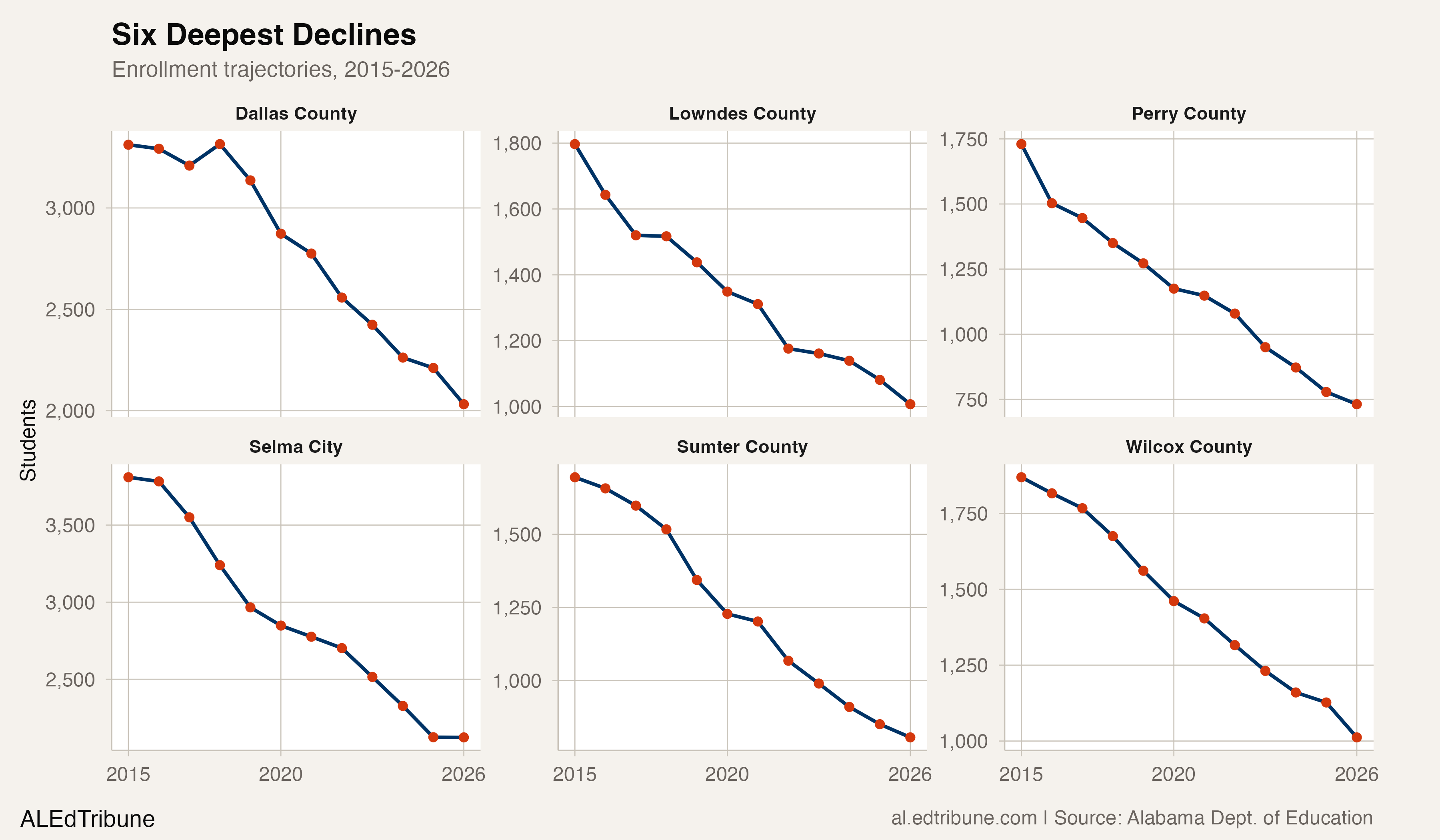
Perry County↗ET enrolled 1,730 students in 2015. This year it enrolls 731. That is not a typo. The district has lost 57.7% of its students in 11 years, a rate of decline so steep that it amounts to losing one classroom every few months with no prospect of the seats filling back up.
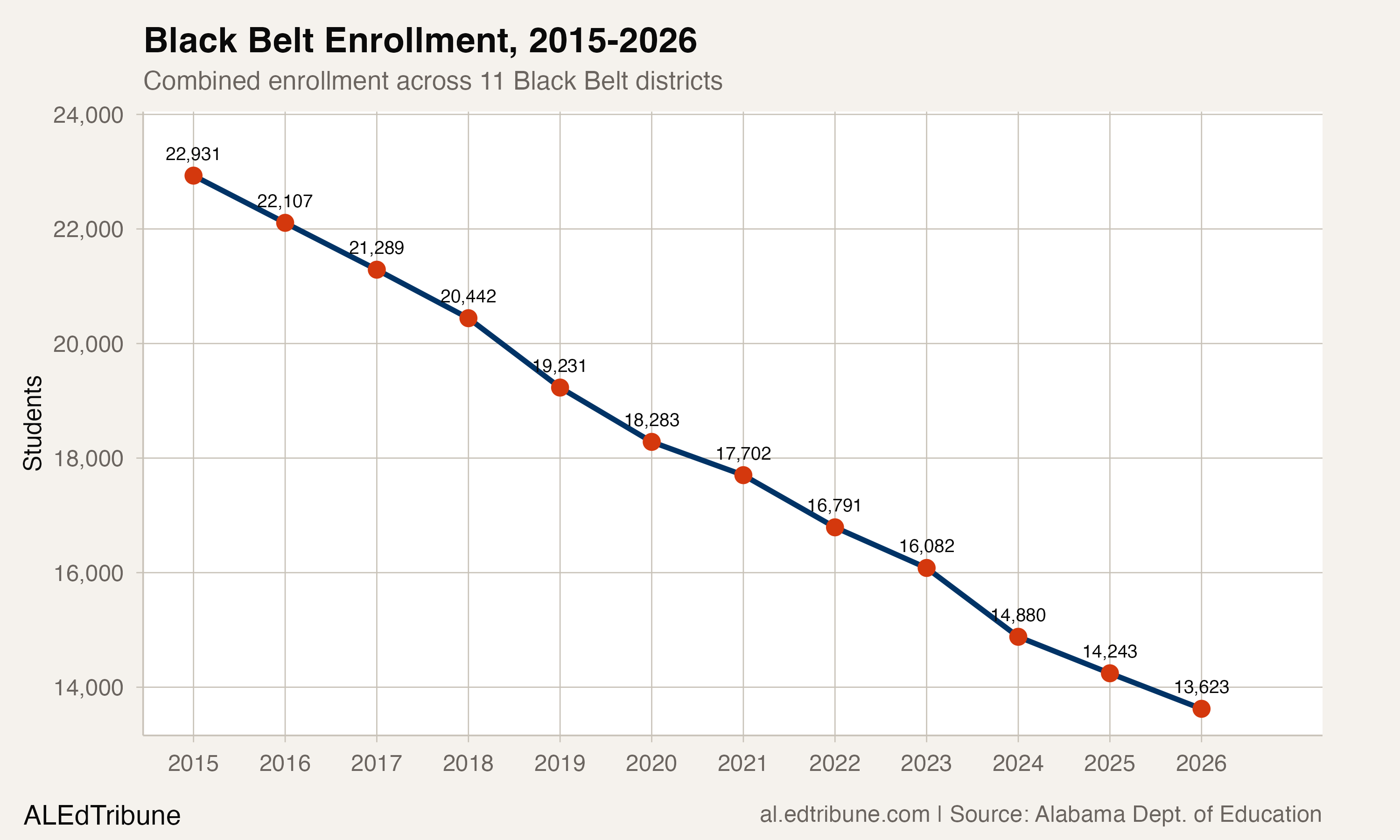
Perry County is not an outlier. It is the sharpest edge of a pattern running through Alabama's historic Black Belt, the crescent of rural counties stretching from the state's southwestern corner through its midsection. Across these 11 districts, combined enrollment has fallen from 22,931 to 13,623, a loss of 9,308 students and a 40.6% decline. The state as a whole lost 2.4% over the same period.
The arithmetic of disappearance
Six of these 11 districts have maintained unbroken decline streaks for the full 11-year span of available data. Lowndes County↗ET, Macon County↗ET, Selma City↗ET, Sumter County↗ET, and Wilcox County↗ET have each declined every single year since 2015 alongside Perry County. Not one year of recovery. Not one year of holding steady.
The losses are not evenly distributed. Perry County's 57.7% decline leads, followed by Sumter County at 52.4%, Wilcox County at 45.9%, Selma City at 44.3%, and Lowndes County at 44.0%. Even the least-affected districts in this group, Hale County↗ET and Macon County, have lost more than a quarter of their students.
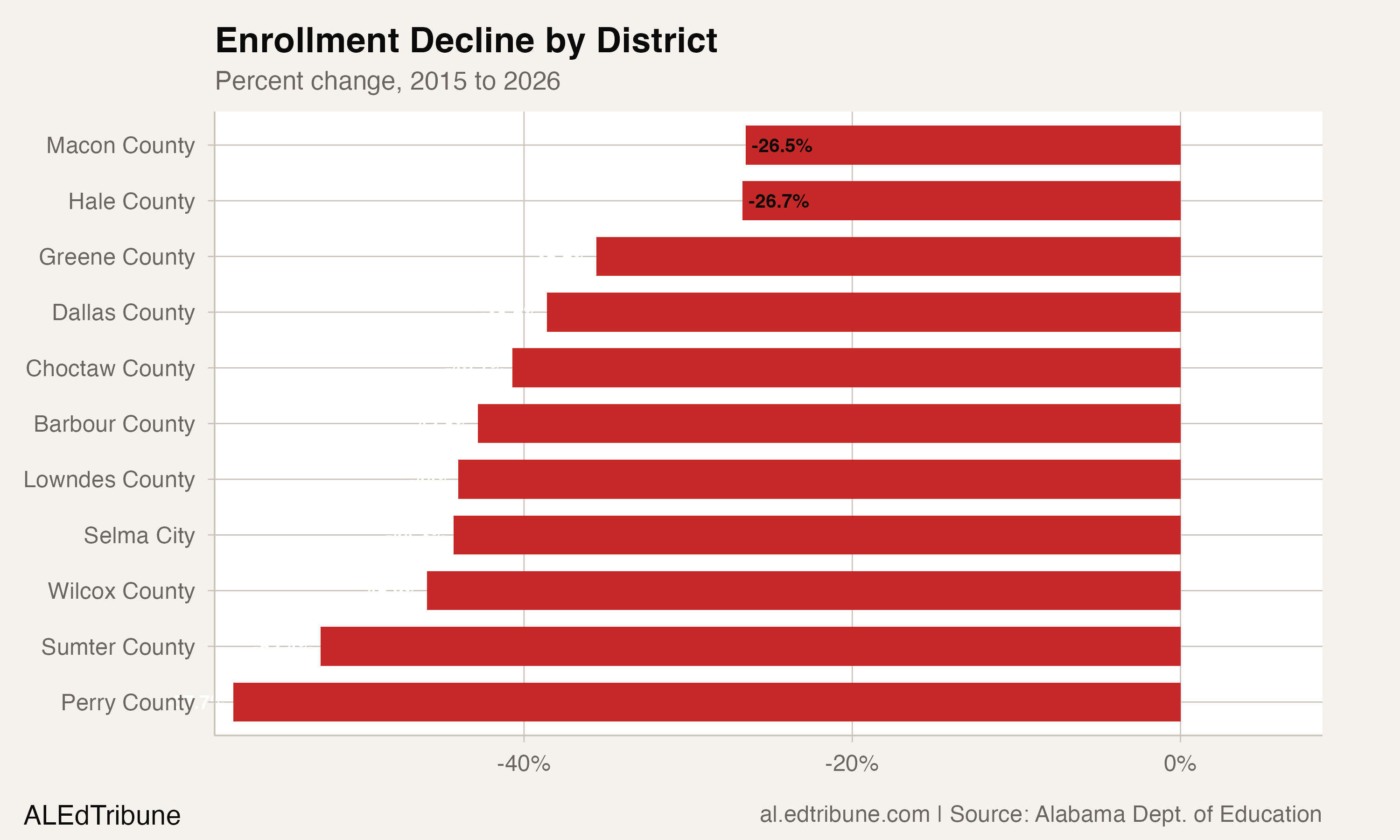
Five of these 11 districts now enroll fewer than 1,000 students. Barbour County↗ET has 537. Perry County has 731. Sumter County and Greene County↗ET each hover just above 800. The median district in this group enrolls 1,007 students, roughly the size of a single large elementary school.
A region emptying from both ends
The enrollment collapse tracks a broader demographic unraveling. Nine of the 10 Alabama counties with the biggest population losses in the 2010s were in the Black Belt. Dallas County, where Selma is located, lost a net 5,000 residents between 2010 and 2020. Perry County's population fell 20% over the same decade, and its median age climbed from 35 to 39.
The mechanism is straightforward: working-age adults leave, and the population that remains skews older and poorer.
"They are positively selected out of the population. They already have higher education, or a skill set that allows them to be mobile." Nyesha Black, University of Alabama demographics director, BirminghamWatch, Jan. 2024
Kenneth Johnson, a sociologist at the University of New Hampshire's Carsey School, put it more bluntly: "The school systems will have to contract because there aren't children anymore to staff all the schools."
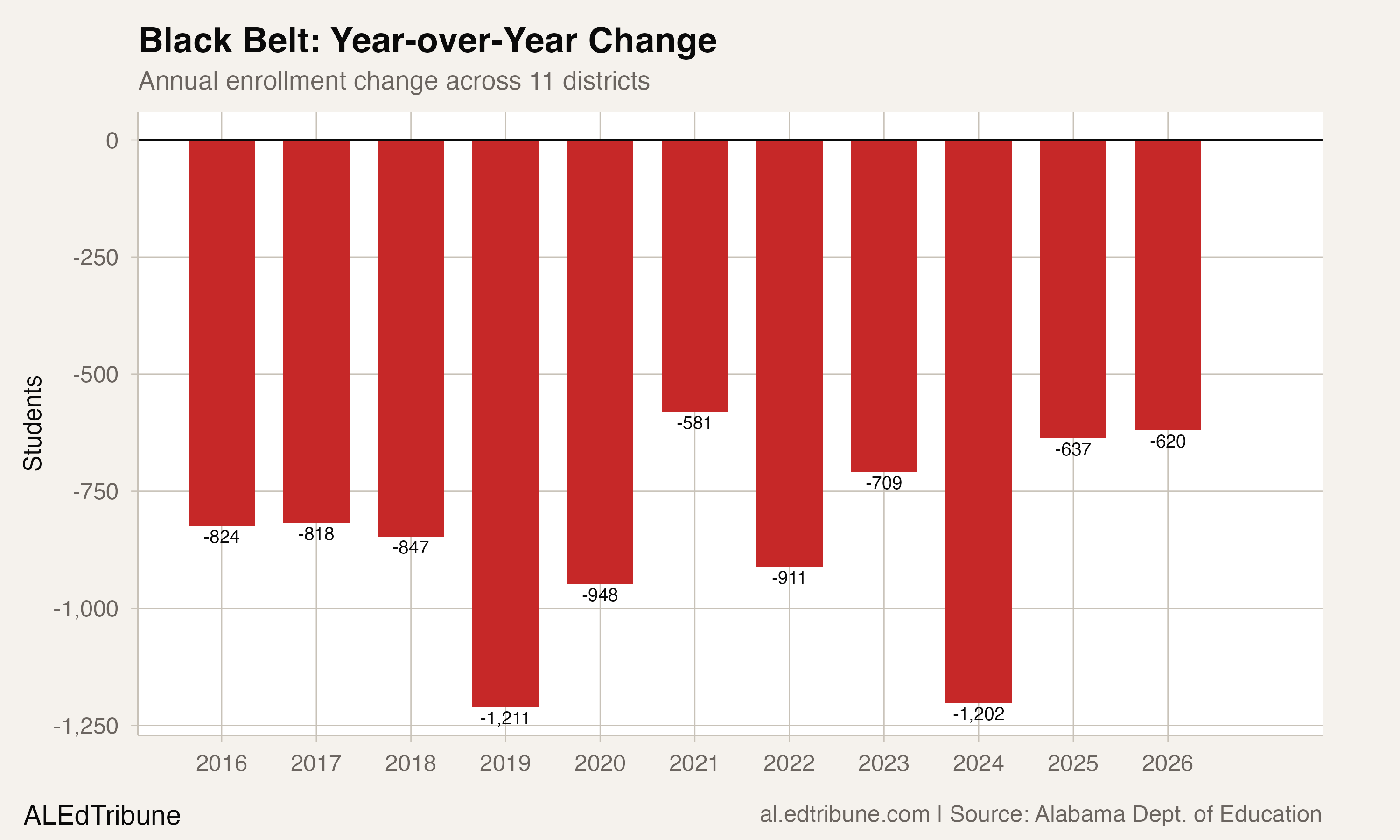
The out-migration is not a new phenomenon. But the enrollment data shows it accelerating. These 11 districts lost 824 students in 2016, 847 in 2018, then 1,211 in 2019. The 2024 loss of 1,202 students was nearly as large. The region has not had a single year of losses below 500 students in the entire data window.
Where the funding formula fails
Alabama's Foundation Program, the state's school funding formula, allocates teacher units based on student headcount: fewer students means fewer units, which means fewer teachers and less money. The formula has been in place for three decades and contains no meaningful weight for poverty, rurality, or the fixed costs of operating a school building regardless of enrollment.
For these districts, where 80% to 92% of students are economically disadvantaged, the formula creates a compounding problem. As students leave, funding shrinks. As funding shrinks, the district can offer fewer programs. As programs disappear, more families leave. Selma City's economically disadvantaged rate stands at 92.4%. Wilcox County: 91.9%. Perry County: 91.0%. Lowndes County: 89.7%. These rates are partly inflated by Community Eligibility Provision, which allows high-poverty districts to classify all students as economically disadvantaged for federal meal programs. But even accounting for that, the underlying poverty in these counties is severe. Perry County's census poverty rate is 35.4%, roughly triple the national average. The funding formula treats these districts almost identically to affluent suburban systems.
Alabama's 2025 RAISE Act began moving the state toward weighted student funding for high-needs students, though advocates say the state remains short of a fully weighted formula. The change adds new support, but it does not erase the fixed-cost problem facing districts that have already lost half their enrollment.
The state is already stepping in
Two of these districts are currently under state intervention. The Alabama State Board of Education took over Sumter County Schools in August 2023, when the district had roughly 990 students. The state is now consolidating all four Sumter County schools onto a single campus, a $14 million construction project. Dallas County Schools followed in March 2025, becoming the third district under state control alongside Sumter and Bessemer City. A state audit had flagged $4.9 million in improperly bid services, and only one-third of students were proficient in English language arts.
Dallas County↗ET has lost 38.6% of its enrollment since 2015, falling from 3,312 to 2,032 students. The state intervention is expected to last about two years.
The gap keeps widening
The indexed comparison between these 11 districts' combined enrollment and statewide enrollment illustrates the divergence. Alabama as a whole has held relatively stable, hovering between 97% and 102% of its 2015 baseline over the past decade. The 11-district group has fallen in a nearly straight line to 59.4% of its 2015 enrollment. The gap between the two trajectories widened every single year.
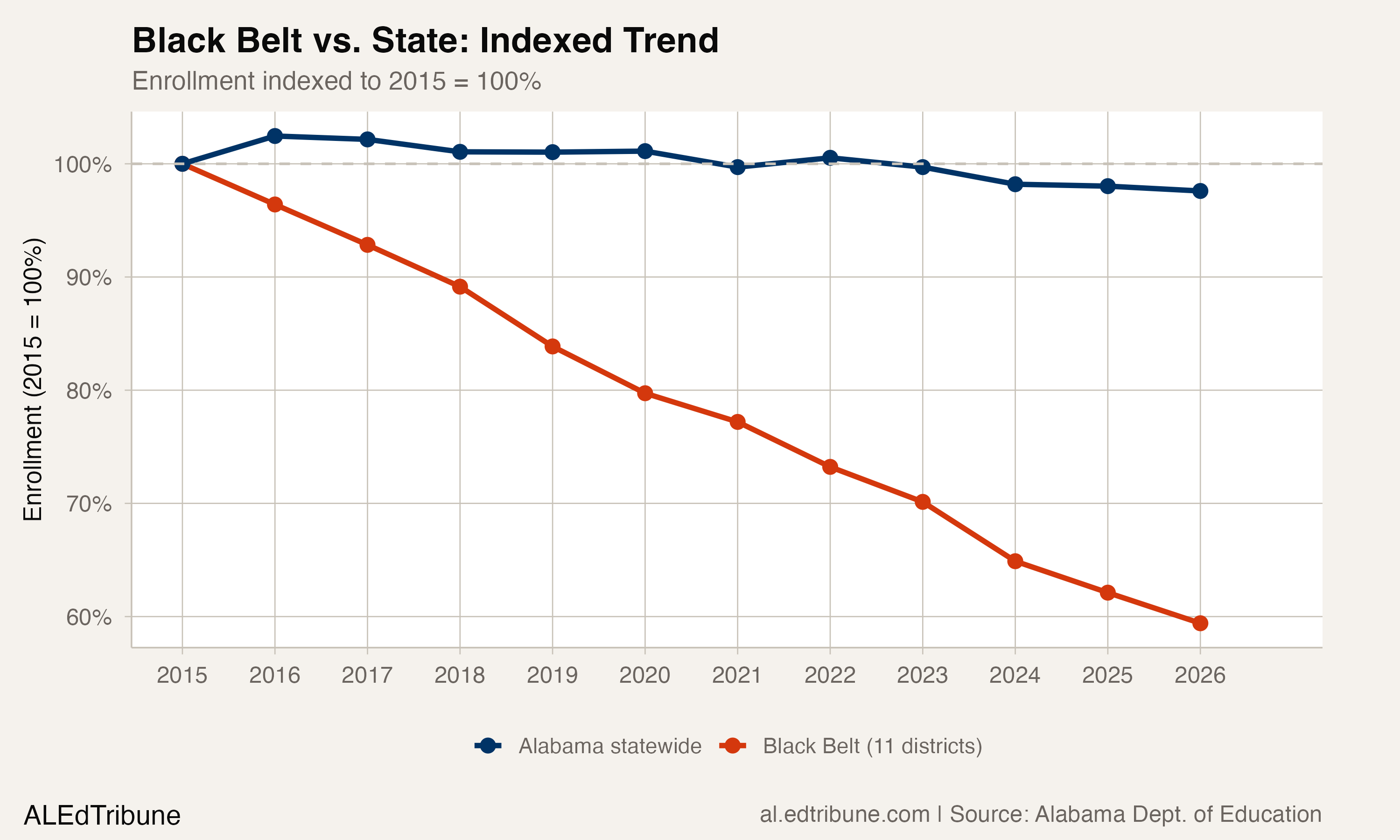
These 11 districts now account for 1.9% of Alabama's total enrollment, down from 3.1% in 2015. Their share has been cut by more than a third. Yet the 9,308 students they lost represent 53.0% of the state's total enrollment decline over that period. More than half of Alabama's net student losses since 2015 have come from a cluster of districts that together enroll fewer students than Huntsville City alone.
What happens next
The CHOOSE Act, Alabama's new voucher-like program, awarded over 23,000 education savings accounts for the 2025-26 school year, totaling more than $124 million. Most recipients were already enrolled in private or homeschool settings, which limits the direct enrollment impact on public schools. But in districts where the nearest private school is 40 miles away, the program offers little practical alternative. It is the districts with the most options that benefit; the ones with the fewest options that pay.
The question for these districts is not whether enrollment will continue to fall. Barring an economic reversal in counties that have been losing population for decades, it will. The question is at what enrollment level a district can no longer function as a district. Barbour County at 537 students is approaching that threshold. Perry County at 731, after losing nearly 1,000 students in 11 years, may cross it before the RAISE Act's weighted-funding changes have enough time to matter. The funding shift is arriving after much of the damage.
Detailed code that reproduces the analysis and figures in this article is available exclusively to EdTribune subscribers.
Discussion
Sign in to join the discussion.
Loading comments...