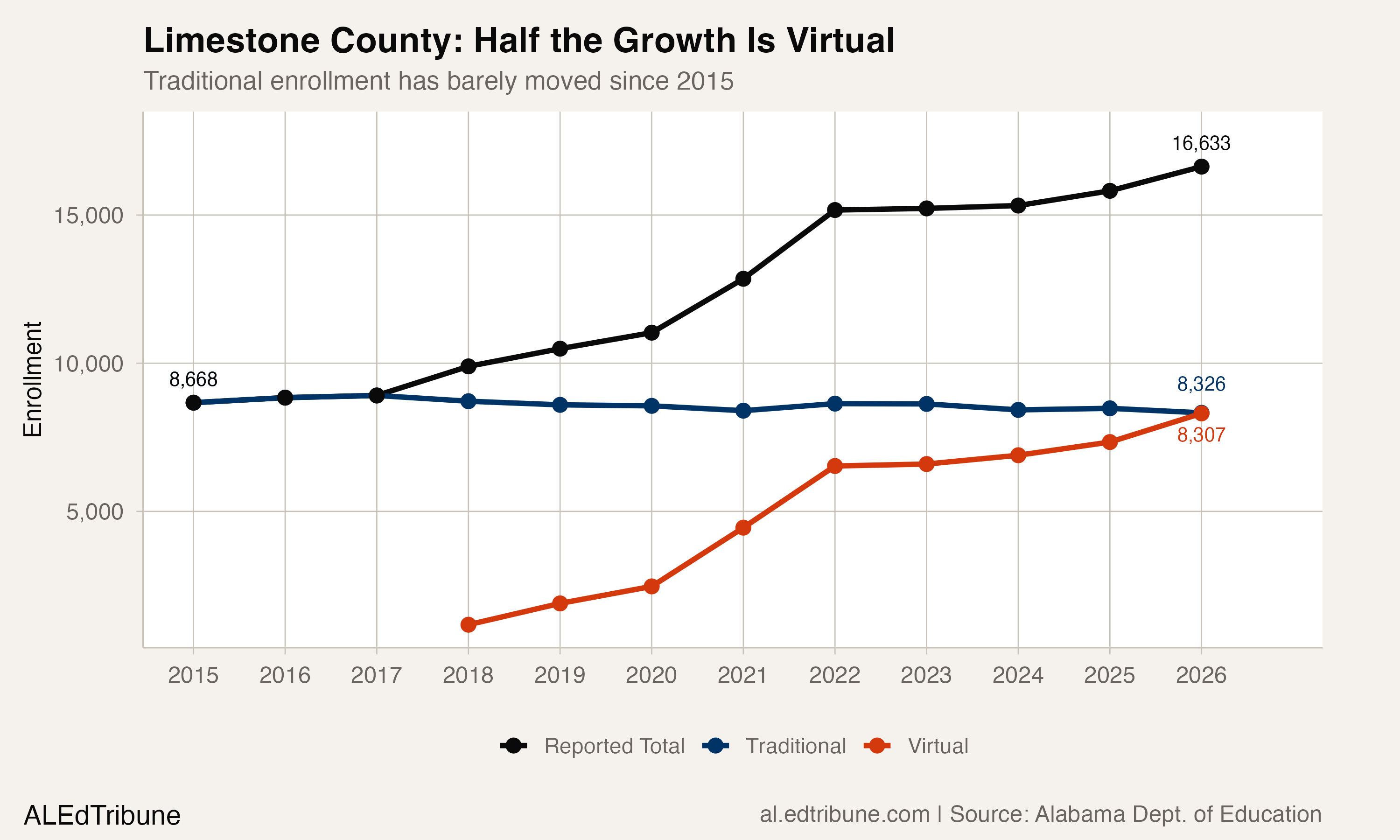
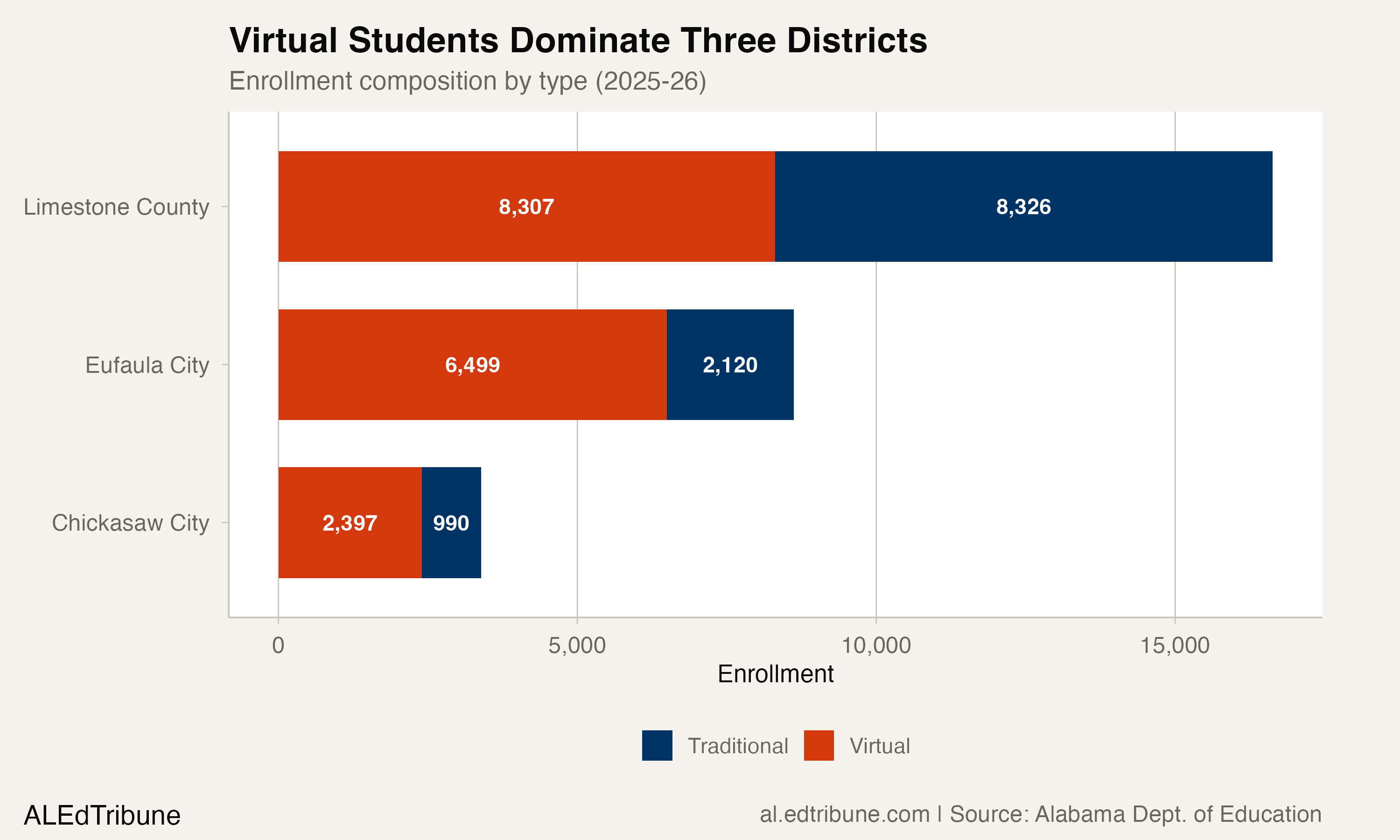
Limestone County↗ET reports 16,633 students in 2025-26, nearly double its enrollment from a decade ago. On paper, it is one of only two Alabama districts with an 11-year unbroken growth streak. But 8,307 of those students have never set foot in a Limestone County school. They attend Alabama Connections Academy, a statewide virtual school operated by Pearson that happens to be administratively housed in the district. Strip out the virtual enrollment, and Limestone County's traditional schools serve 8,326 students, a number that has actually declined by 342 since 2014-15.
The same pattern repeats in two other districts. Eufaula City↗ET reports 8,619 students, up 213.0% since 2014-15. Three-quarters of them are virtual. Chickasaw City↗ET reports 3,387, up 263.0%. More than 70% are virtual. Alabama's three fastest-growing districts by percentage are, in reality, administrative hosts for statewide virtual schools run by two publicly traded corporations.
The 17,203-student question
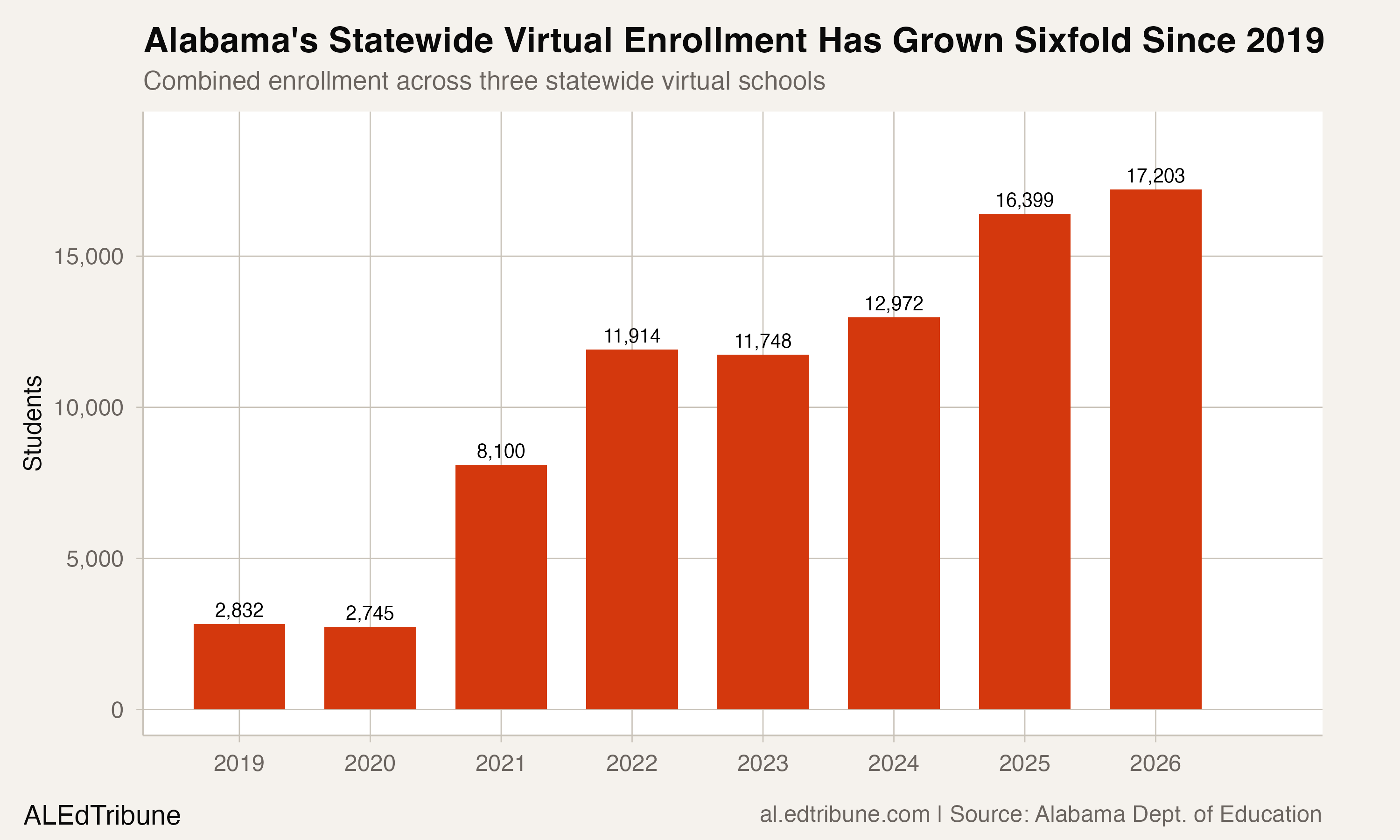
Alabama's three statewide virtual schools collectively enrolled 17,203 students in 2025-26, representing 2.4% of the state's 714,363 total enrollment. That figure has grown sixfold since 2018-19, when only Alabama Virtual Academy at Eufaula reported statewide virtual enrollment of 2,832.
The growth accelerated after COVID-19 normalized remote instruction. Alabama Connections Academy, a Pearson-operated program, first appears in the state enrollment data in 2020-21 with 4,451 students and reached 8,307 in 2025-26. Alabama Virtual Academy, operated by Stride (formerly K12 Inc.), grew from 2,832 students in 2018-19 to 6,499 in 2025-26. Alabama Destinations Career Academy, also a Stride school, first appears in the data in 2021-22 with 1,644 students and has grown to 2,397.
These students attend school from anywhere in Alabama. But because each virtual school is chartered under a local district, the enrollment counts as that district's headcount for state reporting purposes. The result: three small districts carry enrollment figures that bear little relationship to their actual brick-and-mortar student populations.
Who's behind the growth
Both operators are subsidiaries of publicly traded companies. Alabama Connections Academy is a division of Connections Education LLC, part of Pearson, the British education conglomerate. Alabama Virtual Academy and Alabama Destinations Career Academy are programs of Stride Inc., which reported $2.41 billion in revenue for fiscal 2025, a 17.9% increase over the prior year. Stride's Alabama Virtual Academy has seen a 50% enrollment increase over five years, a pace the company characterizes as evidence that families view virtual learning as a "preferred, long-term path."
The virtual charter sector nationally is projected to grow from $5.76 billion in 2025 to $14.41 billion by 2032, a 14% compound annual growth rate. Alabama is one of the states where that growth is most visible.
What the traditional numbers show
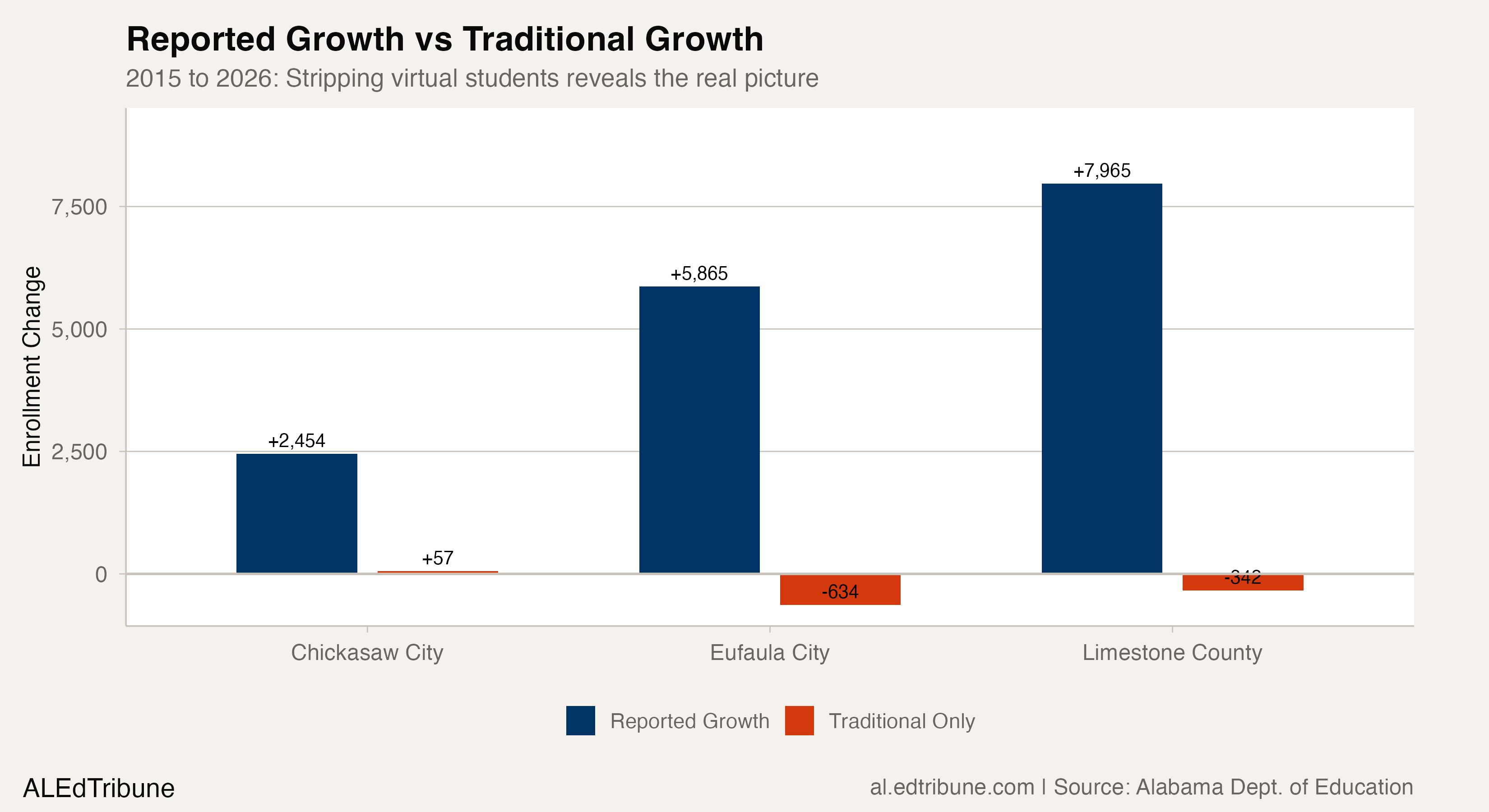
The gap between reported and actual enrollment is stark. Limestone County's reported total grew by 7,965 students since 2014-15. Its traditional enrollment fell by 342. Eufaula City's reported total grew by 5,865. Its traditional enrollment fell by 634. Only Chickasaw City saw any traditional growth at all: 57 students over 12 years.
For Limestone County's 14 traditional schools, enrollment peaked at 8,911 in 2016-17 and has drifted downward since, reaching 8,326 in 2025-26. The trajectory is indistinguishable from many rural Alabama counties. Eufaula City's four brick-and-mortar schools serve 2,120 students, down 23.0% from the 2,754 enrolled before the virtual school arrived. Chickasaw City's four traditional schools serve 990 students, roughly where they were a decade ago.
Statewide, 43 of 135 districts that operated in both 2014-15 and 2025-26 reported enrollment growth. After adjusting for virtual school enrollment, 41 still grew. The virtual distortion does not meaningfully change the statewide count of growing districts. It changes which districts top the list.
A performance gap
The academic question is whether these virtual schools deliver outcomes comparable to the traditional schools whose enrollment they inflate. Available performance data suggests they do not.
Alabama Connections Academy's math proficiency rate is 8%, compared to a state average of 30%. Its reading proficiency is 42%, versus a state average of 47%. The school ranks in the bottom 50% of all Alabama schools for overall test scores. Alabama Virtual Academy at Eufaula shows a similar pattern: 7% math proficiency and 38% reading proficiency.
These proficiency gaps are not unique to Alabama. National research on virtual schools has consistently found lower academic performance than brick-and-mortar counterparts. Whether that reflects the schools themselves, the student population they attract, or both, remains contested. Virtual schools often serve students who struggled in traditional settings, which makes direct comparison difficult.
The accountability question
The structural arrangement raises a tension that Alabama has debated before. The Alabama Association of School Boards warned in 2016 that statewide virtual schools would "pull students and funding from all over the state," circumventing local control protections established in 2015 legislation. The association argued that existing law required local school systems to maintain "protocol for participation, monitoring, test-taking and all of the supports and guidance that is critical for students to succeed."
"National data shows allowing statewide open-enrollment at virtual schools is a bad idea." -- Alabama Association of School Boards, 2016
That warning predated the current scale. In 2016, statewide virtual enrollment was negligible. Today, 17,203 students enroll through three virtual schools, all of them operated by for-profit companies and all of them housed in districts that contribute a fraction of the students they serve. The host districts receive state funding based on total enrollment, including virtual students, while the actual instruction is delivered by the corporate operator.
The new funding formula
Alabama's new RAISE Act, which took effect in June 2025, shifted the state toward weighted student funding that allocates more resources for students in poverty, English learners, and students receiving special education services. How virtual students are weighted under the new formula could reshape the incentive structure for host districts. If virtual students carry lower weights than the specialized populations they often serve, the financial calculus for hosting a statewide virtual school may change.
The more immediate question is whether enrollment data consumers, from state legislators to local school boards to researchers, understand that Alabama's top three growth districts are growth districts in name only. Limestone County's 11-year growth streak is real in the data. It is not real in the hallways.
Detailed code that reproduces the analysis and figures in this article is available exclusively to EdTribune subscribers.
Discussion
Sign in to join the discussion.
Loading comments...