In 2022-23, nearly one in three Mobile County students was chronically absent. Two years later, in 2024-25, it was closer to one in eight.
Alabama's largest school system reduced its chronic absenteeism rate from 31.54% in 2022-23 to 12.81% in 2024-25, an improvement of 18.73 percentage points, cutting the rate by 59.4%. The two-year trajectory (31.54% to 17.91% to 12.81%) is the steepest sustained decline of any Alabama district enrolling more than 10,000 students.
Mobile County's 2024-25 rate is not just approaching pre-COVID levels. It has dropped below them. The district's 2018-19 baseline was 14.44%. At 12.81%, Mobile sits 1.63 percentage points better than where it stood before the pandemic disrupted everything.
From worst to near-average
The scale of the turnaround becomes clearer in context. In 2022-23, Mobile County↗ET's chronic rate of 31.54% made it one of the worst-performing large districts in Alabama, higher than Birmingham↗ET (23.35%), Montgomery County↗ET (26.33%), or Jefferson County↗ET (17.83%).
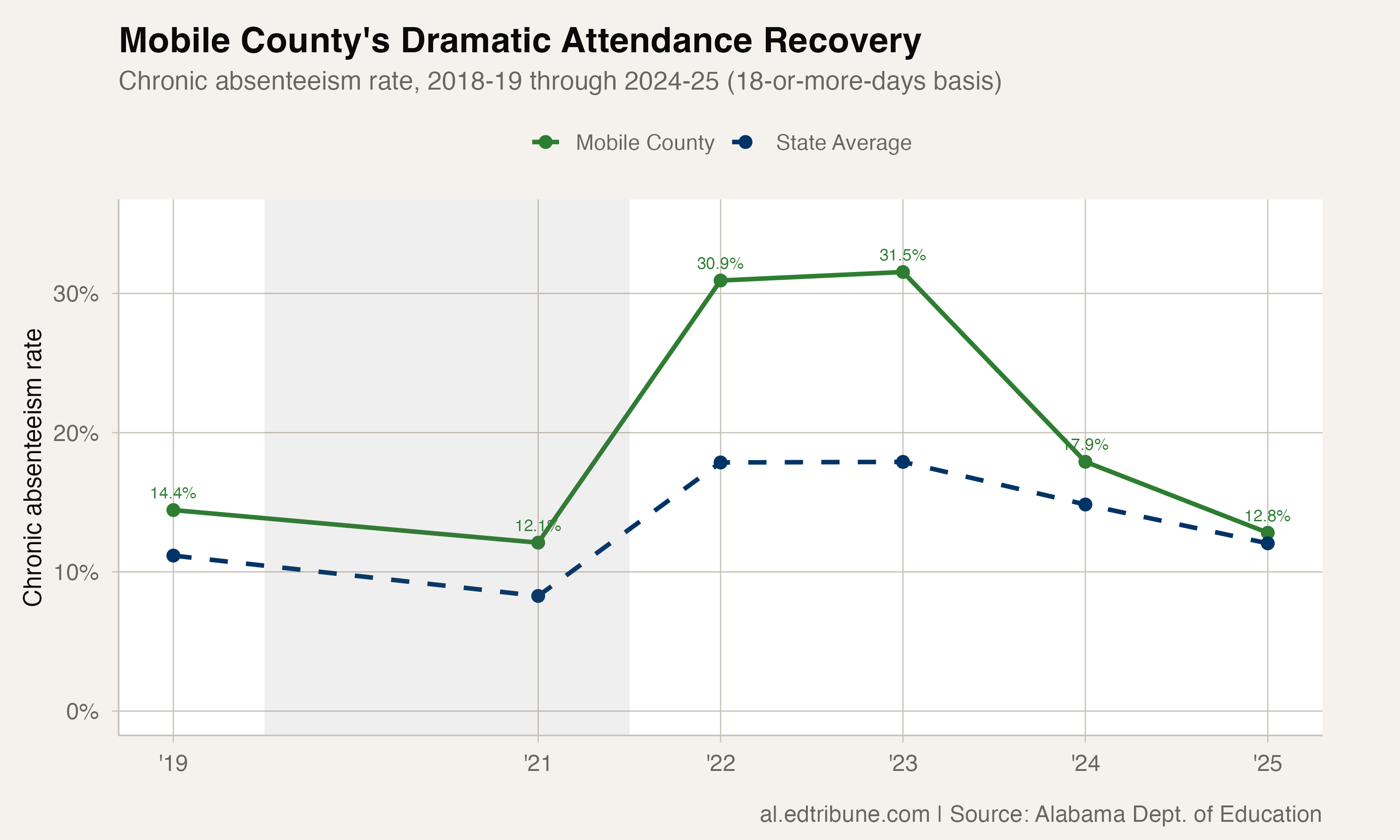
By 2024-25, Mobile sits at 12.81%, just 0.76 percentage points above the state average of 12.05%. A district that was once the attendance crisis of the state is now essentially average.
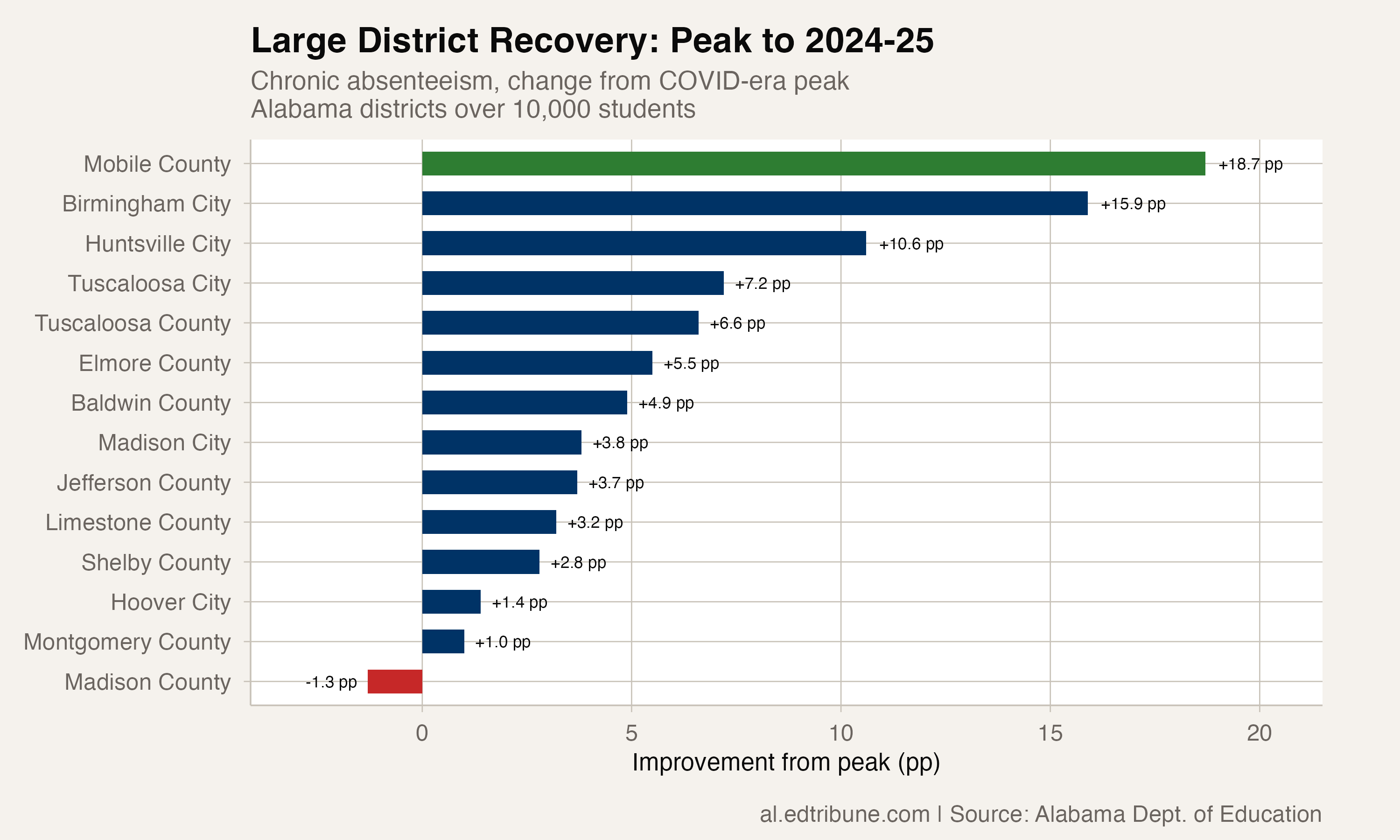
The improvement outpaces what other large districts achieved. Birmingham improved by 15.9 percentage points from its peak, impressive, but still less than Mobile's 18.7. Huntsville City↗ET improved by 10.6 points. Montgomery, by contrast, improved by just 1.0 point.
Every subgroup improved
What distinguishes Mobile's recovery is its breadth. Every major subgroup improved substantially from its 2022-23 level:
Economically disadvantaged students improved the most, dropping 20.5 percentage points (from 35.7% to 15.2%). Black students improved by 20.4 points (33.9% to 13.5%). White students improved by 17.4 points (30.4% to 13.1%).
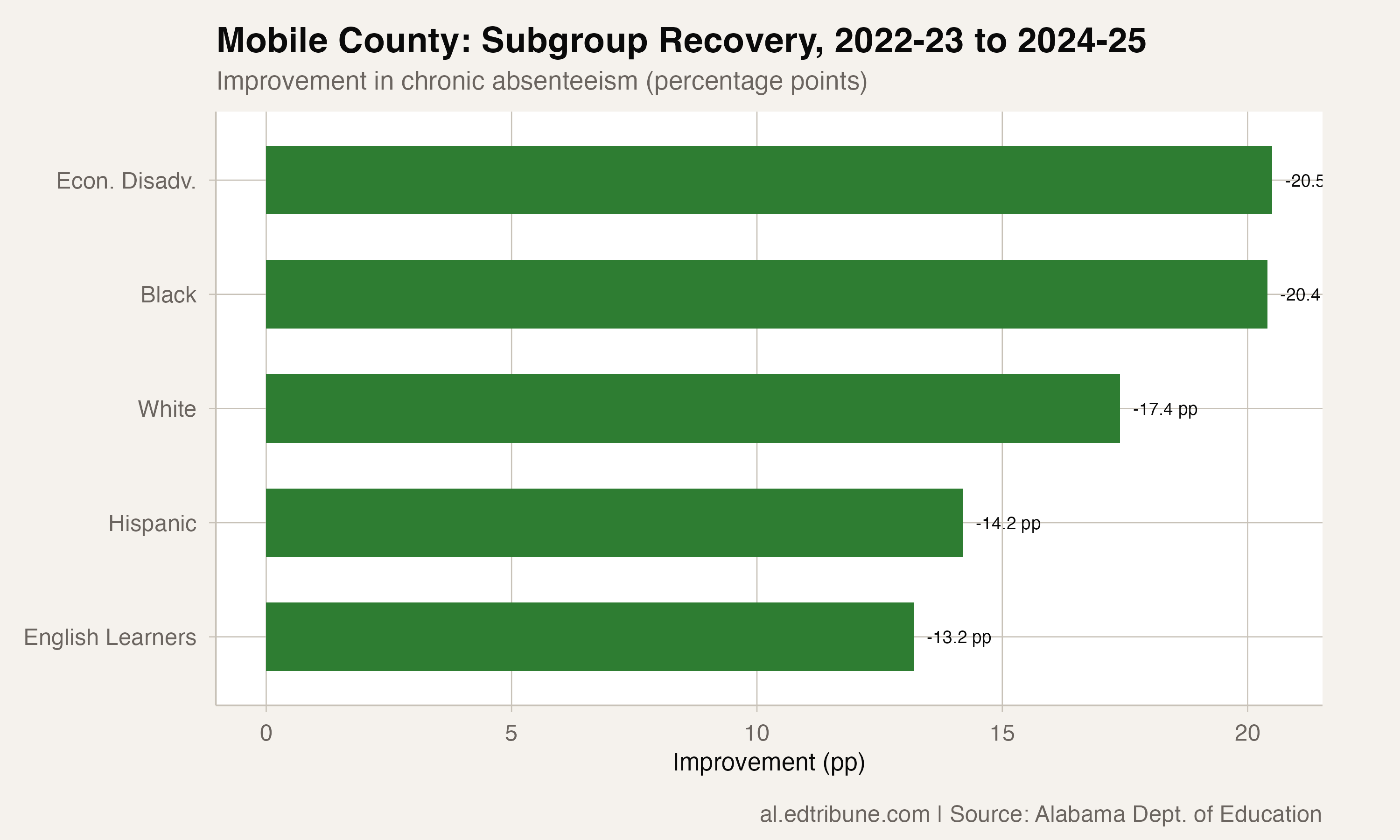
Even English learners, who already had comparatively lower chronic rates, improved by 13.2 percentage points (19.6% to 6.39%). Hispanic students improved by 14.2 points.
Of those five groups, economically disadvantaged and Black students had the highest 2022-23 rates and also posted the largest absolute improvements. Mobile's recovery did not simply ride on its more affluent students getting back to school. The most affected populations participated in the turnaround.
What happened
Mobile's trajectory suggests something more deliberate than a natural regression to the mean. The district's rate was essentially flat from 2021-22 to 2022-23 (30.93% to 31.54%), and it was not gradually improving. Then it dropped 13.6 points in a single year, and another 5.1 the next.
That kind of sharp inflection point typically reflects a policy change, a leadership decision, or a systematic intervention rather than organic drift. Alabama's statewide strategies (the Helping Families Initiative, early warning systems, the shift from punitive truancy enforcement to school-based parent meetings) may have found particularly fertile ground in a large district with the infrastructure to implement them at scale.
The district's size works in its favor. With 47,366 students in 2024-25, Mobile County has the staff, data systems, and administrative capacity to identify chronically absent students early and deploy targeted interventions. Smaller districts in the Black Belt, facing similar or worse rates, often lack these resources.
The remaining gap
At 12.81%, Mobile's chronic absenteeism is not solved: applied to the district's 47,366 students, that rate works out to roughly 6,100 children missing 18 or more days of school in 2024-25. And within the district, subgroup disparities persist. Economically disadvantaged students remain at 15.22%, more than twice the rate of English learners at 6.39%.
But the district has demonstrated something that the broader data only hints at: that a large, high-poverty, majority-Black school system can not only recover from the pandemic attendance crisis, but surpass where it was before. Mobile County's pre-COVID rate of 14.44% was itself unremarkable. Its 2024-25 rate of 12.81% is meaningfully better.
Five of the 14 Alabama systems enrolling more than 10,000 students now sit below their 2018-19 chronic absenteeism rate. Mobile is the one that began the recovery with the highest rate of any of them and finished with the largest drop.
Detailed code that reproduces the analysis and figures in this article is available exclusively to EdTribune subscribers.
Discussion
Sign in to join the discussion.
Loading comments...