Correction (August 16, 2026): An earlier version attributed attendance differences to immigration, family culture, economic conditions and a reported threshold change without evidence that could establish those explanations. Those passages have been removed. The article now reports only findings reproduced from Alabama's published chronic-absence data.
Hispanic students in Alabama miss less school than white students, and they have done so in most years the state has published chronic absenteeism data.
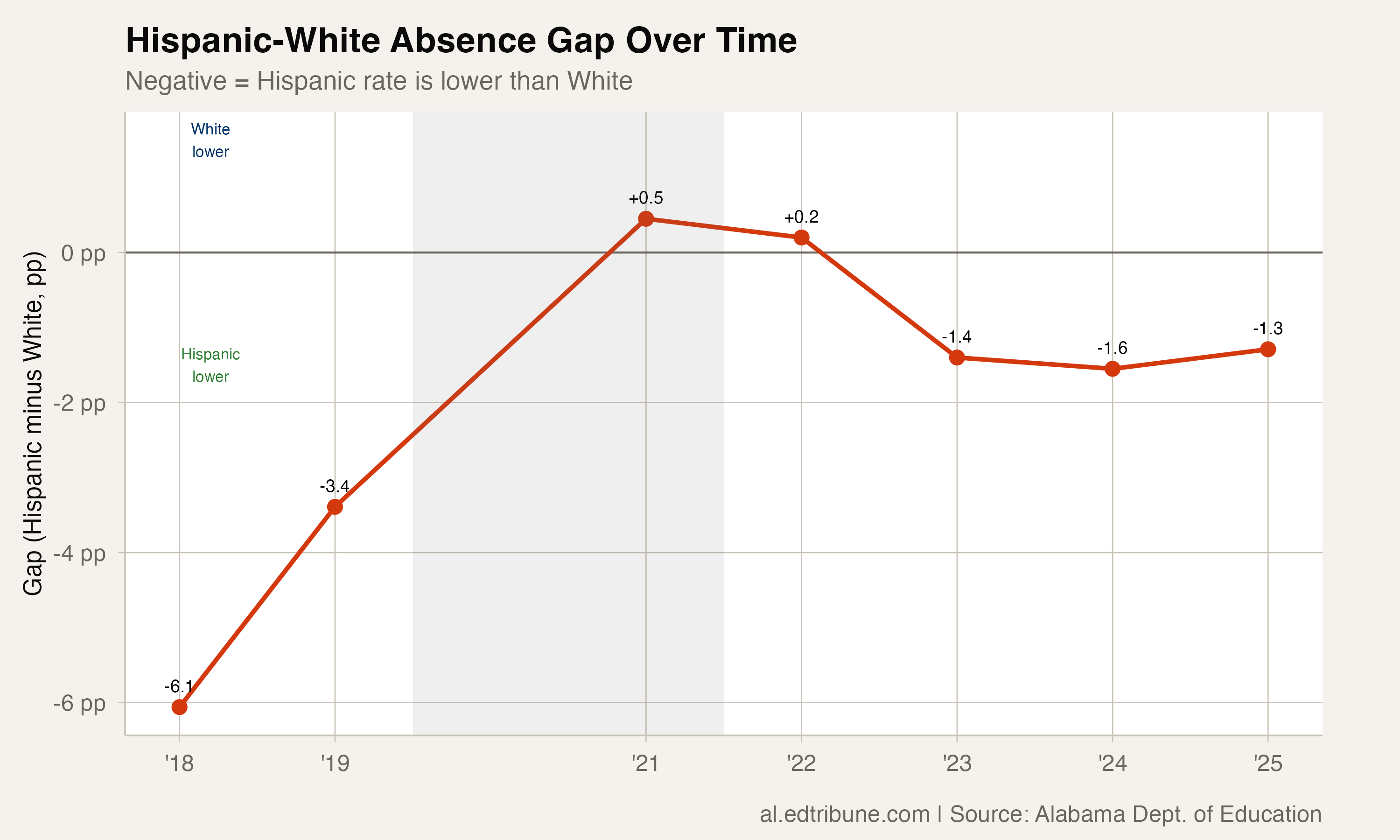
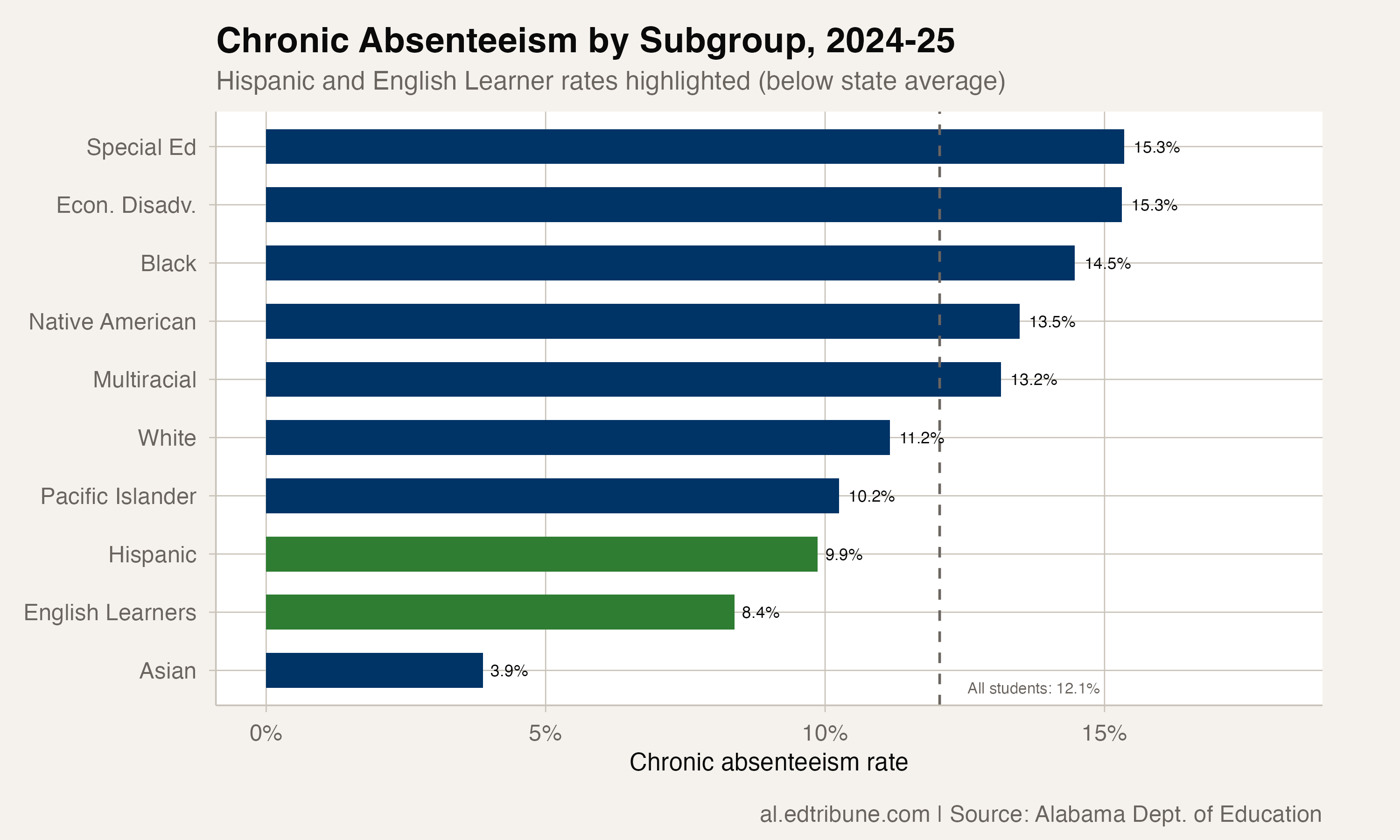
Hispanic students have a chronic absenteeism rate of 9.87% in 2024-25, compared to 11.16% for white students, a gap of 1.29 percentage points in Hispanic students' favor. This is not a one-year anomaly. Hispanic students have had lower chronic rates than white students in five of the seven years Alabama has tracked the data.
The pattern holds at the district level too: in 96 of 132 districts with data for both groups (72.7%), Hispanic students are chronically absent at lower rates than their white peers.
A persistent pattern
The Hispanic-white gap has existed in Alabama's chronic absenteeism data almost from the beginning. In 2017-18, the first year of reporting, Hispanic students' rate was 6.06 percentage points lower than white students'. In 2018-19, the gap was 3.39 points.
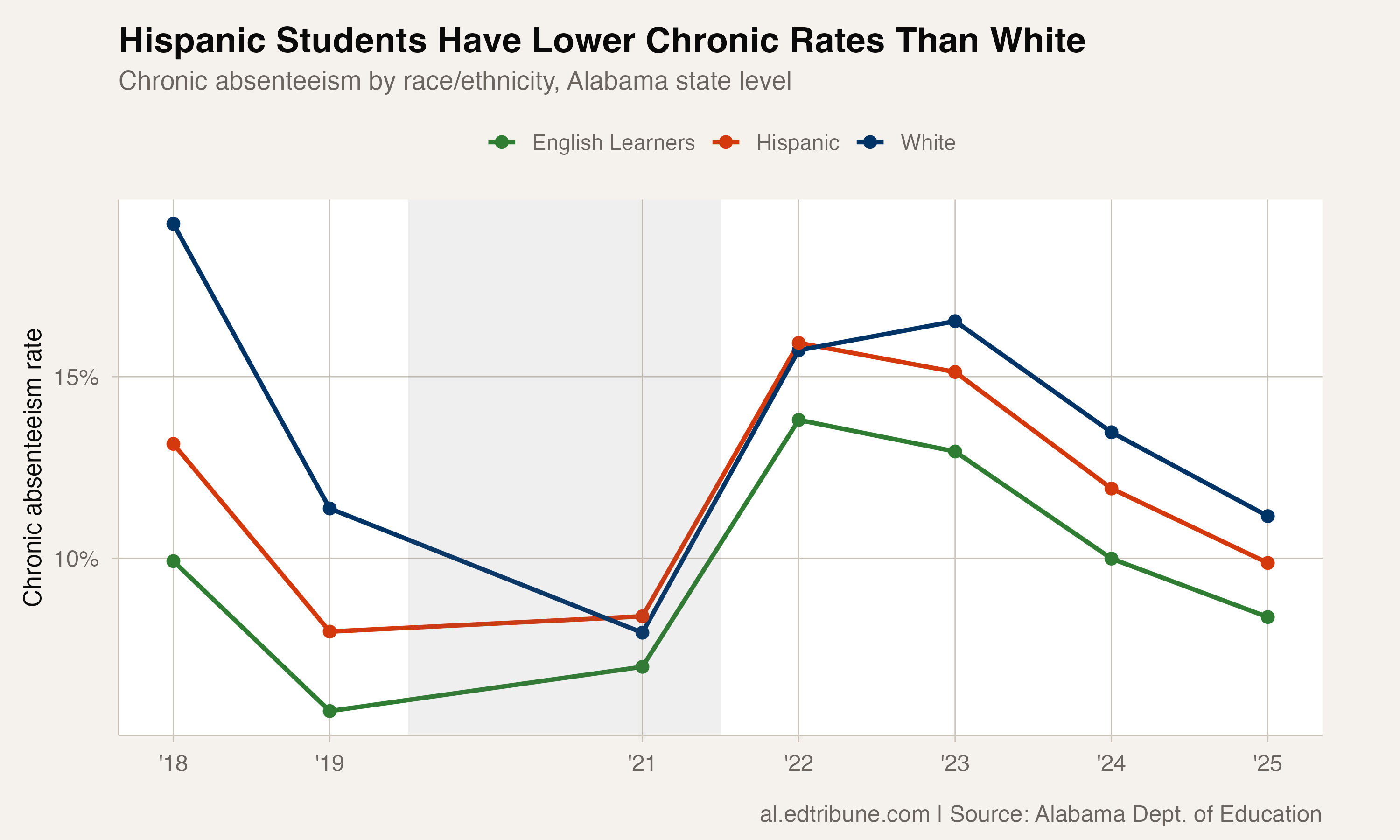
The statewide rate fell from 18.28% in 2017-18 to 11.17% in 2018-19. The published rates alone do not establish what caused that break, so this analysis does not treat it as evidence of a behavioral change.
The pattern reversed in 2020-21 and 2021-22. In 2021-22, Hispanic students' rate was 15.93% while the white rate was 15.73%. By 2022-23, the Hispanic rate was lower again.
English learners, a largely overlapping population, have even lower rates. At 8.38% in 2024-25, English learners are the second-best-attending subgroup in Alabama, trailing only Asian students at 3.88%.
District examples
The statewide pattern appears in several districts with large gaps between the two reported groups. In Albertville, Hispanic students' rate was 12.2% versus 21.9% for white students, a 9.7 percentage-point gap. In Russellville, it was 5.94% versus 15.3%, a 9.3-point gap. Fort Payne reported 6.65% versus 12.3%, and Marshall County reported 2.29% versus 3.87%.
What the data can and cannot say
These are descriptive comparisons, not explanations. The aggregate records show which groups and districts have higher or lower published rates, but they do not identify the causes. Explanations involving language, family circumstances, school practice or local economies remain unresourced by this analysis.
The exceptions
The pattern is not universal. In 35 of 132 districts (26.5%), Hispanic students had higher chronic rates than white students, and in one district the rates were identical. The largest gaps in that direction were in Selma City (+10.5 points), Sheffield City (+9.7), and Macon County (+9.4). In Barbour County, both reported rates exceeded 45%.
But the dominant pattern is clear. In nearly three-quarters of Alabama districts, Hispanic students miss less school than white students, and at the state level they have done so in five of the seven years the state has published chronic absenteeism data.
Chronic absenteeism rates come from the Alabama State Department of Education's school data reports.
Detailed code that reproduces the analysis and figures in this article is available exclusively to EdTribune subscribers.
Discussion
Sign in to join the discussion.
Loading comments...