Correction: An earlier draft described the observed reporting span as the last four school years. This version names the years and treats 2024-25 as the most recent published data.
Montgomery County's chronic absenteeism rate fell 3.25 percentage points in 2024-25. Its 25.29% rate remained the highest among Alabama districts enrolling more than 10,000 students, and it has been above 25% in each of the four reporting years from 2021-22 through 2024-25.
The district's rate stood at 25.29% in 2024-25, more than double the statewide 12.05%. That is down from 28.54% the year before, an improvement of 3.25 percentage points that slightly outpaced the state's 2.79-point improvement over the same year. Across those four reporting years, the endpoint changed by 0.53 points, while the annual rates varied: 25.82% in 2021-22, 26.33% in 2022-23, 28.54% in 2023-24, and 25.29% in 2024-25, a net change of about half a percentage point.
Elsewhere the change has been much larger. Mobile County↗ET went from 30.93% to 12.81%, a drop of 18.1 points. Birmingham City↗ET fell 15.9 points, to 13.16%. Huntsville City↗ET is now at 8.23%, below the 11.41% it recorded in 2018-19.
The widening gap
Before the pandemic, Montgomery County↗ET's attendance figures were close to the statewide picture. Its 2018-19 rate of 11.95% sat 0.78 points above the state's 11.17%.
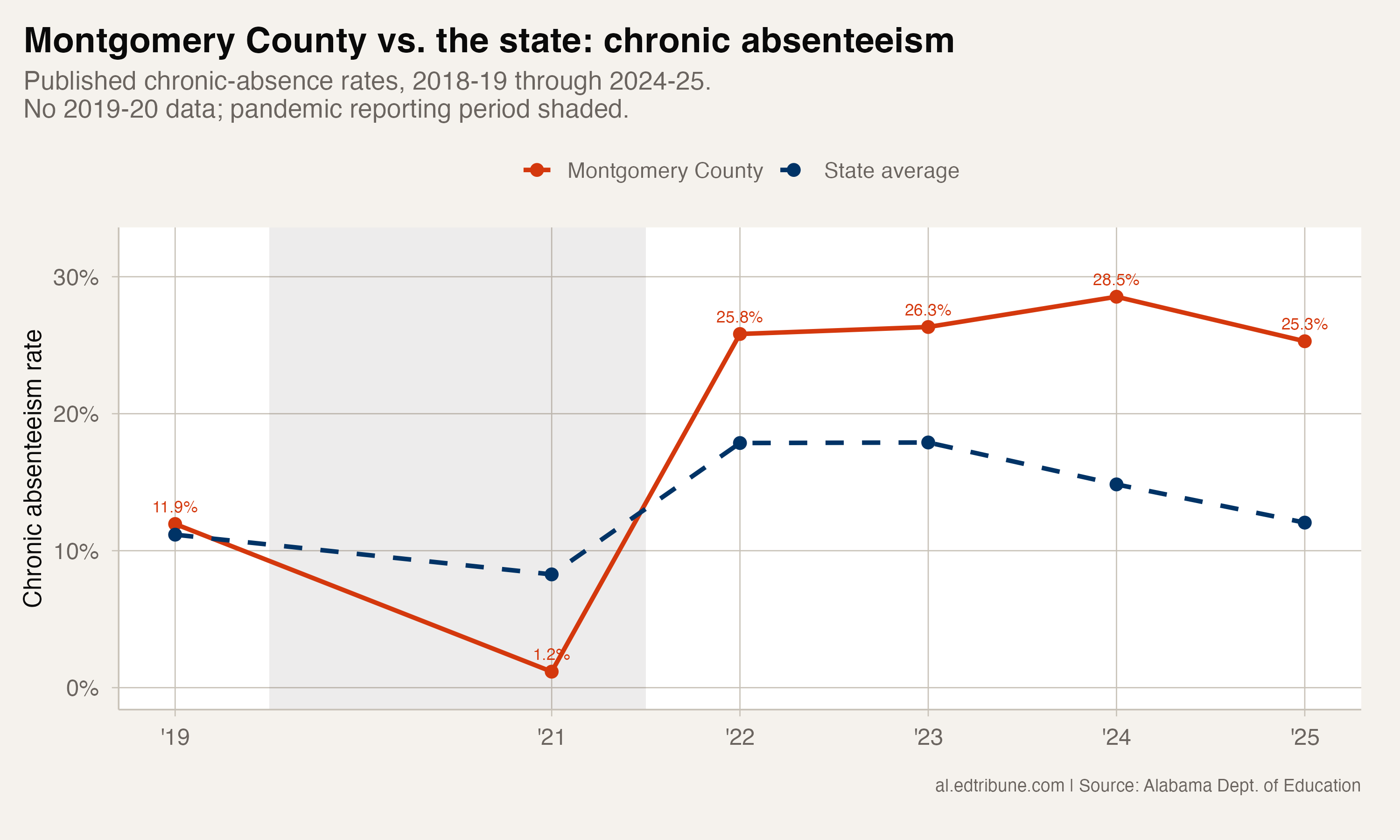
Chronic absenteeism rose sharply across Alabama in 2021-22. Montgomery's rate reached 25.82%, but so did Mobile's (30.93%) and Birmingham's (29.09%). The difference is what came next.
The gap between Montgomery and the state has widened from 0.78 points in 2018-19 to 13.24 points in 2024-25. Montgomery's rate is now more than twice the statewide figure, a disparity that did not exist before the pandemic.
This comparison begins in 2018-19. Alabama does not publish a 2019-20 figure in the data used here, and the panel resumes with 2020-21.
Among large districts
Fourteen Alabama districts enrolled more than 10,000 students in 2024-25. Montgomery has the highest chronic absenteeism rate of the fourteen, at 25.29%, more than 8 points clear of the next highest, Jefferson County↗ET at 16.97%.
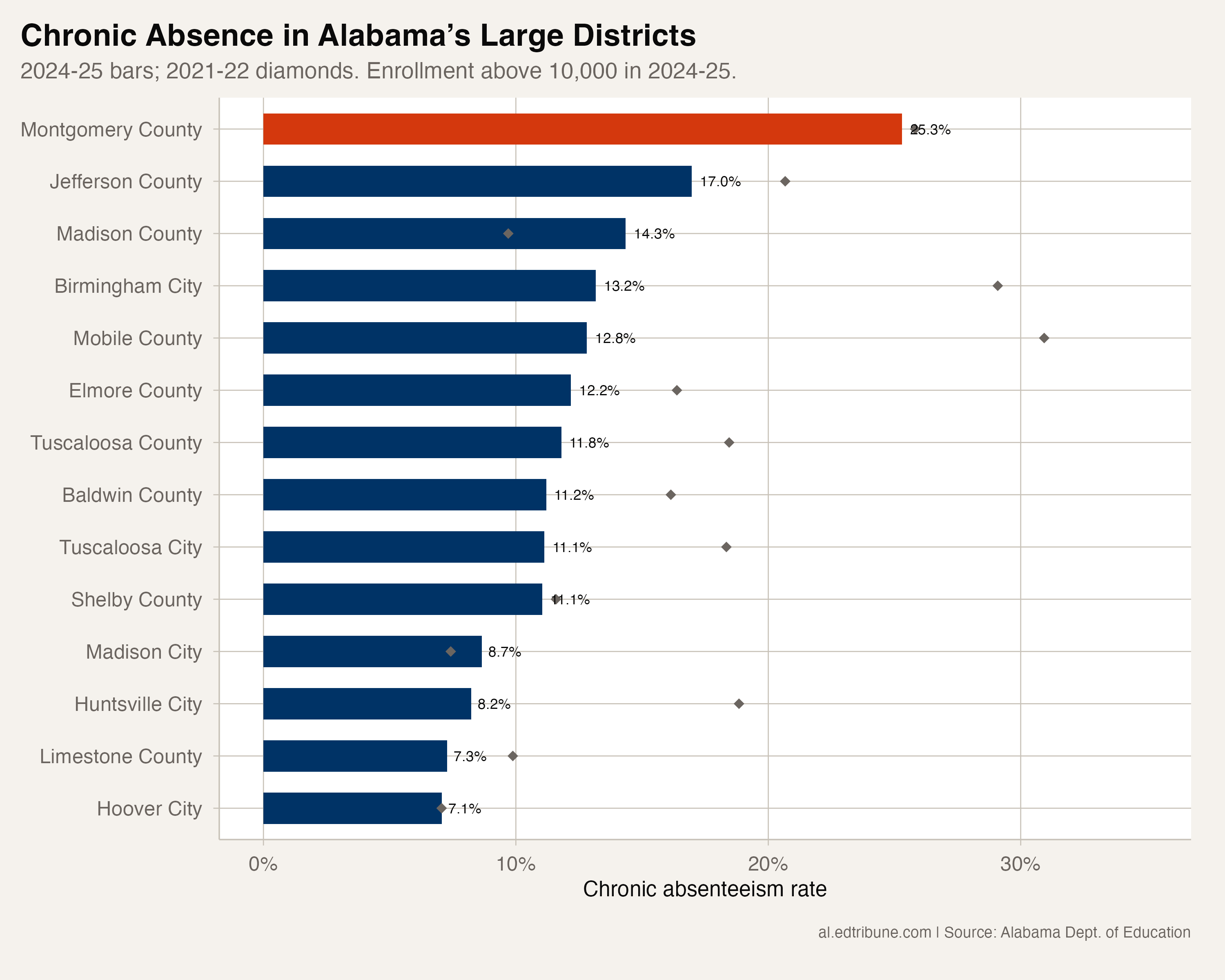
Montgomery is also furthest from its own pre-pandemic level. It sits 13.34 points above its 2018-19 rate. The next largest such gap belongs to Jefferson County, at 6.50 points, and nine of the fourteen remain above where they were in 2018-19.
Nine of the fourteen large districts remained above their own 2018-19 rates in 2024-25, so recovery was uneven across the comparison group.
Those comparisons start from very different places. Shelby County↗ET's 0.54-point decline began at 11.59%, near the state average at the time. Madison County↗ET rose from 9.70% to 14.35%, which is still nearly 11 points below Montgomery's level. Montgomery began the span at 25.82%.
Inside the numbers
Within Montgomery, chronic absenteeism varies widely from one student group to another.
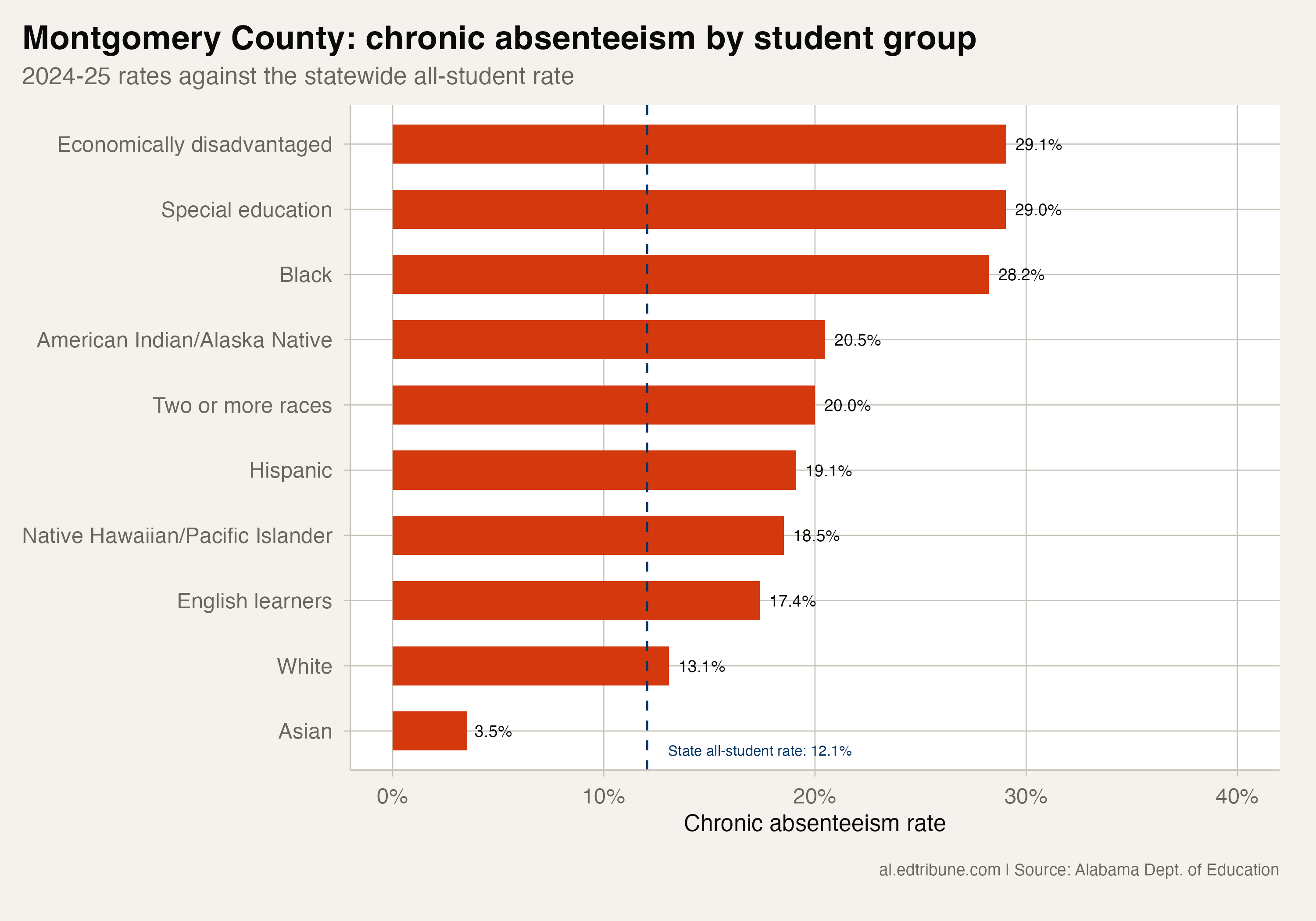
Students who are economically disadvantaged and students who receive special education services share the highest rate, both at 29.0%. Black students are at 28.2%. Nine of the ten student groups the state reports separately for Montgomery sit above the statewide all-student rate of 12.05%, including white students at 13.1% and English learners at 17.4%. The exception is Asian students, at 3.5%, who are below both the state's all-student rate and the state's rate for Asian students of 3.9%.
The published rates are elevated across several student groups. These outcome data do not establish a cause.
Thirteen percentage points above pre-pandemic
Montgomery County sits 13.34 percentage points above its 2018-19 rate of 11.95%. Statewide, the corresponding figure is 0.88 points.
The state improved by 2.79 points from 2023-24 to 2024-25. Montgomery improved by 3.25 points during that interval, but its published rate remained 13.34 points above its 2018-19 level.
Chronic-absence rates come from the Alabama State Department of Education’s Federal Report Card.
Detailed code that reproduces the analysis and figures in this article is available exclusively to EdTribune subscribers.
Discussion
Sign in to join the discussion.
Loading comments...