In Linden City↗ET, the eighth grade class has 19 students. Five of the district's 13 grade levels have fewer than 30. The entire system enrolls 399 children, down 27.8% from 553 a decade ago.
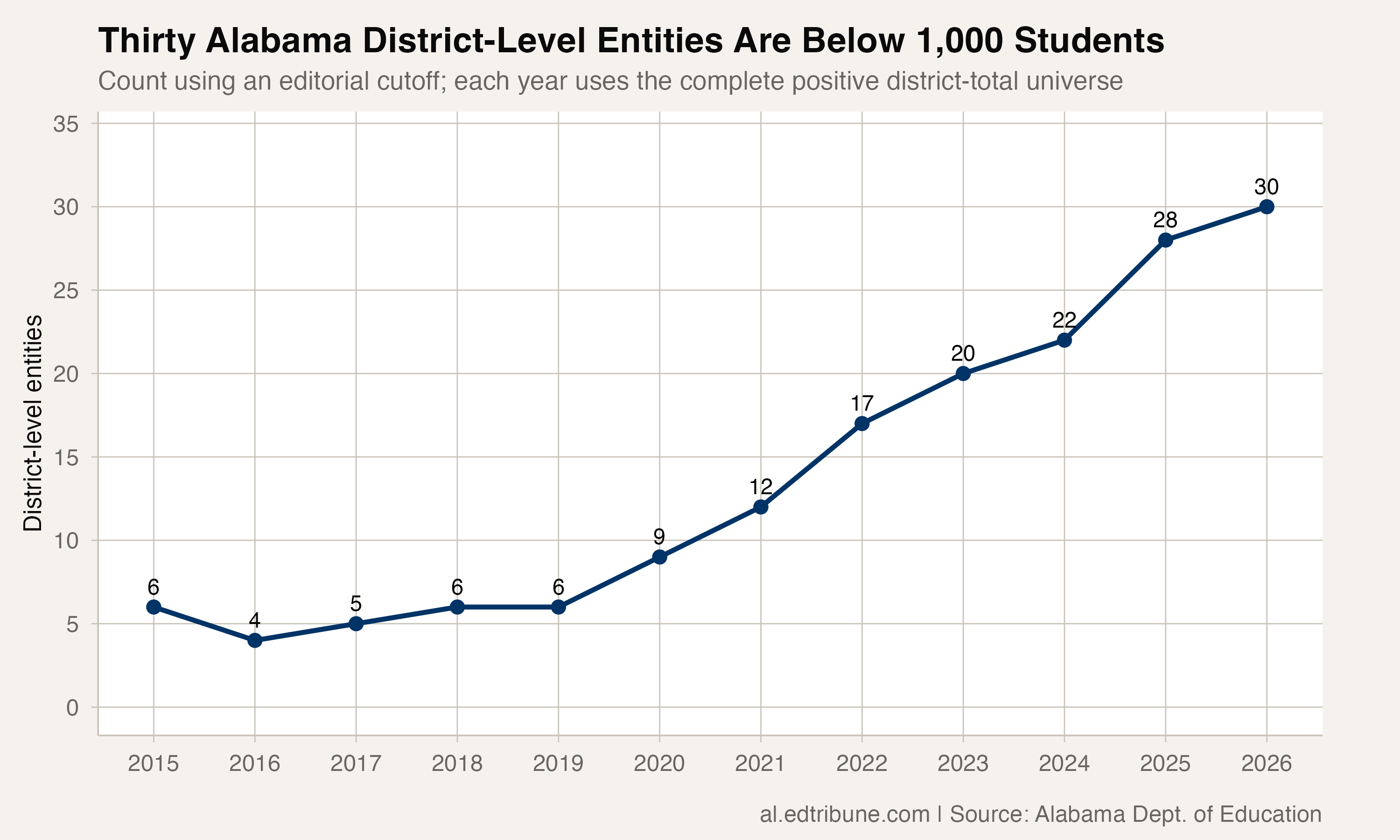
Linden is not alone. Thirty Alabama districts now enroll fewer than 1,000 students, nearly one in five statewide. A decade ago, the count was six.
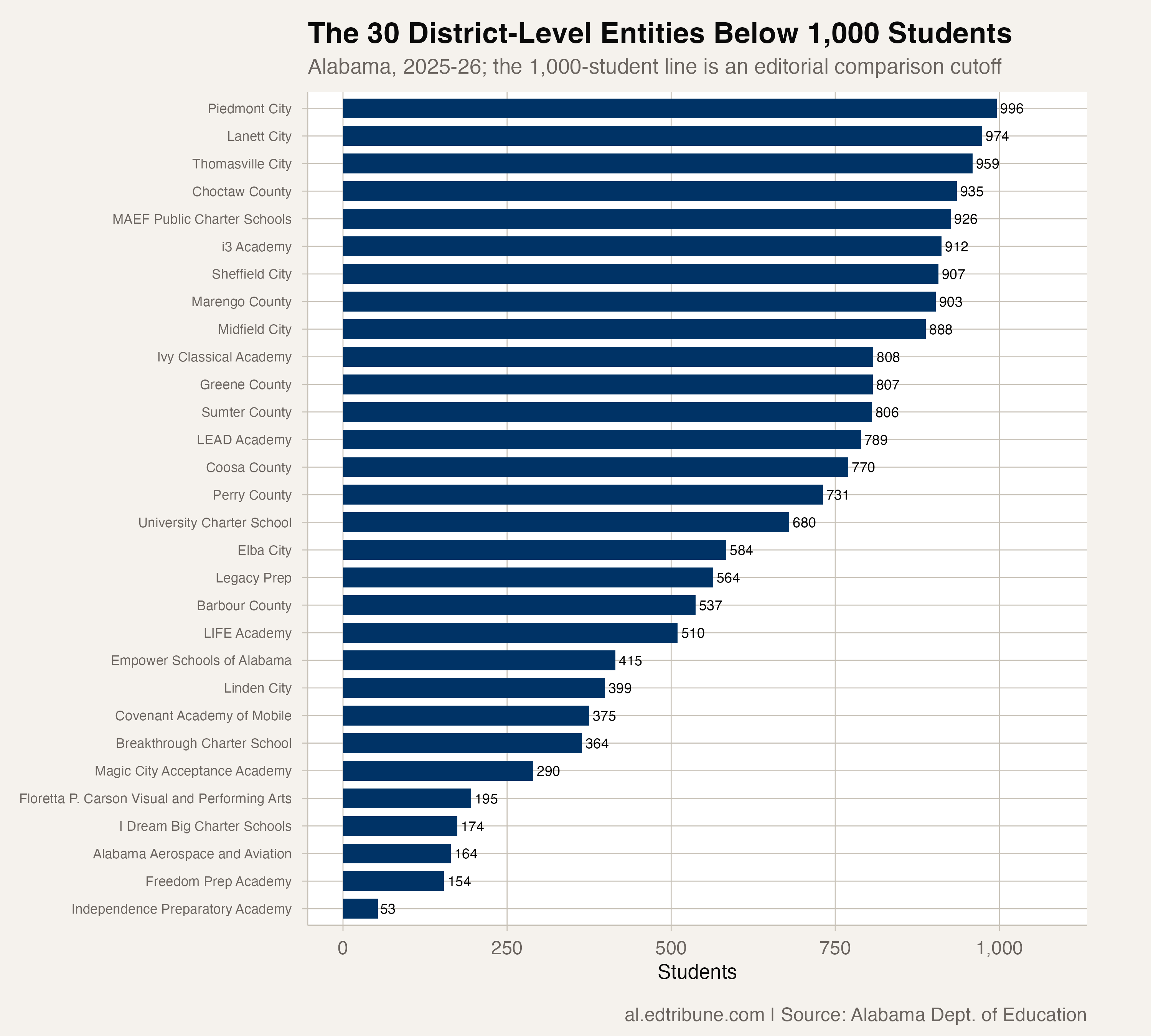
The number is misleading in one direction: 16 of the 30 are charter schools or specialty academies, most of them recently opened and still scaling up. But strip those out and the picture is worse, not better. The remaining 14 are legacy districts, traditional county and city systems that have been losing students for years and are approaching the enrollment levels where maintaining a full K-12 program becomes structurally difficult.
The count keeps growing

In 2014-15, six Alabama districts had fewer than 1,000 students. By 2019-20, the count had risen to 10. Then the growth accelerated: 17 in 2021-22, 23 in 2023-24, 30 in 2025-26. The share of all districts below 1,000 climbed from 4.4% to 19.4% over the same span.
Part of this is arithmetic. Alabama has added 19 new district-level entities since 2015, nearly all charter schools and specialty academies. These start small by design. But part of it is legacy systems shrinking past thresholds they once sat comfortably above.
Ten districts that were above 1,000 students in 2014-15 have since fallen below. Perry County↗ET, which enrolled 1,730 students in 2015, now has 731, a 57.7% loss. Sumter County↗ET dropped from 1,695 to 806, down 52.4%. Choctaw County↗ET fell from 1,577 to 935, losing 40.7%.

What 399 students looks like
The 14 legacy districts below 1,000 collectively enroll 11,196 students, down from 16,241 in 2015, a 31.1% decline. Their average enrollment has fallen from 1,160 to 800.

At the bottom of the list, Linden City's 399 students are spread across 13 grades. The median grade has 32 students, roughly the size of a single classroom. Barbour County↗ET enrolls 537, down 42.8% from 938 in 2015. Elba City↗ET has 584. These are enrollment levels where every departure is felt: a family that moves costs a grade level 3% to 5% of its students.

Six of the 14 legacy districts sit in Alabama's Black Belt, the arc of majority-Black, high-poverty counties stretching across the state's midsection. Perry, Sumter, Greene↗ET, Barbour, Marengo↗ET, and Lowndes↗ET counties have all been losing students for over a decade, driven by the same forces that have hollowed out these communities more broadly: population out-migration, an aging demographic base, and limited economic opportunity.
"When we have students who leave or parents who move away for better job opportunities, that does cause a strain on the district because those funds leave with those students." -- BirminghamWatch, Jan 2024
In Sumter County, 89% of students are economically disadvantaged compared to 65% statewide. Perry County's population fell 20% between 2010 and 2020, and its total population is now just a third of what it was in 1940. When few families move in to replace those who leave, the enrollment math becomes inescapable.
The mismatch between districts and dollars
Alabama's Foundation Program, the state's primary K-12 funding mechanism, has operated on essentially the same framework for three decades. The formula allocates resources based on student counts to determine staffing "units," an approach that Rep. Danny Garrett has described as: "Here's the money. Here's how you have to spend it for these units."
For a district like Linden City, with a median grade size of 32, the formula generates roughly one teaching unit per grade. But a school still needs an administrator, a counselor, a librarian, maintenance staff, and utilities whether it has 400 students or 4,000. Many operating costs, including building maintenance, administration, and utilities, remain fixed regardless of enrollment, making it structurally difficult to scale down proportionally when students leave.
The RAISE Act, signed in 2025, began layering student-weighted funding on top of the Foundation Program. The law directed $166 million in its first year toward students in poverty, special education, and English learners. For small districts with high concentrations of these populations, the additional per-student dollars could matter. But $166 million spread across a $5.4 billion system is a supplement, not a structural fix for districts whose core challenge is a shrinking student base.
The next 17
The current count of 30 districts below 1,000 may grow. Seventeen districts with enrollment between 1,000 and 1,500 are currently declining. Wilcox County↗ET, at 1,012 students, has lost 23.1% in four years. Fairfield City↗ET, at 1,175, is down 23.7% since 2022. Talladega City has 1,378, a 19.8% four-year decline. Lowndes County sits at 1,007 students, 12 above the threshold.

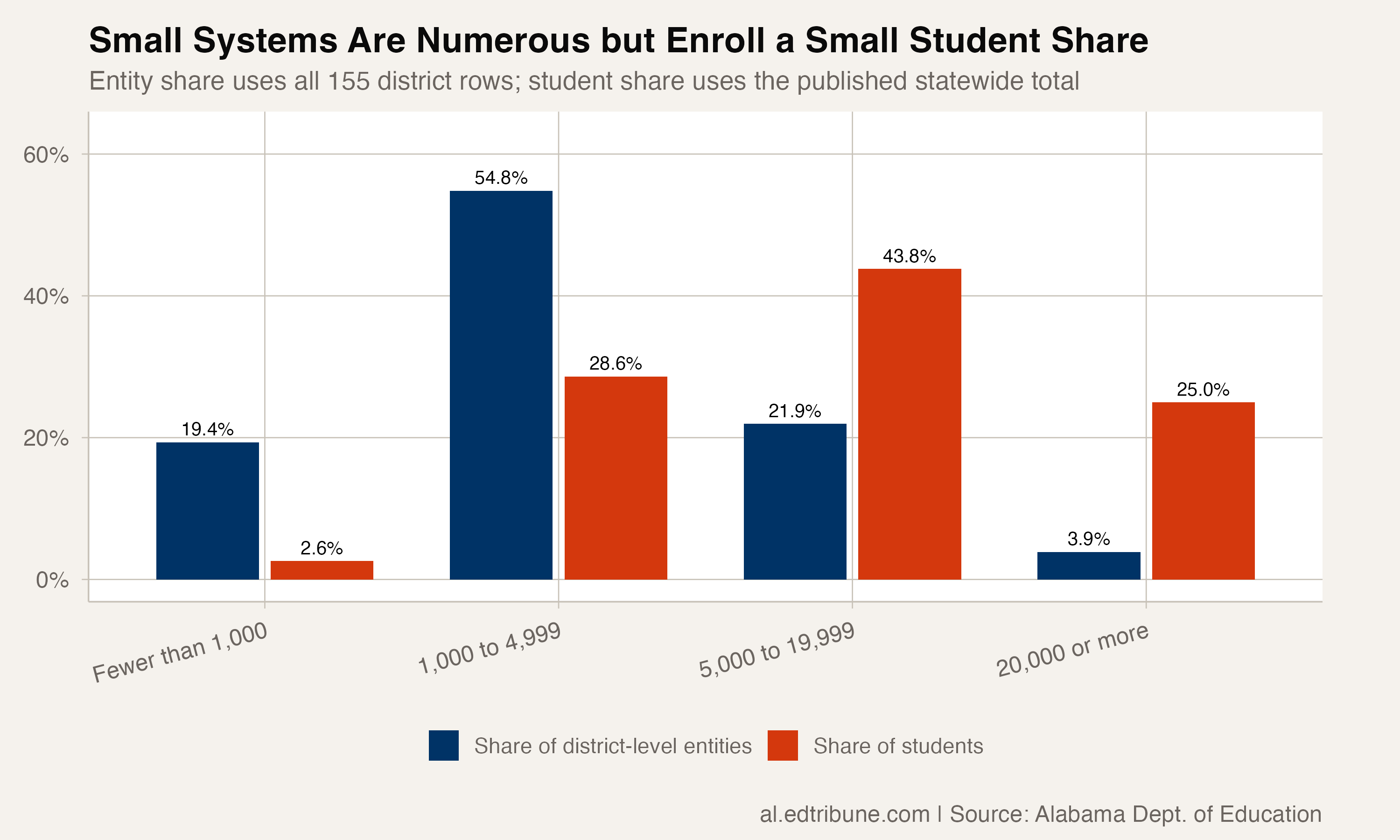
The distribution chart reveals the structural imbalance: 30 districts (19.4%) serve fewer than 1,000 students but account for just 2.6% of statewide enrollment. At the other end, six districts with 20,000 or more students enroll 25% of all Alabama students. The system is fragmented at the bottom and concentrated at the top.
Not all small districts are the same
It matters that 16 of the 30 small districts are charter schools and specialty academies. Independence Preparatory Academy (53 students), Freedom Prep Academy (154), and Alabama Aerospace and Aviation (164) are new entrants whose small size reflects their stage of development, not decline. Several have been open for only a few years. LEAD Academy, at 789 students, is one of Alabama's larger charter operations.
The charter districts' median enrollment is 395 students. The legacy districts' median is 848. Both sit below 1,000, but the trajectories point in opposite directions: charters are generally adding students while legacy systems are losing them.
Among the legacy group, one district bucks the trend: Lanett City↗ET has grown 10.6% since 2015, from 881 to 974 students. Coosa County↗ET also posted a modest rebound in 2026 (up 80 students to 770 after years of decline), though whether that holds remains to be seen.
What comes next
Alabama does not have a history of forced school district consolidation, and the political barriers are substantial. County and city school systems carry deep local identity, especially in the Black Belt, where public schools are often the largest employer and the center of community life.
The question is whether districts like Linden City, with 19 eighth graders, or Barbour County, with a median grade of 40 students, can sustain the breadth of programming that K-12 education requires: not just core academics but electives, advanced courses, extracurriculars, and the counseling and support services that high-poverty student populations need. At some point, the enrollment math does not add up, regardless of per-pupil funding levels.
The 2026-27 kindergarten cohort will determine whether the current trajectory continues. If it does, Alabama could have 35 or more districts below 1,000 within two years. Each one will face the same calculus: how thin can a school system stretch before it can no longer deliver what students are entitled to receive?
Detailed code that reproduces the analysis and figures in this article is available exclusively to EdTribune subscribers.
Discussion
Sign in to join the discussion.
Loading comments...