Alabama Graduation Rates: Nine RecordsET · 2023 CrashET · BirminghamET · Foster Care · CCR GapET
In 2025, nine Alabama student subgroups set all-time graduation rate records. Students in foster care moved in the opposite direction.
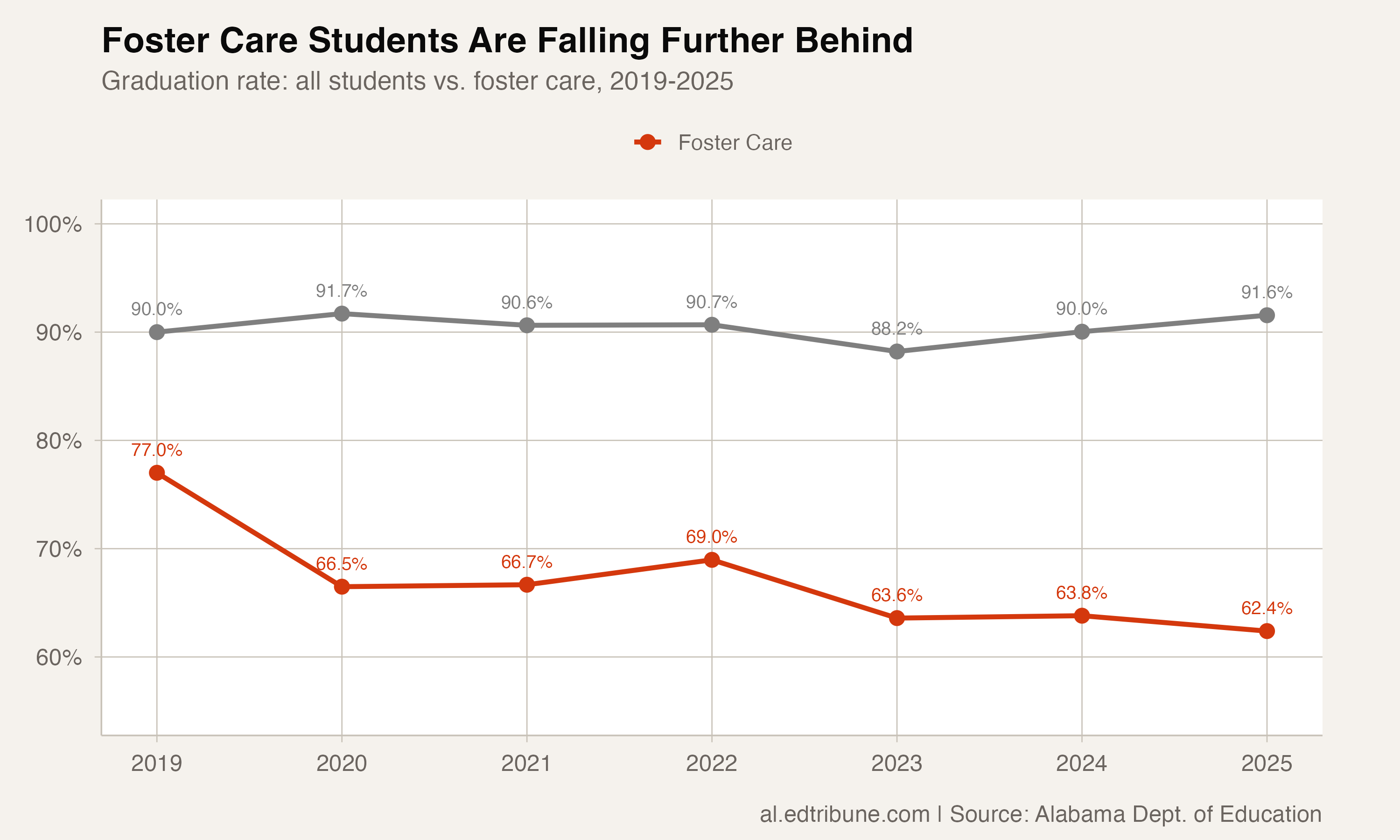
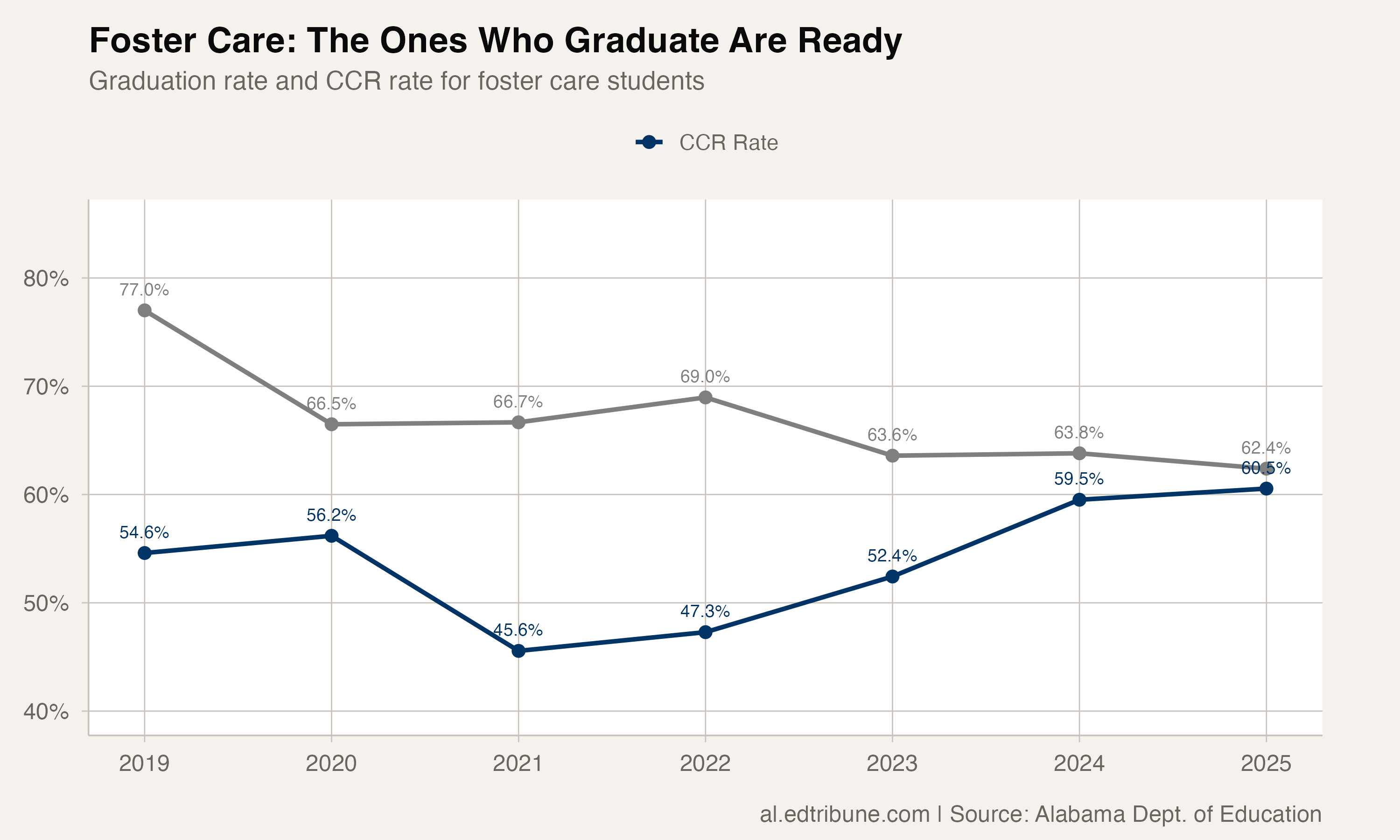
Their graduation rate has dropped from 77.0 percent in 2019 to 62.4 percent in 2025, a 14.6 percentage point decline over seven years. Of the 17 subgroups Alabama tracks, foster care is the only one with a net decline since 2019; every other group's rate is higher today than when reporting began. Students in foster care now graduate at a rate 29.2 points below the state average, the widest gap of any group tracked by the Alabama State Department of Education (ALSDE).
The state's overall graduation rate climbed during the same period. Students who are economically disadvantaged, English learners, students who are currently homeless, and students in special education all reached record highs. Youth in foster care did not.
The numbers year by year
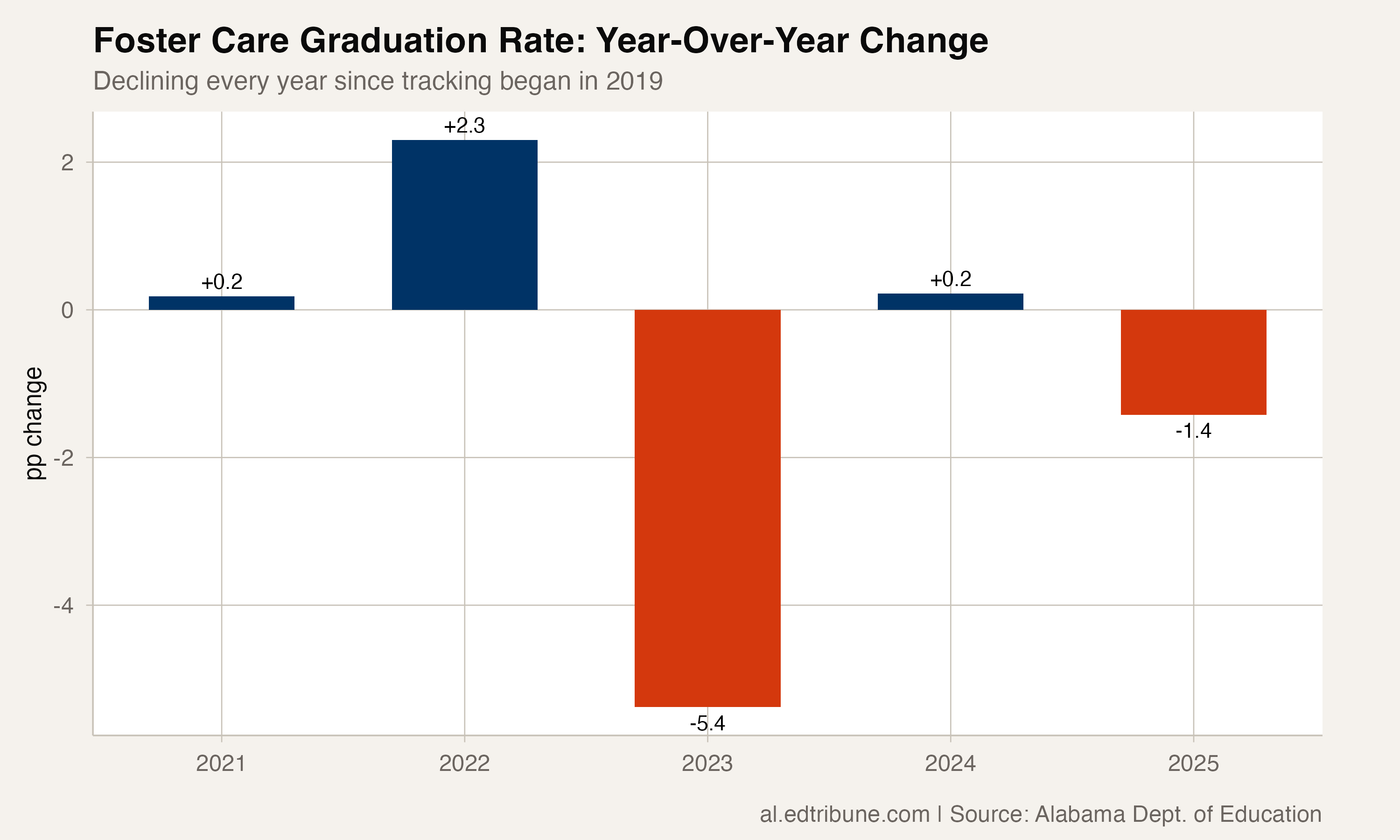
From 77.0 percent in 2019, the rate dropped to 66.5 percent in 2020, held at 66.7 percent in 2021, ticked up to 69.0 percent in 2022, then fell again to 63.6 percent in 2023, 63.8 percent in 2024, and 62.4 percent in 2025. The cumulative shape is a sharp pandemic-era drop, a brief recovery in 2022, and a renewed slide that has not reversed.
The 2020 drop of 10.5 points was the steepest single-year change, coinciding with pandemic disruption that hit the most unstable housing situations hardest. But other groups posted similar pandemic-era losses and recovered; students in foster care did not. The post-2022 slide, in years when most other groups rebounded, points to structural failures beyond COVID.
Where foster care sits in the landscape
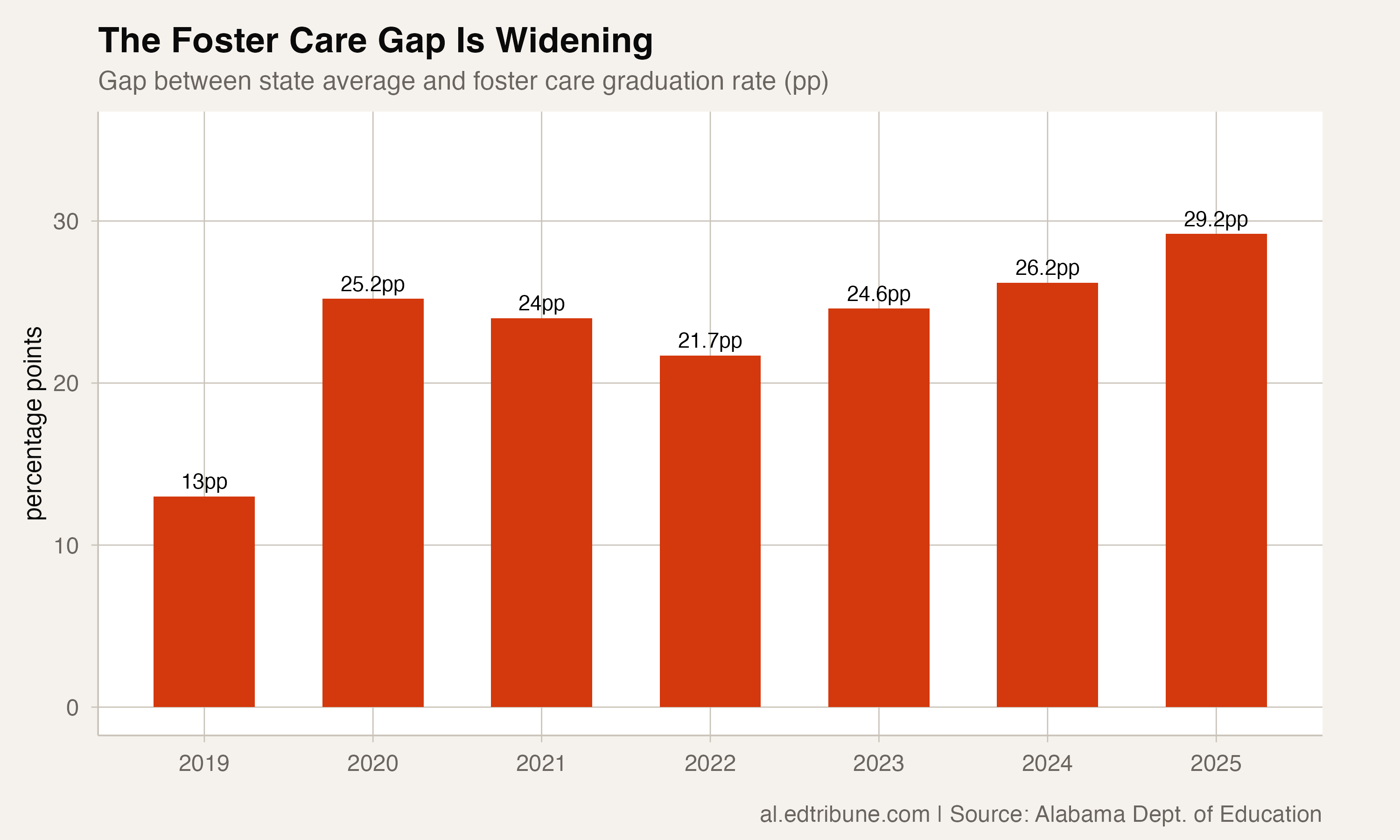
The 62.4 percent rate places students in foster care at the bottom of Alabama's subgroup rankings. Students in special education, the next-lowest group, graduate at 78.4 percent, 16 points higher. Students who are currently homeless, who face their own housing instability, graduate at 86.3 percent.
The comparison to students who are currently homeless is instructive. Both groups face residential instability, but students who are currently homeless in Alabama have improved sharply, from 77.8 percent in 2019 to 86.3 percent in 2025, an 8.5-point gain. Students in foster care, over the same period, fell 14.6 points. Whatever supports are reaching unhoused students are not reaching students in foster care.
The paradox: those who graduate are ready
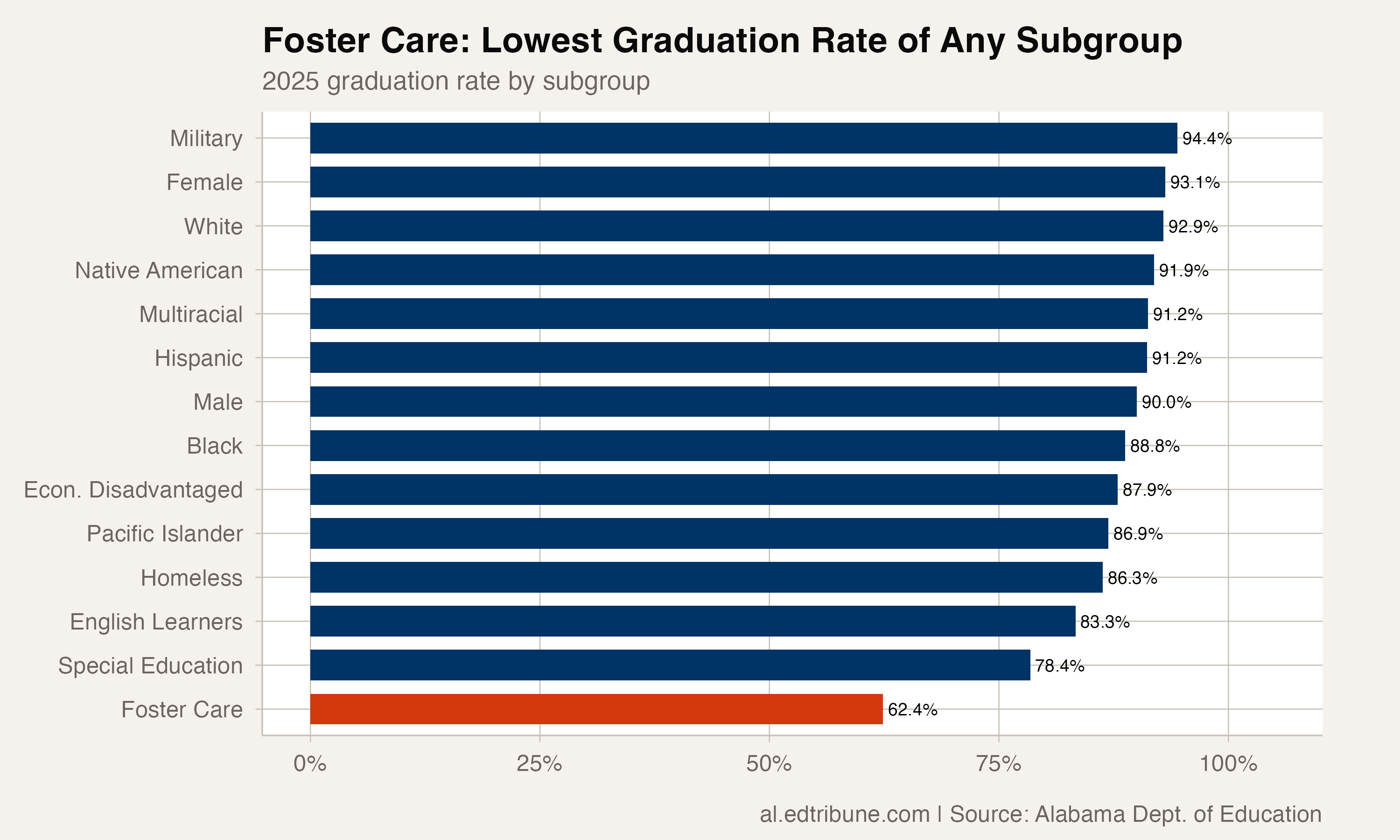
There is one surprising data point in the foster care numbers. The gap between graduation rate and college/career readiness rate has collapsed to 1.8 percentage points: 62.4 percent graduate, and 60.5 percent are college or career ready. For comparison, the statewide CCR gap is 3.7 points.
This means that among students in foster care, nearly everyone who manages to graduate also meets readiness benchmarks. The problem is not quality of preparation for those who persist. The problem is that 38 percent of students in foster care never reach the finish line.
What the data cannot tell us
Foster care data only became available in 2019, limiting trend analysis to seven years. The cohort sizes are relatively small, which means individual students have an outsized impact on the rate: a district with 10 seniors in foster care where one drops out sees a 10-point swing.
The data also does not distinguish between students who aged out of the foster system during high school, those placed in new homes mid-year, or those who remained in stable placements. Research consistently shows that placement stability is the single strongest predictor of foster care graduation, but Alabama's data does not track it.
By the numbers: 62.4%, the graduation rate for Alabama's students in foster care in 2025, down from 77.0% in 2019. The gap to the state average has widened to 29.2 percentage points, the largest of any subgroup.
Detailed code that reproduces the analysis and figures in this article is available exclusively to EdTribune subscribers.
Discussion
Sign in to join the discussion.
Loading comments...