Alabama Graduation Rates: 2023 CrashET · BirminghamET · Black BeltET · CCR GapET · Conecuh · Foster CareET · Gender Gap · Hispanic Gap · Homeless · English LearnersET · MontgomeryET · Nine RecordsET · Phenix City · Special Ed · Race Gap
Correction (July 21, 2026): An earlier version reported the 2025 gap between the statewide graduation rate and the English learner rate as 8.3 percentage points. Recalculation from Alabama's unrounded published rates gives 8.2 points. It also attributed the different trajectories of students who are homeless and students in foster care to support structures that this dataset does not measure. That explanation has been removed. The article's central finding about students who are homeless is unchanged.
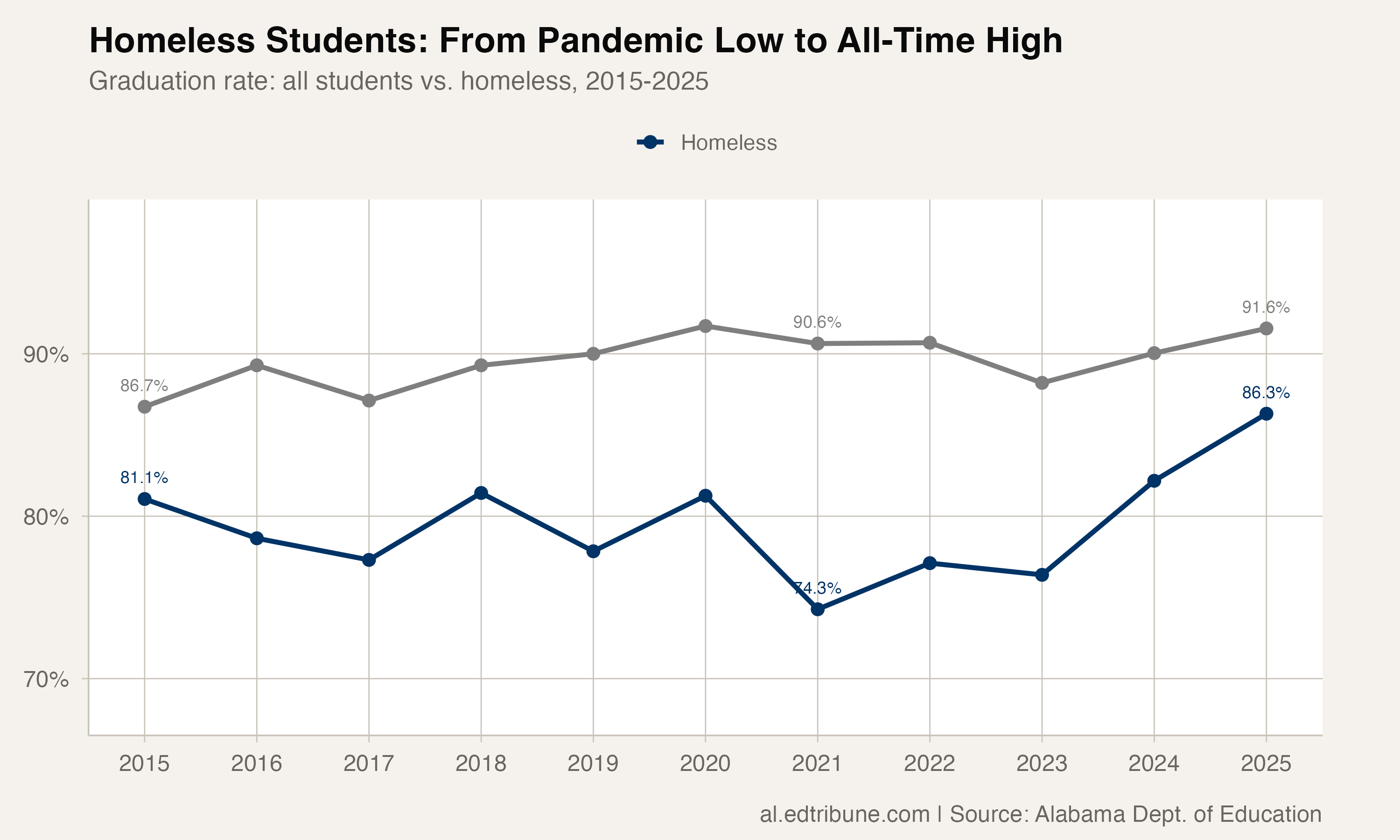
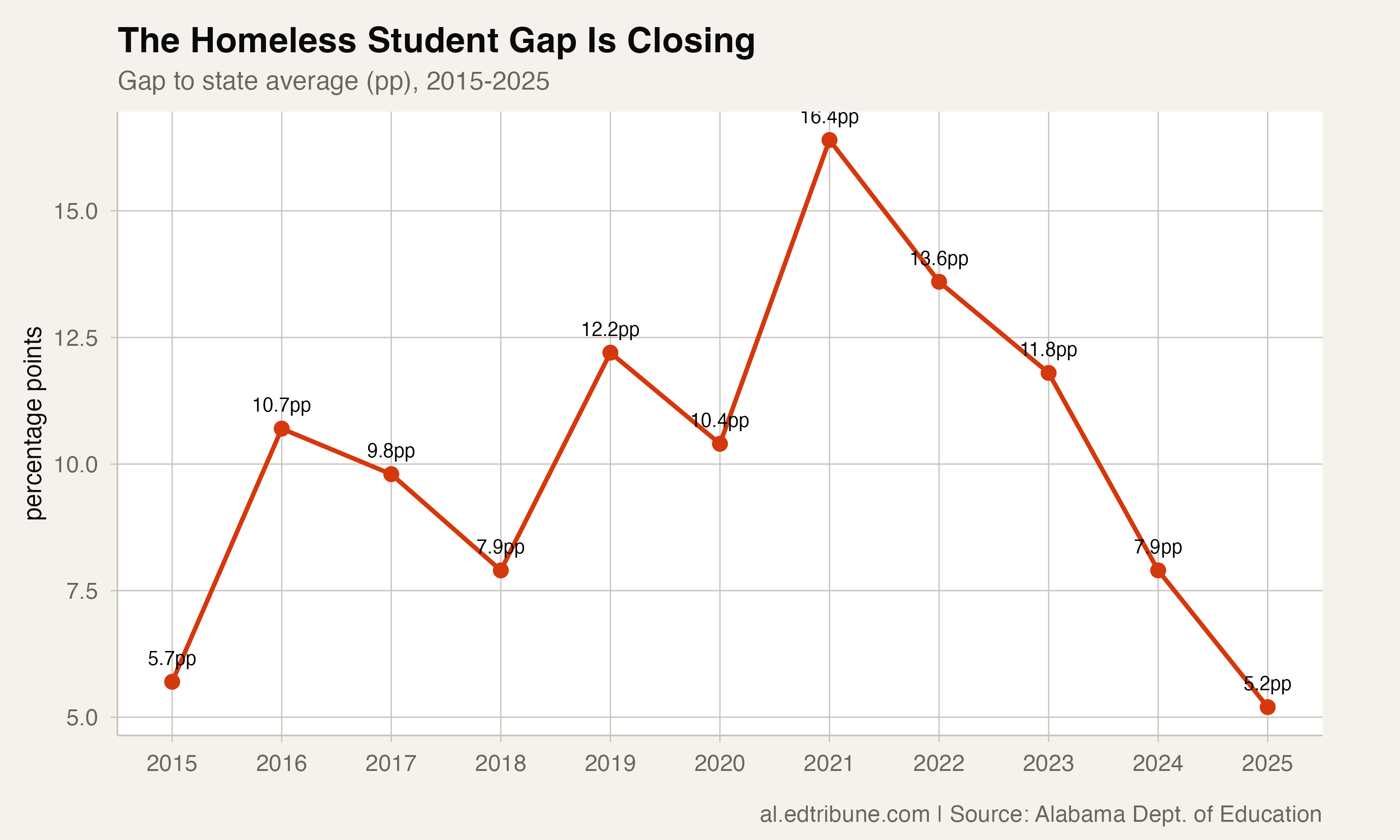
The graduation rate for students who are currently homeless in Alabama hit 86.3 percent in 2025, the highest mark in the state's 2015 through 2025 graduation-rate series and 5.2 percentage points below the state average. Four years ago, the rate was 74.3 percent and the gap was 16.4 points.
The rate improved by 12 points from 2021 to 2025.
The trajectory
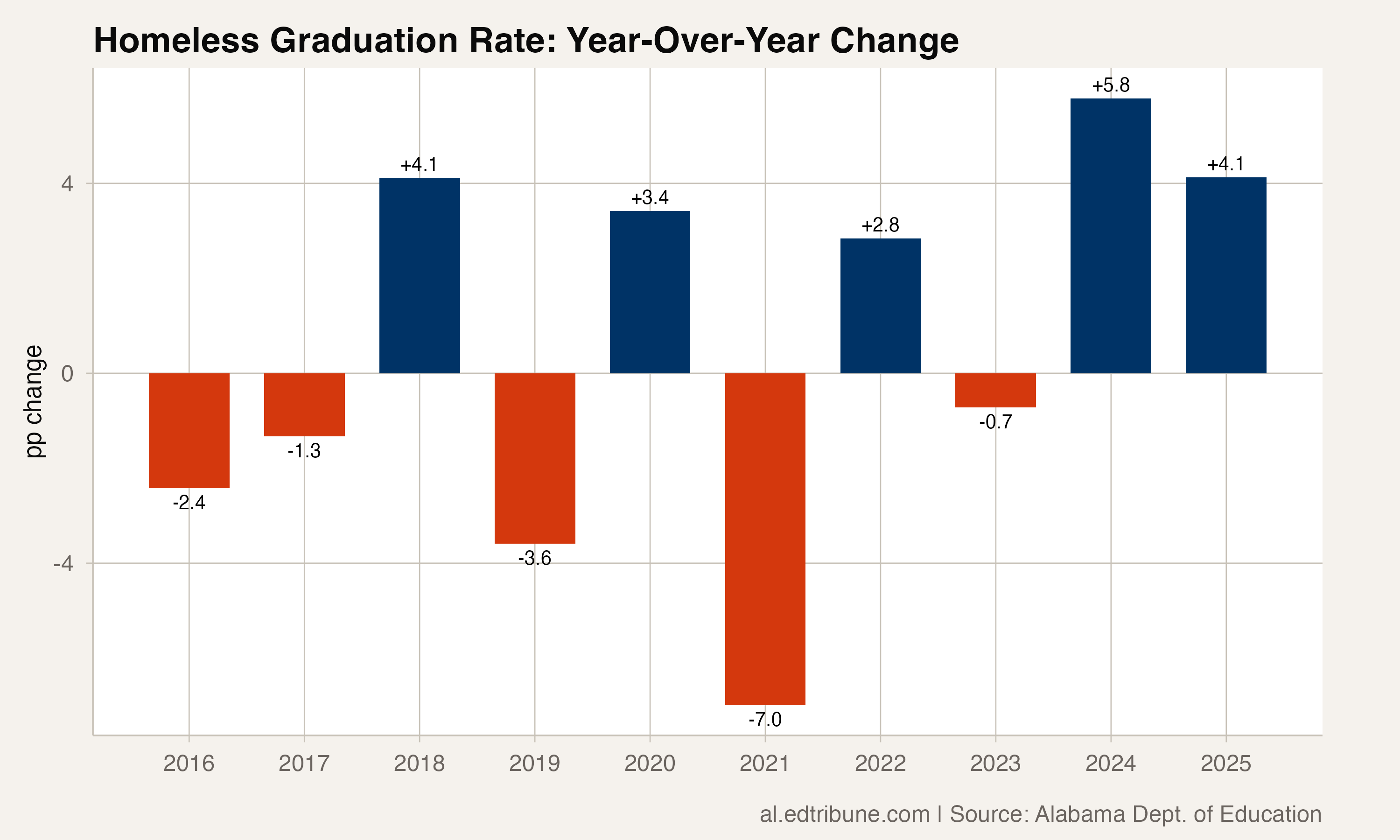
The graduation rate for students who are currently homeless followed a distinctive pattern: 81.1 percent in 2015, 77.3 percent in 2017, 81.3 percent in 2020, then a collapse to 74.3 percent in 2021, the lowest point in the dataset. The recovery started the next year, but it was uneven: 77.1 percent in 2022, 76.4 percent in 2023, 82.2 percent in 2024 and 86.3 percent in 2025.
The climb from 74.3 percent to 86.3 percent occurred across several annual changes, not in a single year. The rate increased in three of the four years after the 2021 low.
The gap reached its narrowest point
The distance between students who are currently homeless and the state average has narrowed from a peak of 16.4 percentage points in 2021 to 5.2 points in 2025. At 5.2 points, the homeless gap is now smaller than the special education gap (13.2pp), smaller than the English learner gap (8.2pp), and vastly smaller than the foster care gap (29.2pp).
A contrast with foster care
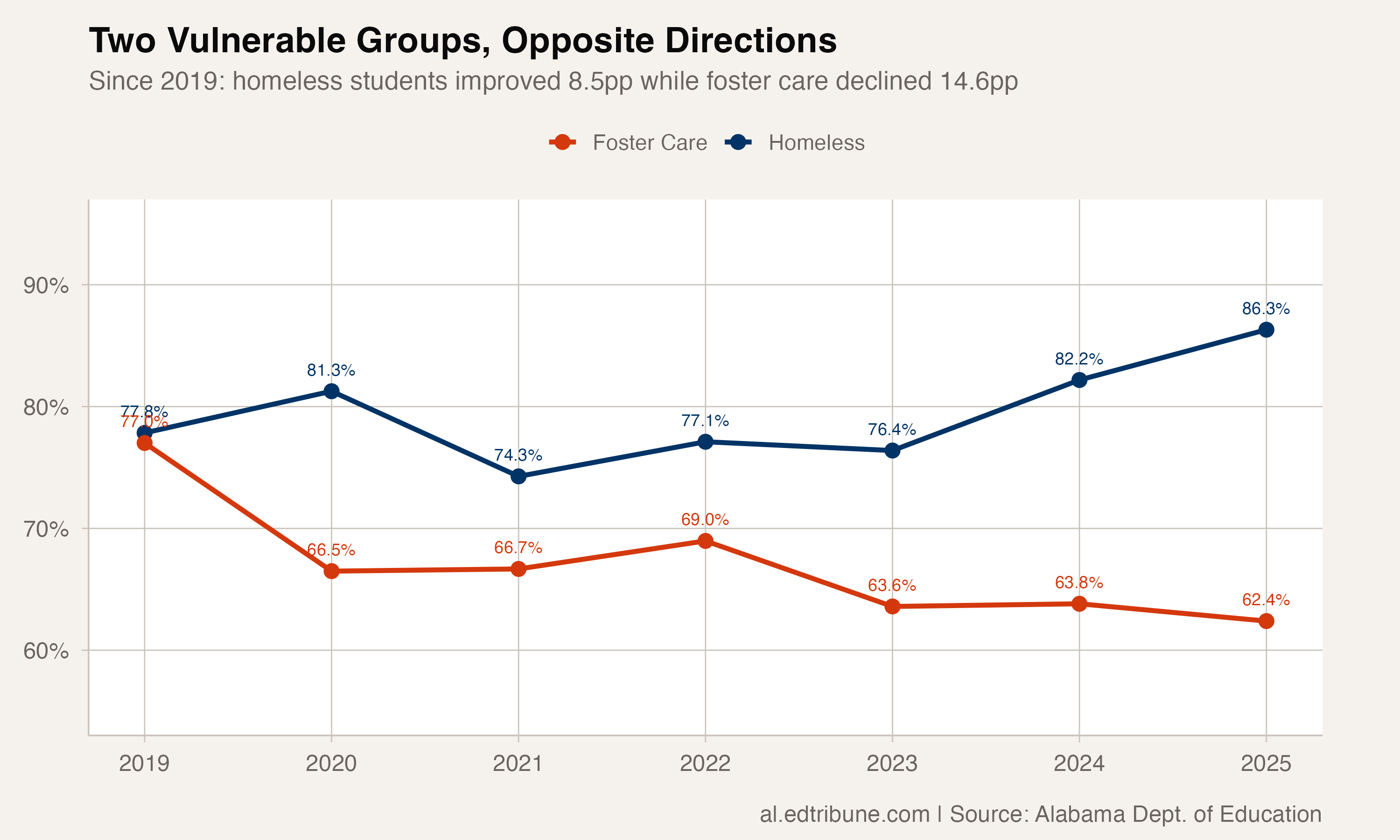
Their trajectories since 2019 moved in opposite directions. Students who are currently homeless improved 8.5 points. Students in foster care declined 14.6 points. That is a 23.1-point divergence between the two changes. The graduation-rate data does not identify why the groups moved differently.
What the data cannot show
The state graduation-rate series measures outcomes, not the programs, school practices or individual circumstances that produced them. It establishes the size and timing of the rebound, but it cannot identify which interventions contributed to the change.
By the numbers: 86.3%, the graduation rate for students who are currently homeless in Alabama in 2025, up from a 2021 low of 74.3%. The gap to the state average has narrowed from 16.4pp to 5.2pp.
Detailed code that reproduces the analysis and figures in this article is available exclusively to EdTribune subscribers.
Discussion
Sign in to join the discussion.
Loading comments...