Alabama Graduation Rates: Nine RecordsET · 2023 CrashET · BirminghamET · Foster CareET · CCR Gap
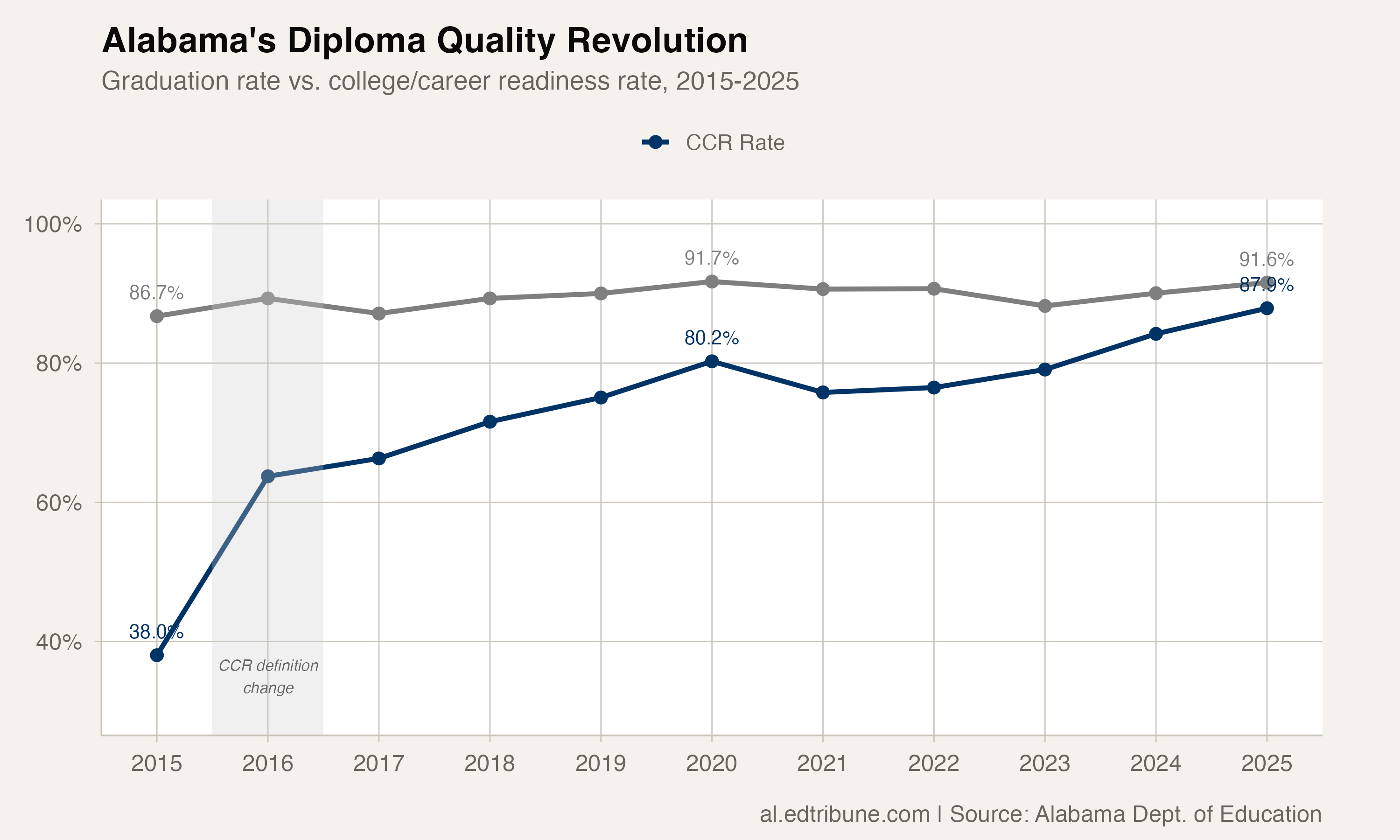
Ten years ago, Alabama had a graduation problem hiding inside a graduation success story. The state graduated 87 percent of its students in 2015, a respectable number by any measure. But only 38 percent of those graduates met college or career readiness benchmarks. Nearly half the diplomas the state handed out led nowhere.
By 2025, that gap has all but vanished.
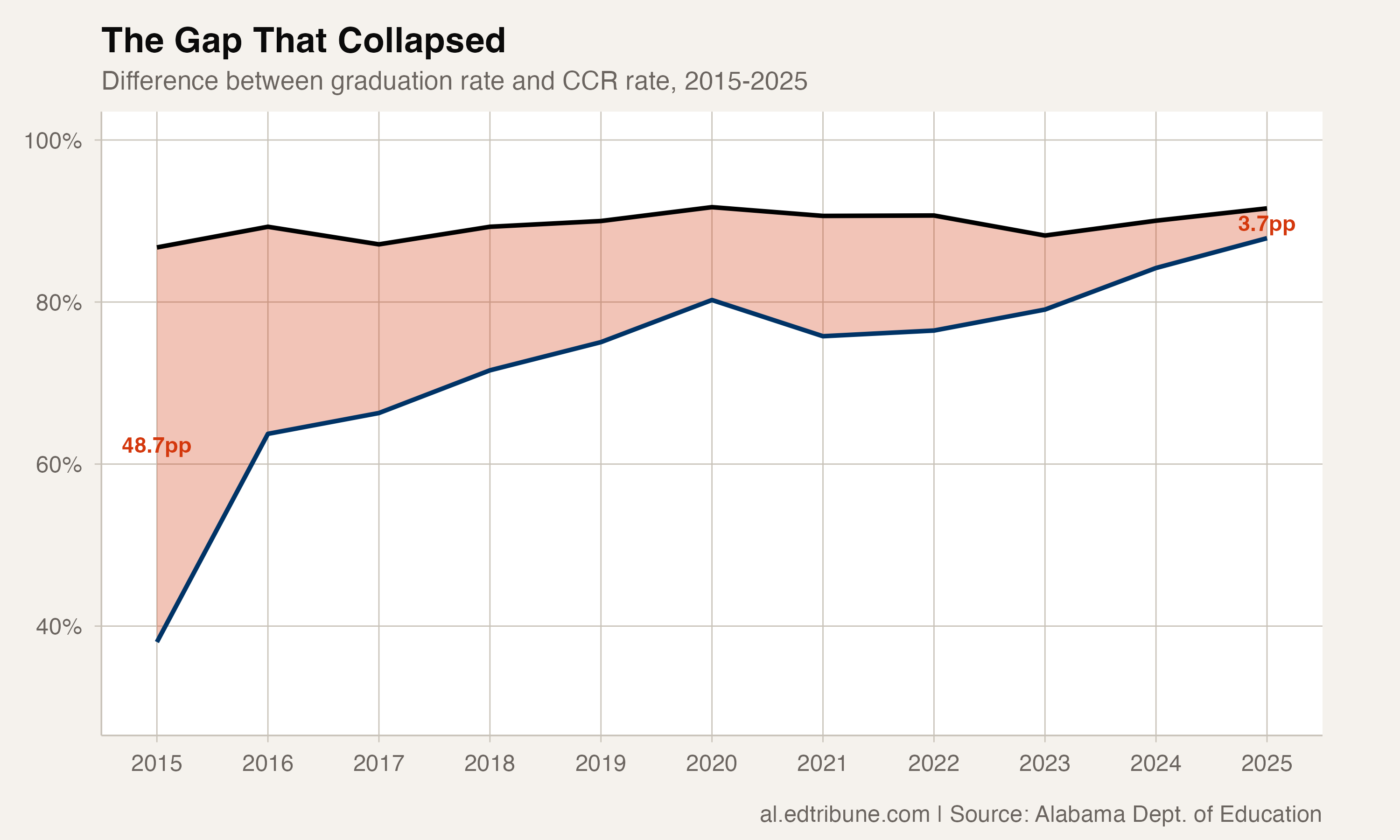
Alabama's four-year graduation rate stands at 91.6 percent, the second-highest in the state's history. Its college and career readiness rate has reached 87.9 percent, an all-time high. The distance between the two numbers (once a 48.7 percentage point chasm) has narrowed to 3.7 points. The diploma, in other words, finally means something close to what it claims.
What the numbers actually show
The CCR rate measures the share of graduates who complete requirements beyond seat time: industry credentials, qualifying ACT scores, AP course completion, or career-technical education pathways. In 2015, Alabama set that bar and discovered most of its graduates couldn't clear it.
A definition change between 2015 and 2016 makes direct comparison across that break unreliable. The CCR rate jumped from 38.0 percent to 63.7 percent in a single year, almost certainly reflecting an expanded definition of what counts as "ready" rather than a sudden improvement in student preparation.
But even taking the more conservative 2016-2025 window, the trajectory is striking. The CCR rate climbed from 63.7 percent to 87.9 percent, a 24.2 percentage point improvement in nine years. That is not a measurement artifact.
The readiness revolution was broad-based
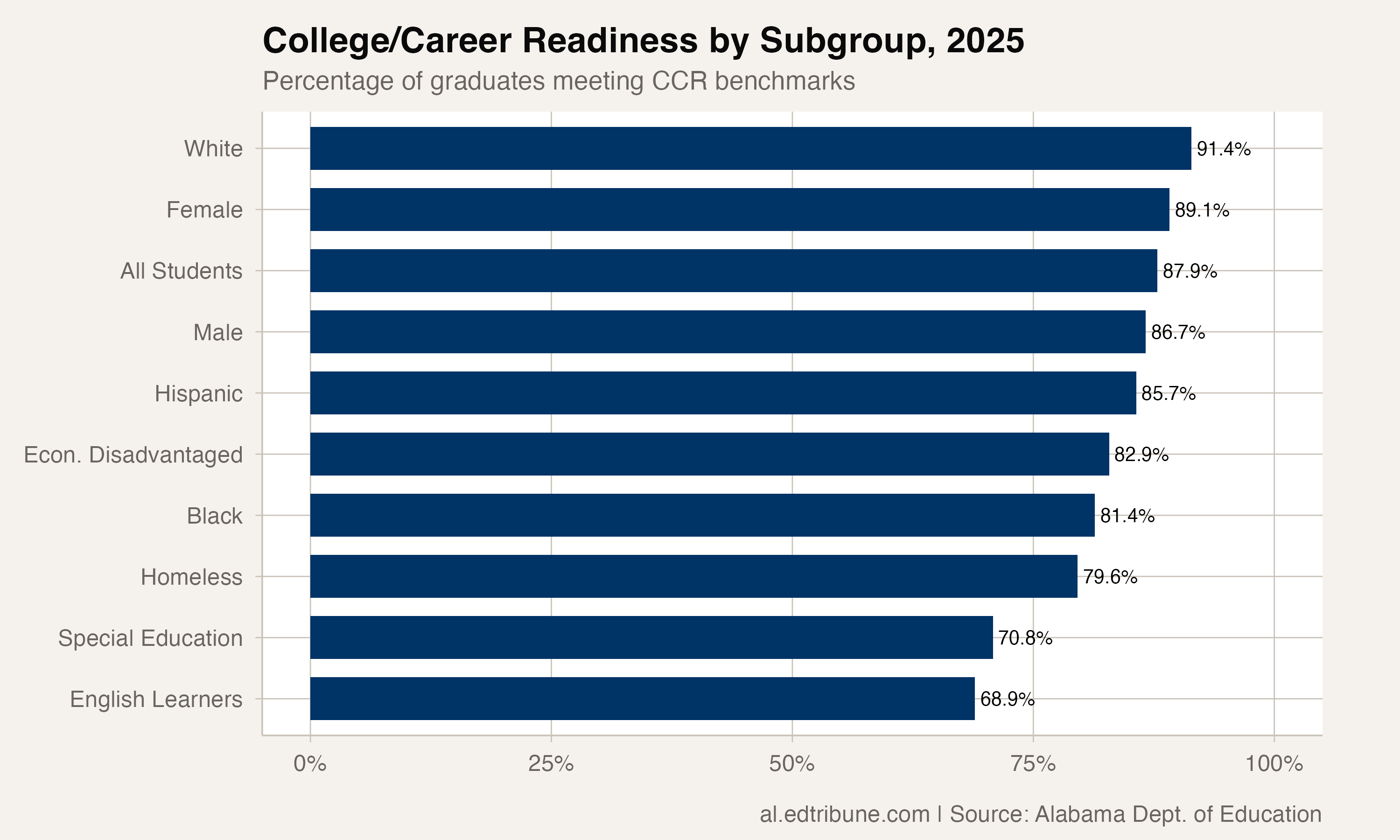
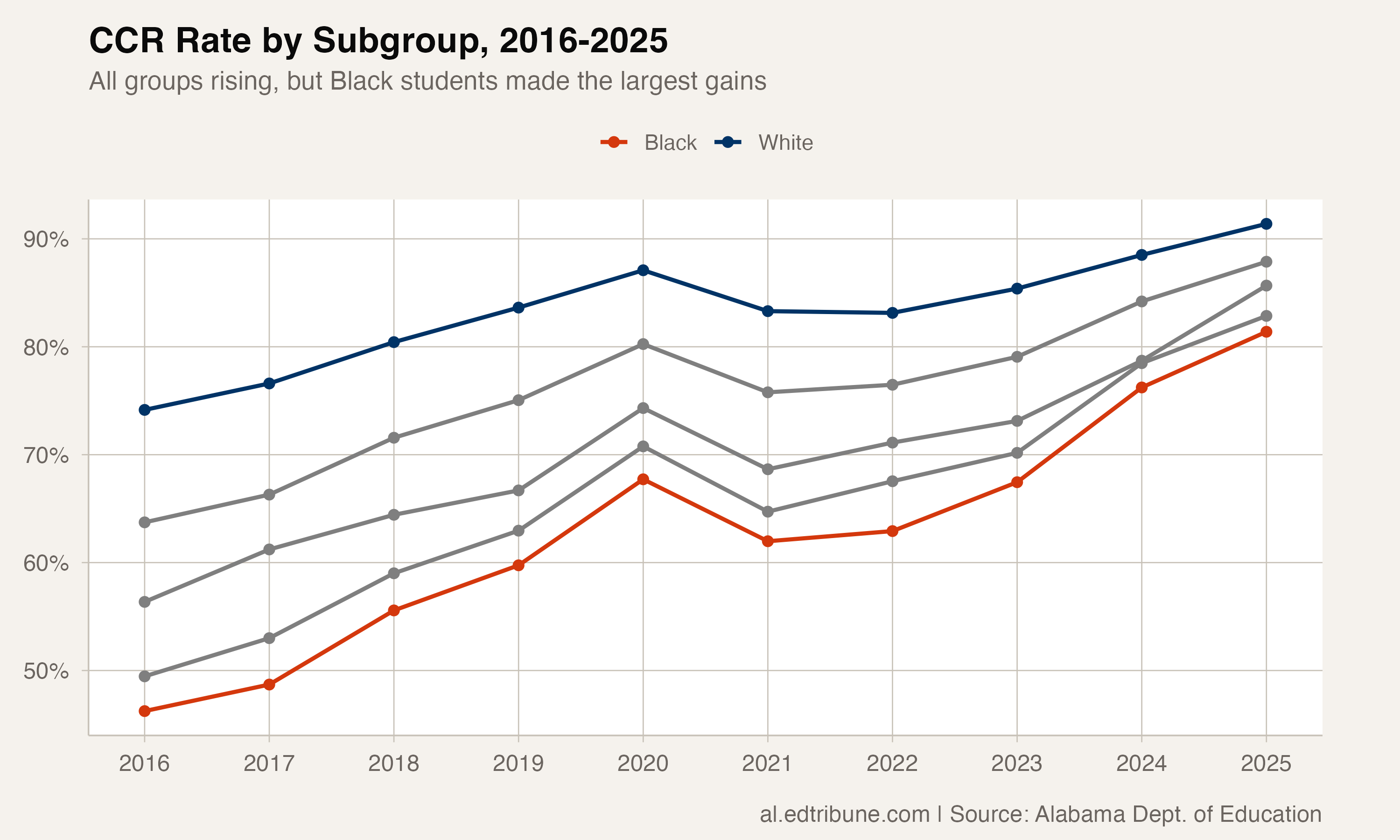
Every subgroup with reliable CCR data improved. Black students went from a 46.2 percent CCR rate in 2016 to 81.4 percent in 2025. Economically disadvantaged students climbed from 49.5 percent to 82.9 percent. Hispanic students rose from 56.4 percent to 85.7 percent.
The pattern is not one group dragging others along. It is convergence: the groups that started furthest behind made the largest absolute gains.
What drove it
Alabama invested heavily in career-technical education pathways over the past decade, expanding access to industry-recognized credentials and dual enrollment programs. The Alabama Ahead Act and related CTE expansions gave students more routes to demonstrate readiness beyond traditional college-prep metrics.
The structure of the CCR benchmark matters here. By counting industry credentials alongside ACT scores and AP completion, Alabama created a readiness measure that rewards vocational and technical preparation, not just college admission. In a state where many graduates enter the workforce directly, that alignment matters.
The asterisk
The 2023 crash year complicates the narrative. The statewide graduation rate dropped 2.5 percentage points that year (the largest single-year decline in the dataset) as COVID-era supports expired. But the CCR rate barely flinched, dipping only 0.5 points before resuming its climb. That divergence suggests the readiness improvements are more structurally durable than the graduation rate itself.
Still, a 3.7-point gap means roughly 2,100 students graduated in 2025 without meeting readiness benchmarks. The gap has narrowed dramatically, but it has not closed.
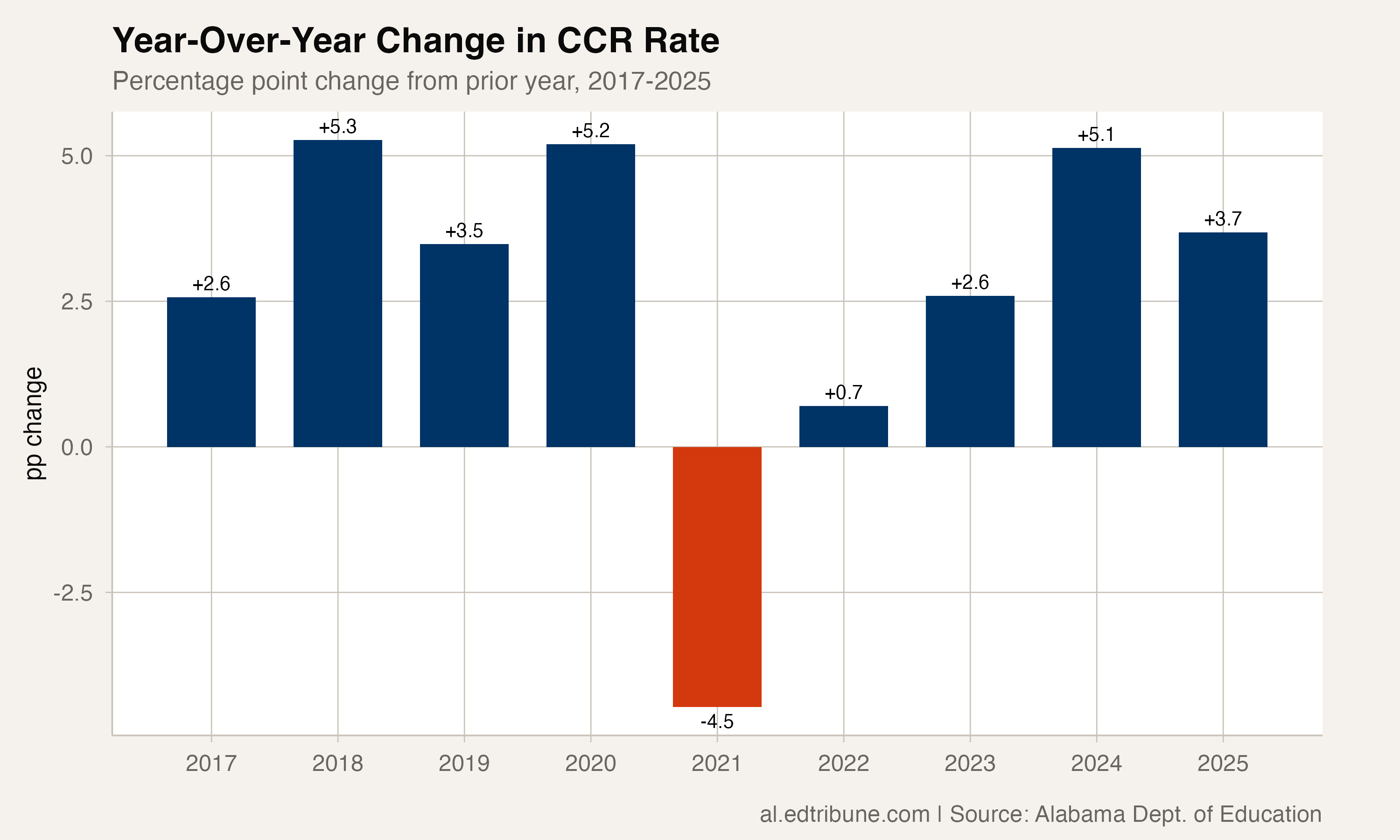
By the numbers: 87.9% of Alabama's 2025 graduates met college or career readiness benchmarks, up from 38.0% a decade ago. The gap between graduating and being ready for what comes next has shrunk from 48.7 percentage points to 3.7.
Detailed code that reproduces the analysis and figures in this article is available exclusively to EdTribune subscribers.
Discussion
Sign in to join the discussion.
Loading comments...