Alabama Graduation Rates: 2023 CrashET · BirminghamET · Black BeltET · CCR GapET · Conecuh · Foster CareET · Gender Gap · Hispanic Gap · HomelessET · English LearnersET · MontgomeryET · Nine RecordsET · Phenix City · Special Ed · Race Gap
Correction (July 21, 2026): An earlier version misstated Alabama's 2020 Hispanic graduation rate as 91.5 percent and the white-student decline in 2023 as 1.7 percentage points. The state data report 90.6 percent and a 1.9-point decline, respectively. The article now limits record claims to the 2015-through-2025 package series and distinguishes the reported subgroup patterns from explanations the data cannot establish.
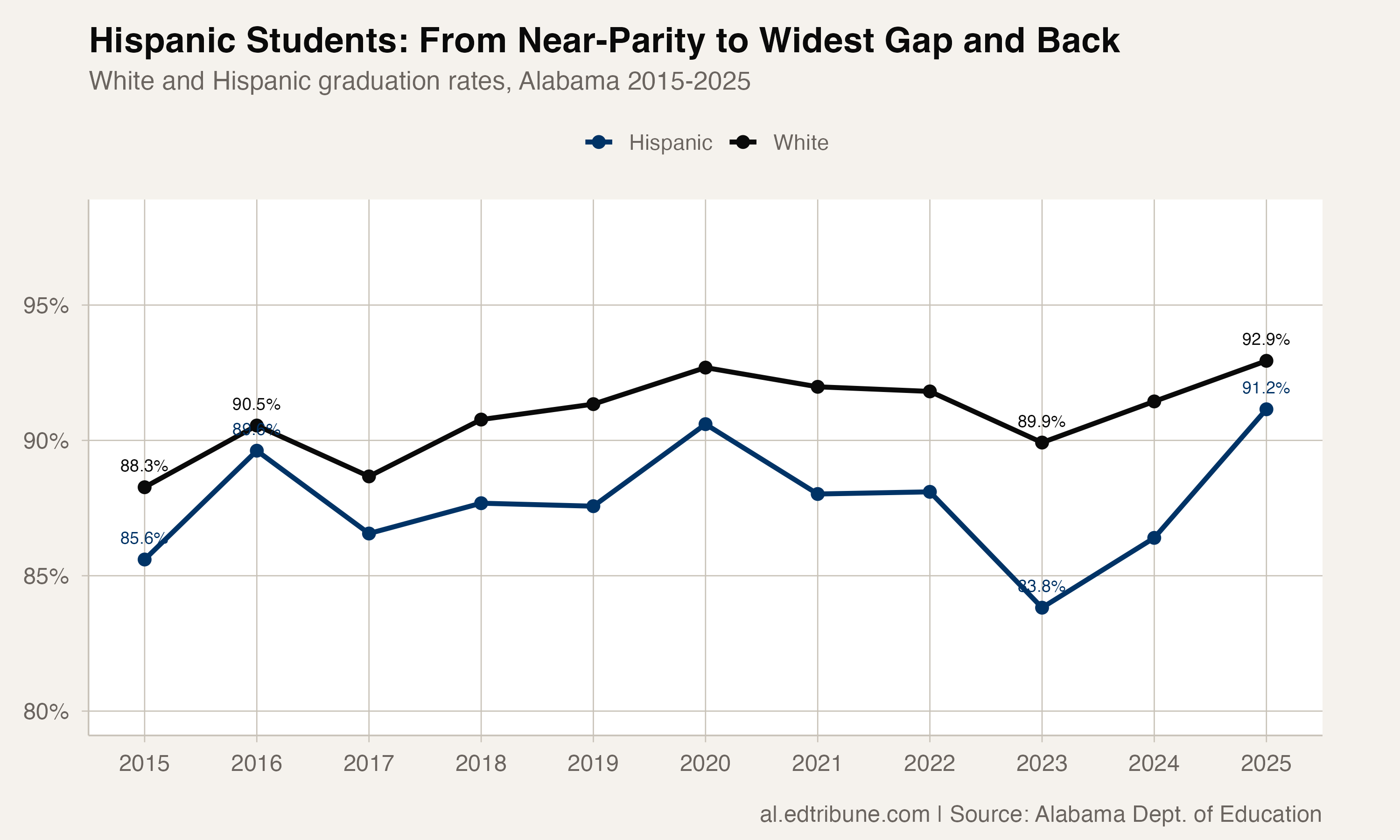
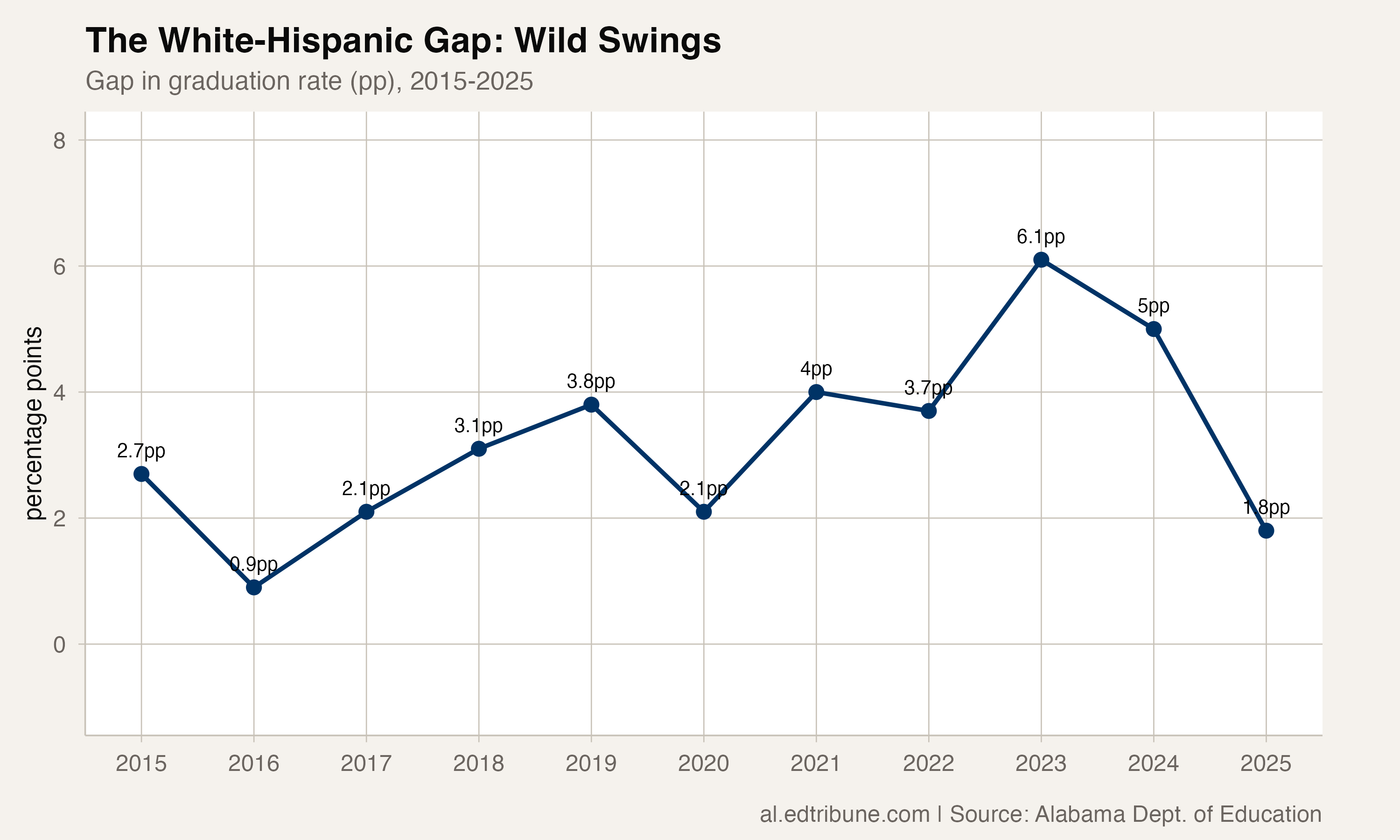
In 2016, the white-Hispanic graduation gap in Alabama was 0.9 percentage points, functionally zero. By 2023, it had widened to 6.1 points, the largest in the dataset. In 2025, it stands at 1.8 points.
Across the package's 2015-through-2025 series, the gap moved from near-parity to its widest point and back to near-parity. Hispanic students reached a series high of 91.2 percent in 2025, compared with the white rate of 92.9 percent.
The swing
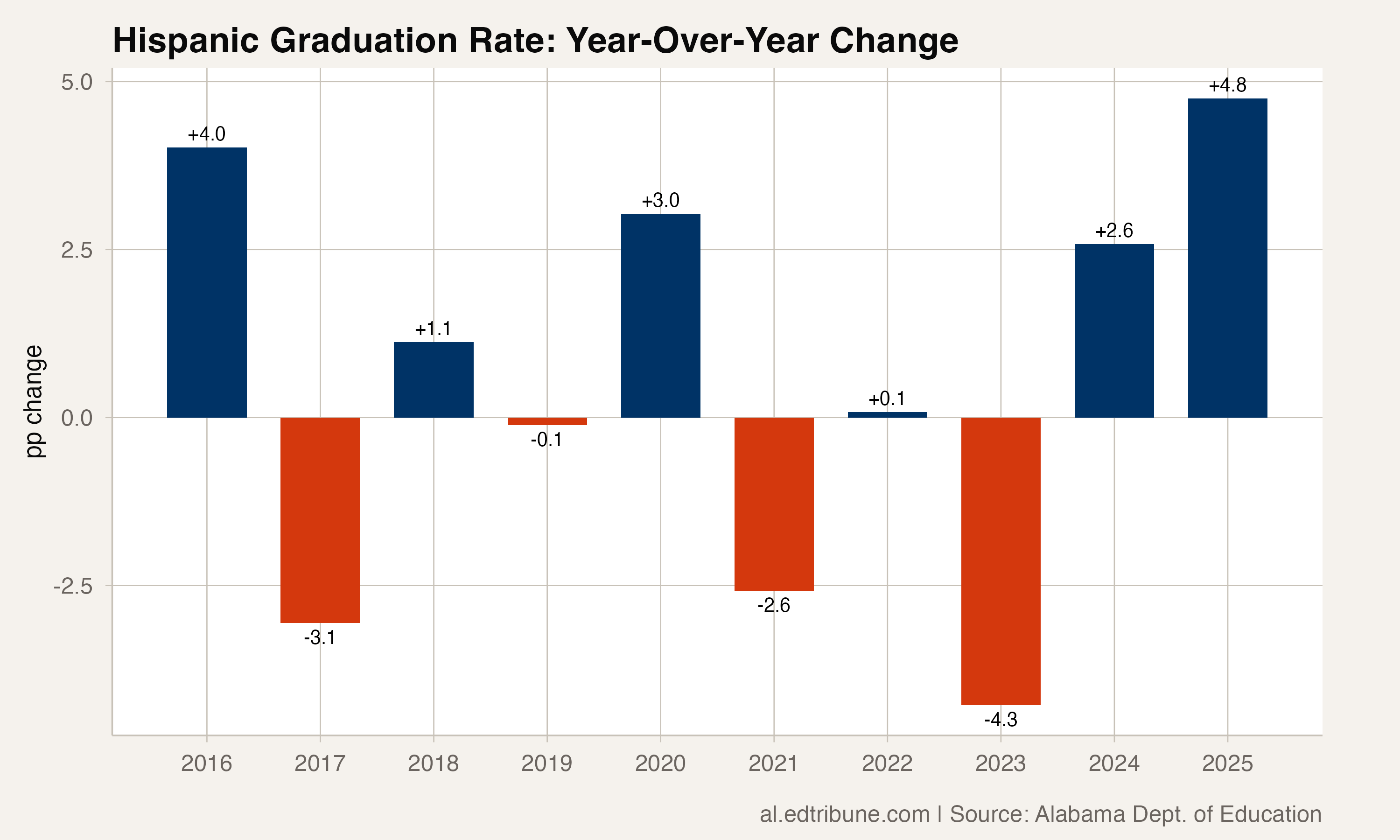
The gap narrowed in the mid-2010s as Hispanic graduation rates climbed from 85.6 percent in 2015 to 90.6 percent by 2020. Then the 2023 change included a 4.3-point drop for Hispanic students that widened the gap to 6.1 points. Across 2024 and 2025, the Hispanic rate rose to 91.2 percent, surpassing the prior series high.
The sequence is volatile, but the graduation-rate series does not identify its cause. It shows when rates moved; it does not show which policies, services, or cohort changes produced those movements.
A growing population
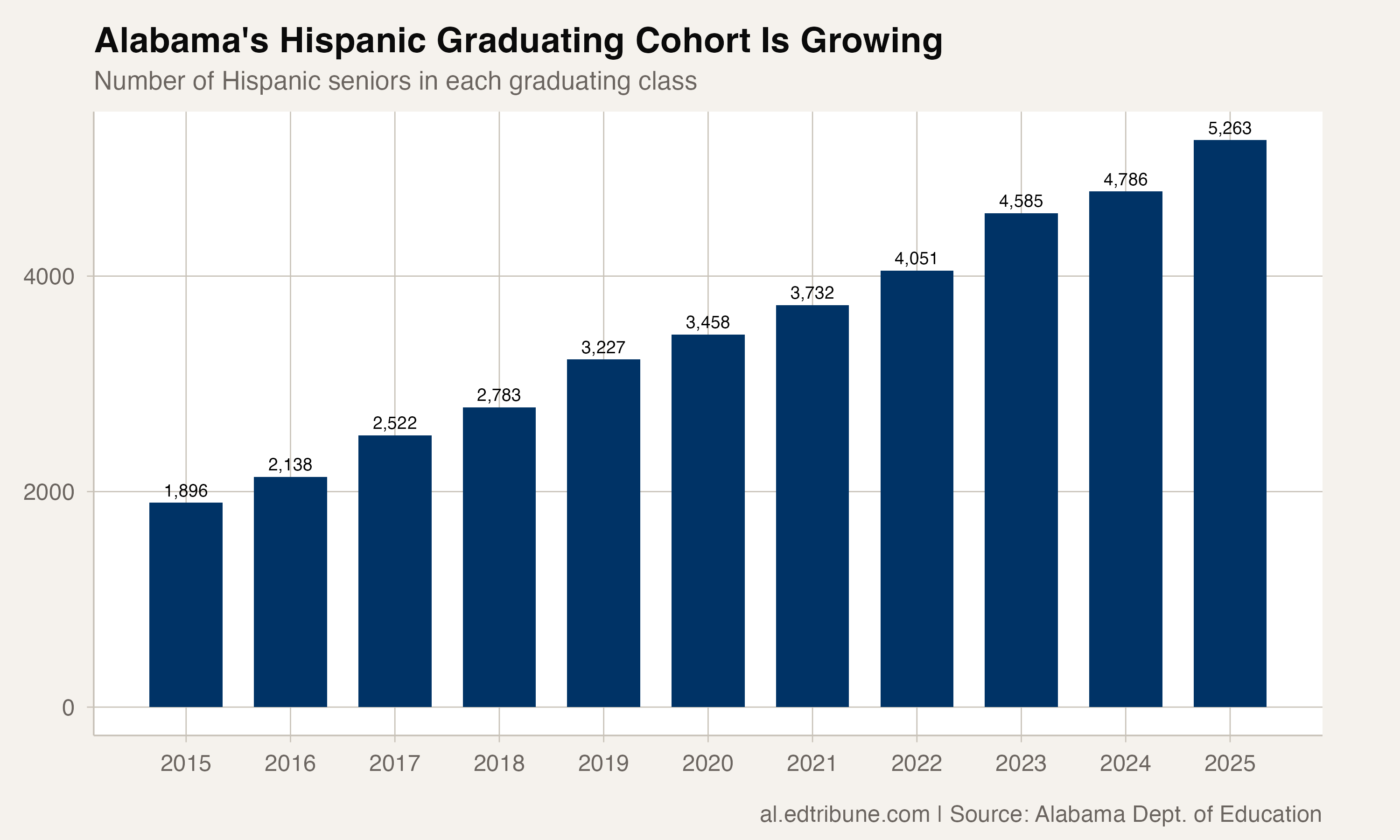
Alabama's reported Hispanic graduating cohort grew from 1,896 students in 2015 to 5,263 in 2025. That growth means the swings occurred in an expanding reported cohort, though the aggregate series alone cannot separate changes in student composition from changes in school performance.
What the data do not explain
Alabama's package publishes Hispanic and English learner results as separate subgroup series, not a cross-tabulation. These data therefore cannot establish how much the groups overlap or attribute the Hispanic trend to English learner services.
The 2023 change, in which the Hispanic rate fell 4.3 points while the white rate fell 1.9 points, was uneven. It does not identify a policy mechanism. Likewise, the recovery to a new series high in 2025 documents an outcome, not proof that a particular approach caused it.
By the numbers: 91.2%, Alabama's Hispanic graduation rate in 2025, the high point in the 2015-through-2025 package series. The white-Hispanic gap narrowed to 1.8pp after peaking at 6.1pp in 2023.
Detailed code that reproduces the analysis and figures in this article is available exclusively to EdTribune subscribers.
Discussion
Sign in to join the discussion.
Loading comments...