Correction: This article was rewritten before publication to remove unsupported projections and externally sourced numbers. The revised analysis treats the 2025-26 grade counts as planning signals, not forecasts.
Alabama still enrolled more kindergartners than grade-12 students in 2025-26, the most recent school year in the state's published data, but the difference was smaller than a year earlier. The state's fall headcount counted 56,088 students in kindergarten and 53,672 in grade 12, leaving a gap of 2,416. On the same headcount in 2024-25, the gap was 3,759, so it narrowed by 1,343 students in one year. Current-year counts will differ once the state publishes 2026-27 data.
That statewide balance can help leaders frame near-term questions about grade-level staffing and space. It cannot predict total enrollment on its own: kindergarten and grade 12 are different cohorts, and students can enter, leave or repeat grades between those endpoints.
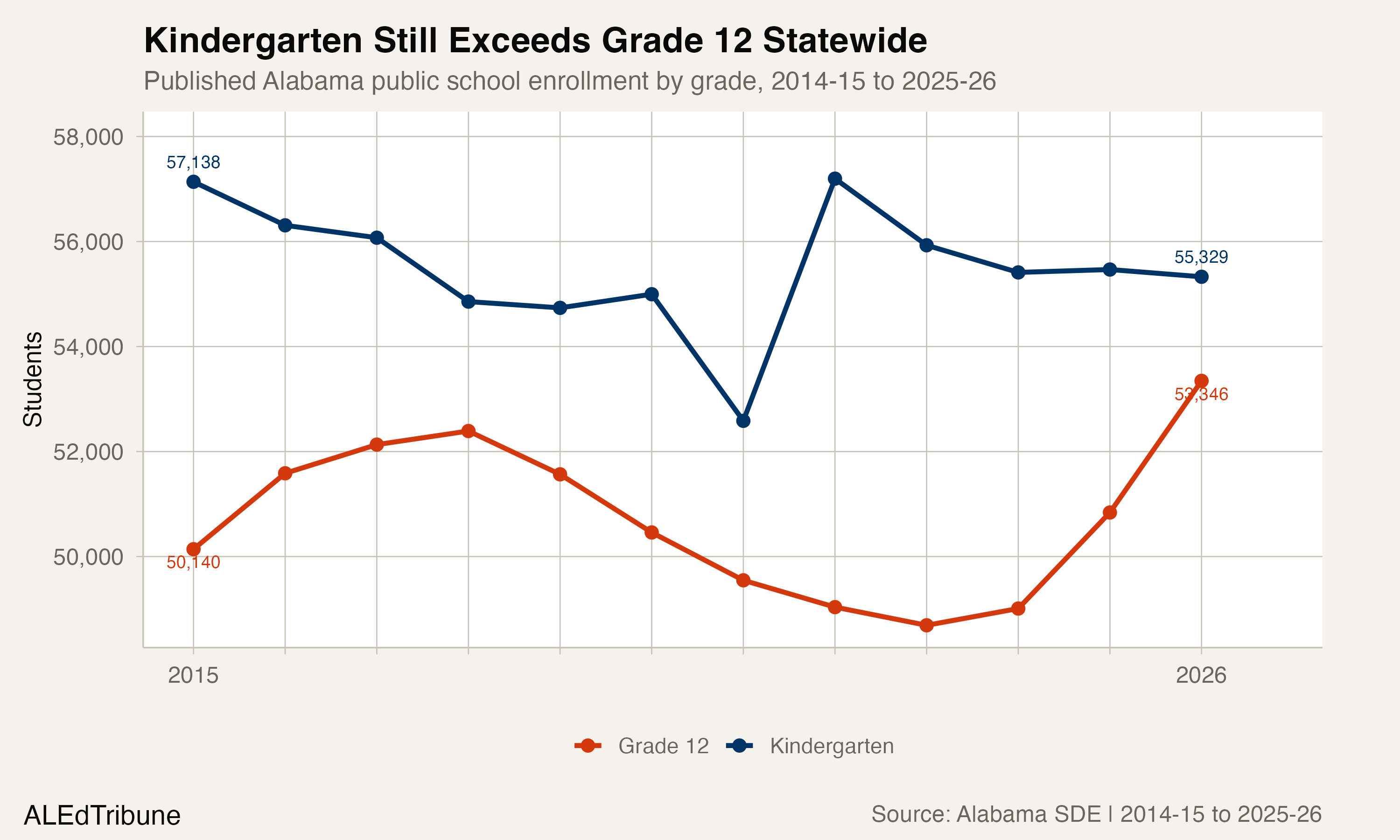
A smaller statewide margin
The longer record comes from a separate state report, the report card, which runs through 2024-25. The two reports count students differently, so this article compares years only within one report and never across them.
On the report card, Alabama counted 57,138 kindergartners and 50,140 grade-12 students in 2014-15, a difference of 6,998. There were 114.0 kindergartners for every 100 grade-12 students. By 2024-25, the report card showed 55,467 kindergartners and 50,839 grade-12 students, a difference of 4,628 and a ratio of 109.1, a decline of 4.9 points. On the fall headcount, the ratio fell from 107.2 in 2024-25 to 104.5 in 2025-26.
The path was not steady. On the report card, the gap narrowed in seven of the 10 annual transitions and widened in three, and its largest value, 8,161, came in 2021-22, well after the start of the record. The direction over the full report is toward a smaller margin, but the annual path has not moved one way every year.
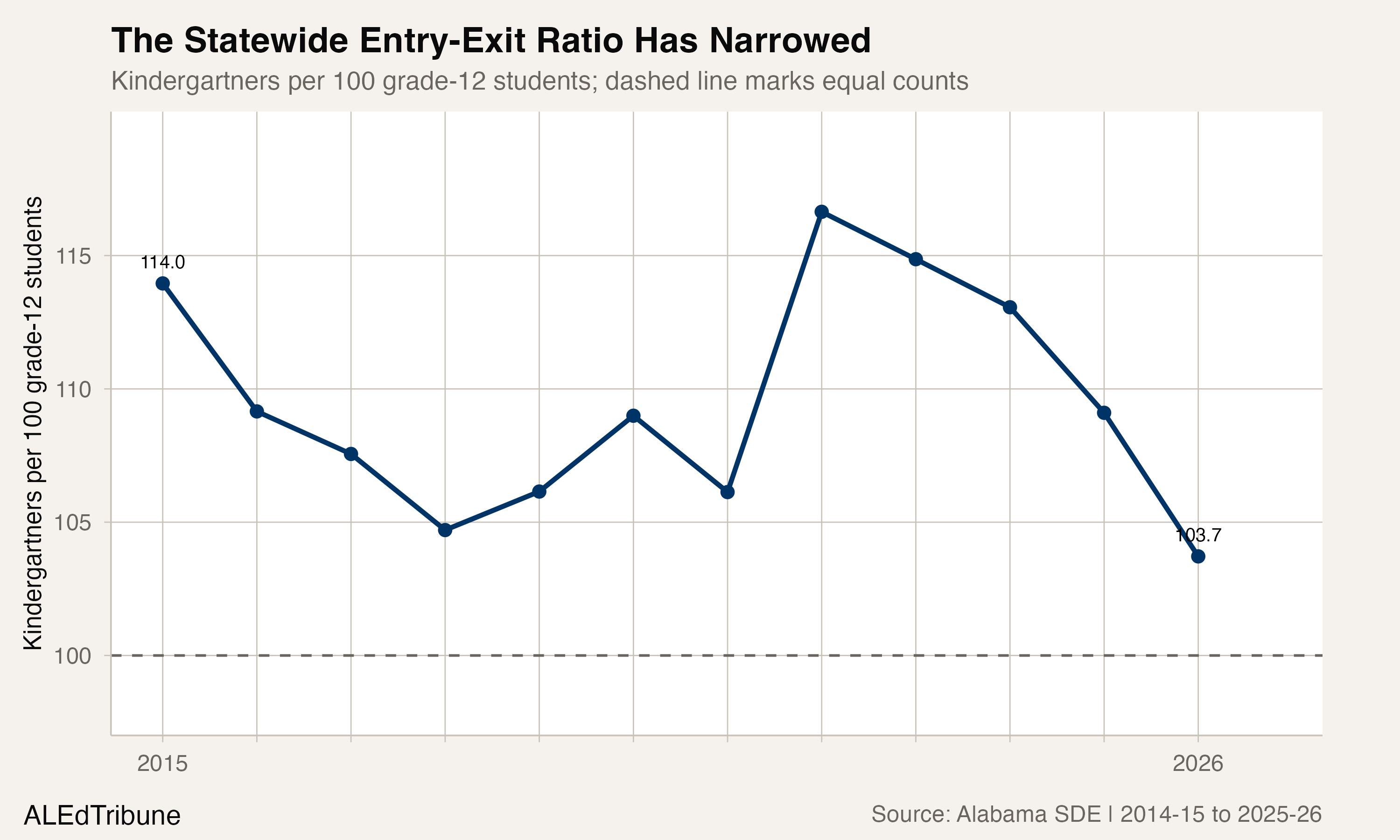
The ratio is best read as a snapshot of the grades at opposite ends of the K-12 system. A ratio above 100 says the kindergarten count is larger in that reporting year. It does not establish when or whether the two grades will cross, and it does not show what will happen to the students between them.
Districts face different balances
The statewide result also hides local variation. Among 141 districts with positive published counts in both kindergarten and grade 12 on the 2025-26 fall headcount, 44 enrolled fewer kindergartners than grade-12 students, 95 enrolled more, and two had equal counts.
Limestone County↗ET had 1,014 kindergartners and 1,640 grade-12 students, a difference of 626 in the other direction. Jefferson County↗ET had 2,328 kindergartners and 2,848 grade-12 students, a difference of 520.
Other large systems pointed the opposite way. Mobile County↗ET enrolled 3,750 kindergartners and 3,394 grade-12 students, 356 more at the entry grade. Montgomery County↗ET enrolled 2,256 kindergartners and 1,540 grade-12 students, a difference of 716.
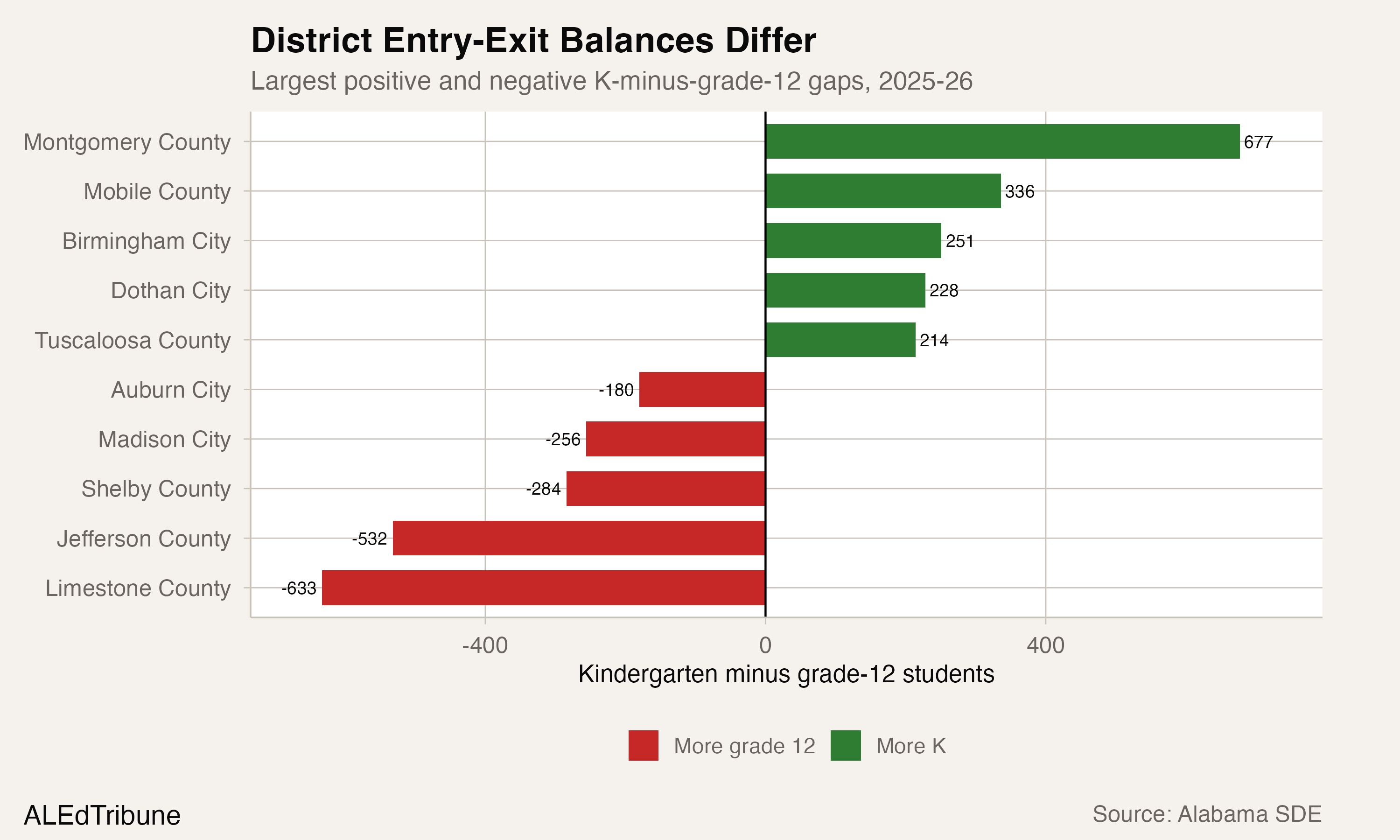
Those district counts are not performance measures. They identify where the grade mix is different enough to merit a closer look at local class sections, staffing assignments and building use. The enrollment data alone does not identify the reasons for each district's balance.
Every grade band ended smaller
The broader K-12 grade spine shows a quieter pattern than the two endpoint grades. On the report card, from 2014-15 to 2024-25, K-5 enrollment decreased by 2,398 students, grades 6-8 by 2,105 and grades 9-12 by 1,950. On the fall headcount, from 2024-25 to 2025-26, K-5 decreased by 1,986, grades 6-8 by 2,104 and grades 9-12 by 2,821.
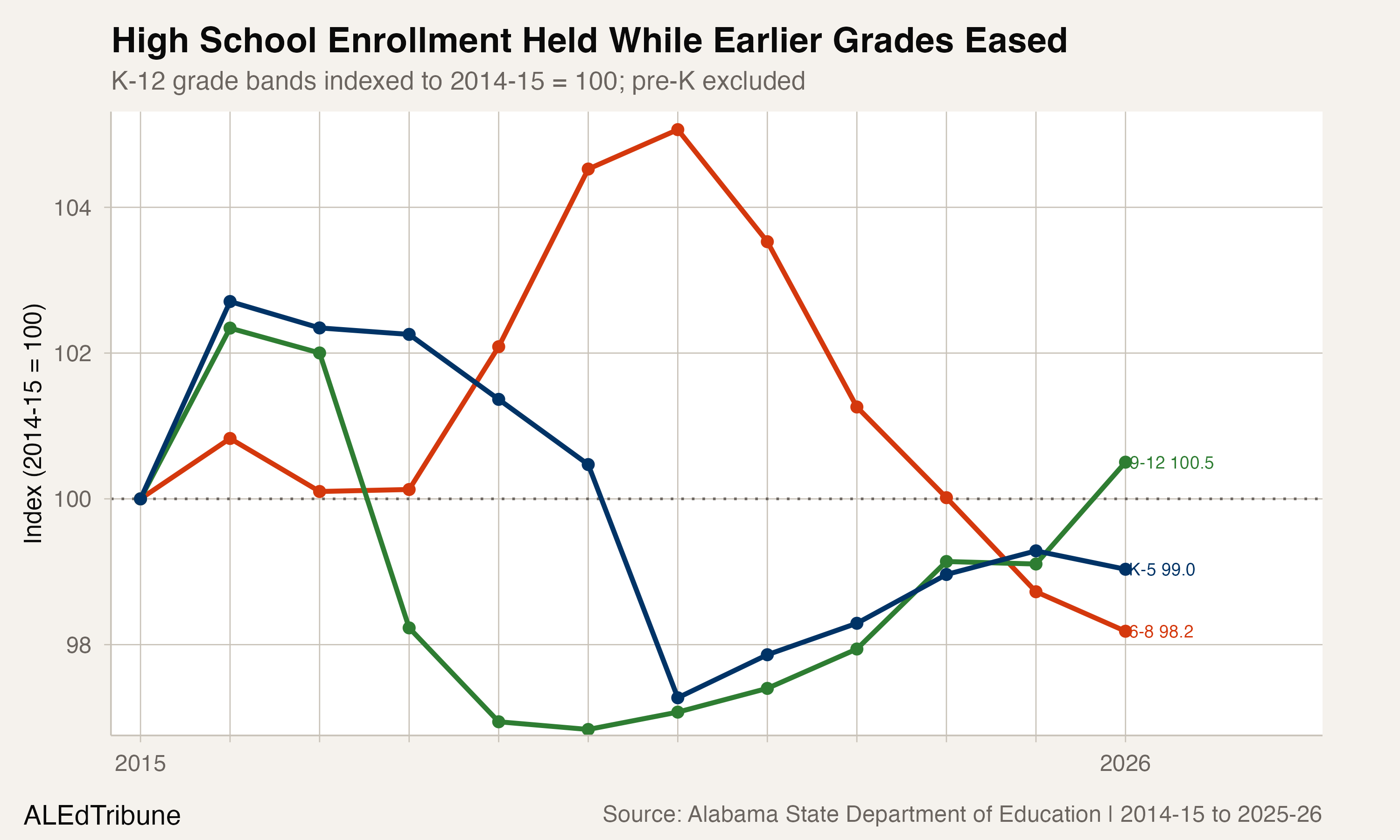
These are observed cross-sections, not a projection of future graduating classes. Cohort movement, retention and student mobility can change the relationship as students progress through school. The useful question for state and district leaders is therefore narrower: whether the 2025-26 distribution of students matches where teachers, courses and classrooms are assigned.
Dr. Michael Sibley of the Alabama State Department of Education did not respond to a request for comment from The ALEdTribune before publication.
Enrollment counts come from the Alabama State Department of Education's school data reports: the report card's student counts for 2014-15 through 2024-25, and the fall attendance headcount for 2024-25 and 2025-26. The two reports are not comparable with each other.
Correction, November 23, 2026: An earlier version said Alabama counted 55,329 kindergartners and 53,346 grade-12 students in 2025-26, a gap of 1,983 and a ratio of 103.7, and measured a 10.2-point decline in the ratio, a narrowing in eight of 11 annual transitions and a 2,645-student narrowing in the latest year, all from 2014-15 to 2025-26. Those 2025-26 figures came from a fractional attendance measure that is not a student count, and the comparisons bridged two state reports. The state's fall headcount shows 56,088 kindergartners and 53,672 grade-12 students in 2025-26, a gap of 2,416 (ratio 104.5), down 1,343 from 3,759 a year earlier. The article now measures the long run on the report card alone, from 2014-15 to 2024-25: the ratio fell 4.9 points, from 114.0 to 109.1, and the gap narrowed in seven of 10 transitions. The earlier version also said 47 of 141 districts enrolled fewer kindergartners than grade-12 students and 92 more; the headcount shows 44 and 95, and the four named districts' counts are corrected above. It also said grades 9-12 grew by 1,098 while K-5 fell by 3,247 and grades 6-8 by 3,000; on the report card all three bands fell from 2014-15 to 2024-25, and that section has been rewritten.
Detailed code that reproduces the analysis and figures in this article is available exclusively to EdTribune subscribers.
Discussion
Sign in to join the discussion.
Loading comments...