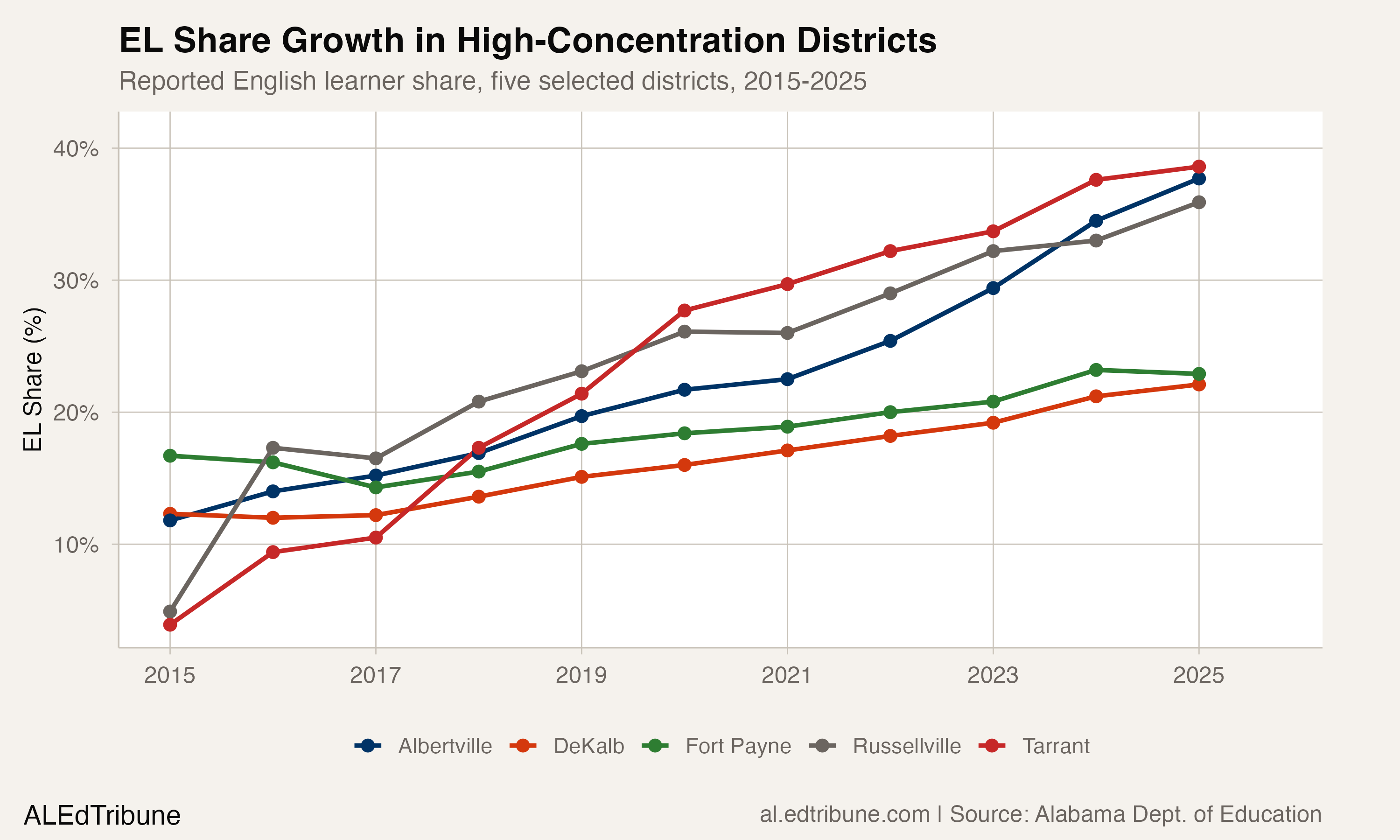
Albertville City↗ET enrolled 5,540 students in the school year ending 2025. Of those students, 2,086 were classified as English learners, a rate of 37.7%. The district's rate was 11.8% in the year ending 2015.
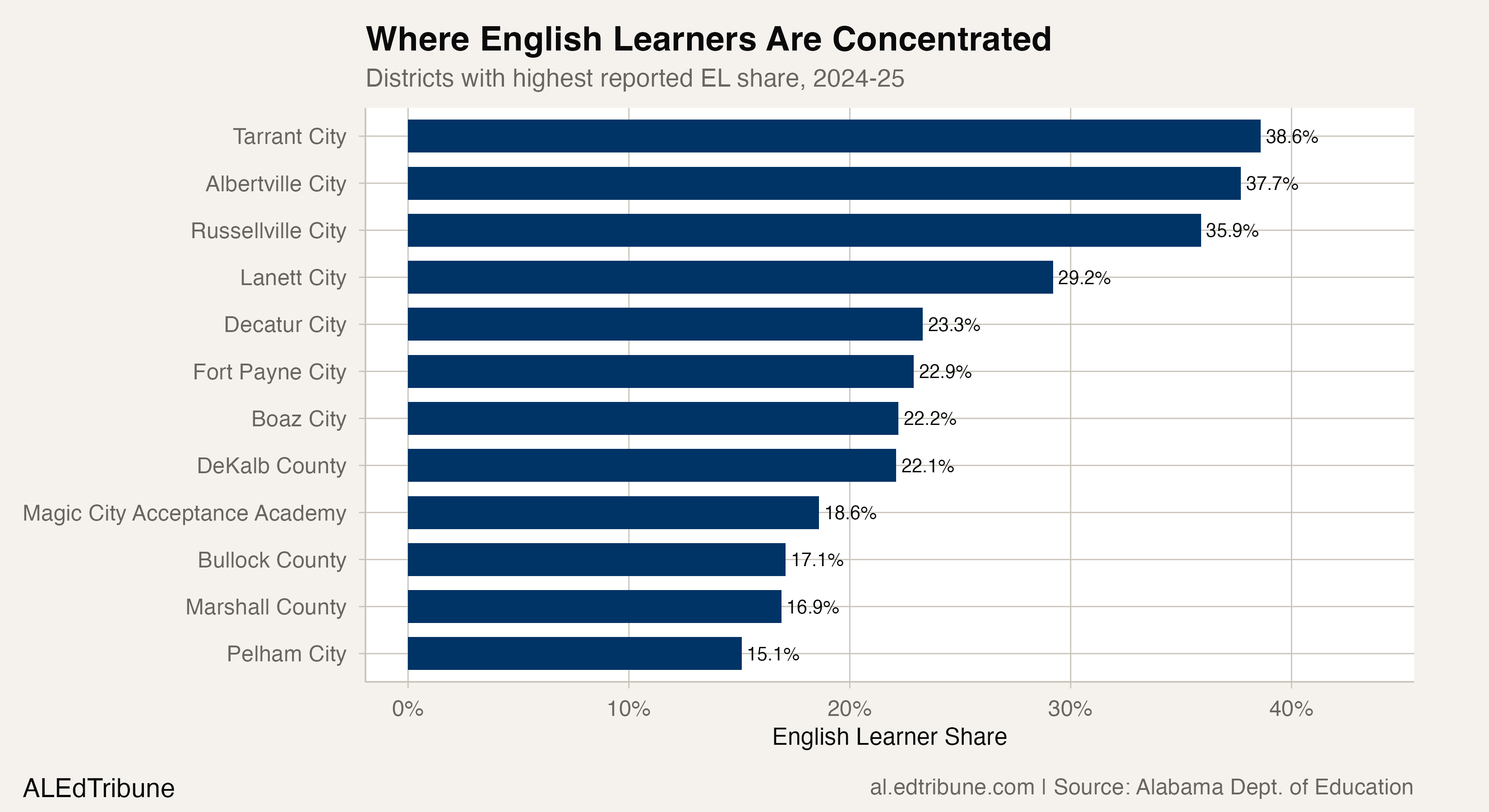
The concentration is not unique to Albertville. Tarrant City↗ET had the state's highest district share at 38.6%, followed by Albertville and Russellville City↗ET at 35.9%. Lanett City↗ET reported 29.2%, Decatur City↗ET 23.3%, Fort Payne City↗ET 22.9%, Boaz City↗ET 22.2%, and DeKalb County↗ET 22.1%.
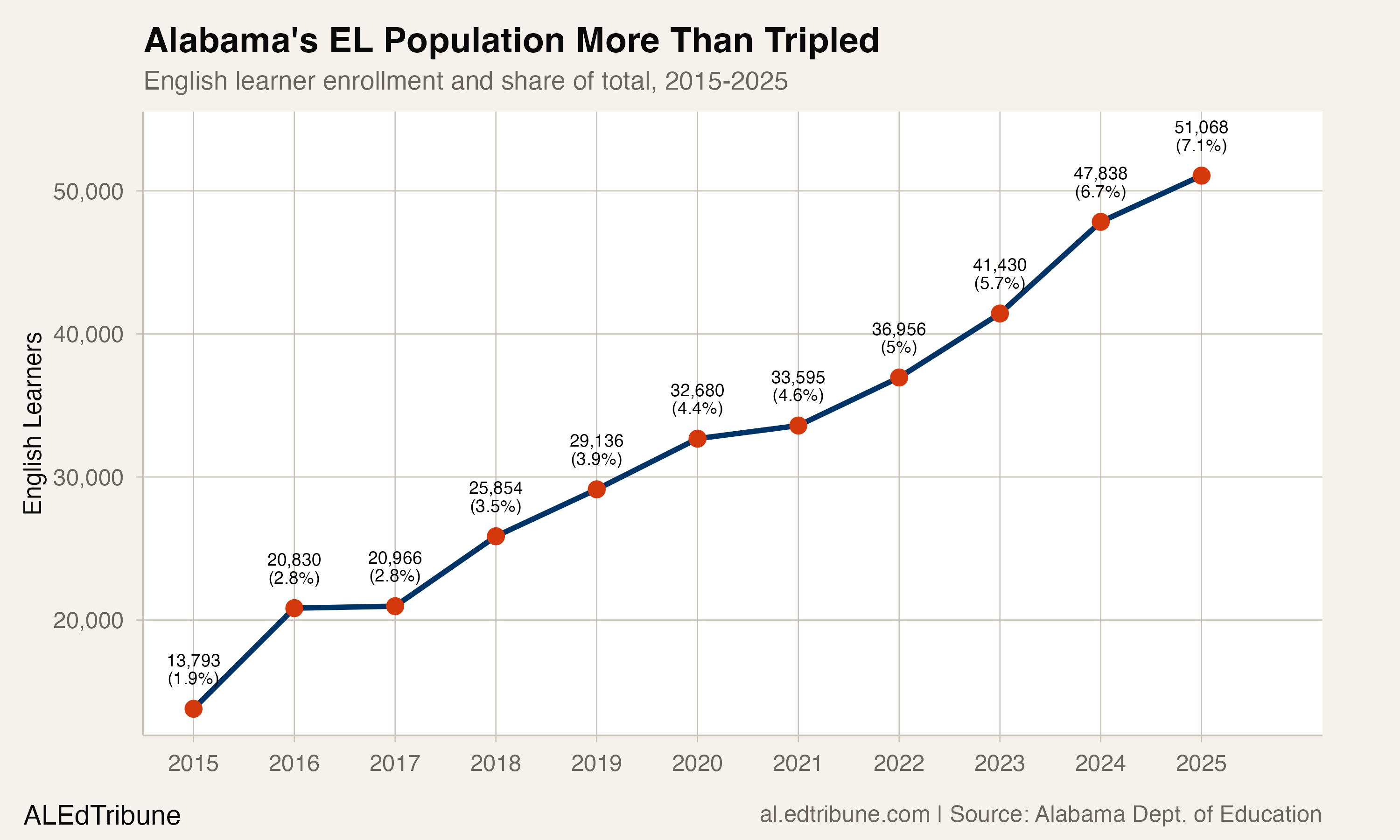
Statewide, the English learner count grew from 13,793 students, or 1.9% of enrollment, in the year ending 2015 to 51,068, or 7.1%, in the year ending 2025. That is an increase of 37,275 students, or 270.2%. Every annual statewide observation increased, even as total enrollment fell by 14,450 over the same endpoints. In the year ending 2025, 128 districts reported a positive English learner count, and together they enrolled 96.4% of the state's students. Of those 128, 28 had shares of at least 10%. The comparable reported-row count was 74 in the year ending 2015. Missing district-subgroup rows were not treated as zeros.
The geography of language
The state data shows where English learner enrollment is concentrated, but it does not record why families chose those communities.
A New America report on rural English learner education connects Russellville's language diversity to employment in poultry processing. That reporting supplies local context; it does not establish that the industry caused every enrollment change in this article.
Decatur City↗ET rose from 8.3% in the year ending 2015 to 23.3% in the year ending 2025. Marshall County↗ET rose from 3.4% to 16.9% over the same endpoints.
Tarrant City enrolled 1,221 students in the year ending 2025, the most recent year in these Report Card counts. Its English learner count was 471, and its share rose from 3.9% in the year ending 2015 to 38.6% in the year ending 2025.
What the growth actually measures
The state's counts cover students classified as English learners. It does not identify newcomers, length of residence, home language, family migration, or changes in local screening practice. The series therefore cannot separate movement between communities from changes in identification.
The New America report describes Russellville families who speak K'iche' and Q'anjob'al in addition to Spanish. The state's enrollment data does not record home languages, so those details come only from that report.
Growth was uneven by year
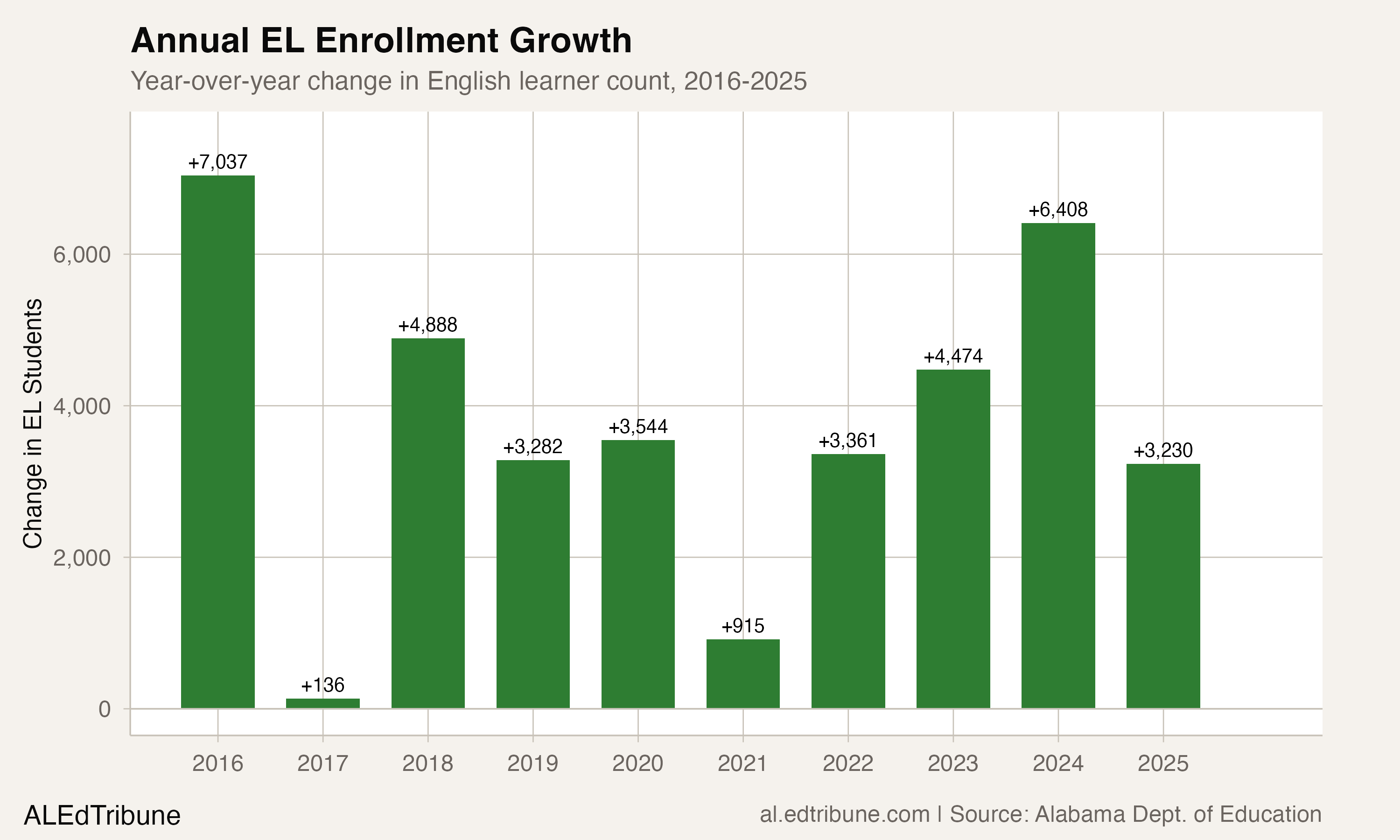
The statewide English learner count did not grow at the same pace every year. The increase in the year ending 2016 was 7,037 students. The increase in the year ending 2024 was 6,408, the largest annual gain after that initial jump. The increase in the year ending 2025 was 3,230.
Alabama's recent school-funding changes include additional weight for English learners, according to A+ Education Partnership's policy summary. The enrollment data does not show whether that policy changed staffing, services, or outcomes in any district.
These counts end with the year ending 2025, so they cannot show whether the statewide increase continued after that. A later observation would not, by itself, explain whether a change came from migration, classification, local employment, or district practice.
Enrollment counts and shares come from the Alabama State Department of Education.
The figures cover school years ending from 2015 through 2025, all from the state's Report Card student counts.
Detailed code that reproduces the analysis and figures in this article is available exclusively to EdTribune subscribers.
Discussion
Sign in to join the discussion.
Loading comments...