Correction: This article was updated on Aug. 20, 2026, to clarify the comparison universe used to rank the male graduation-rate gain.
Alabama Graduation Rates: 2023 CrashET · BirminghamET · Black BeltET · CCR GapET · ConecuhET · Foster CareET · Gender Gap · Hispanic GapET · HomelessET · English LearnersET · MontgomeryET · Nine RecordsET · Race GapET
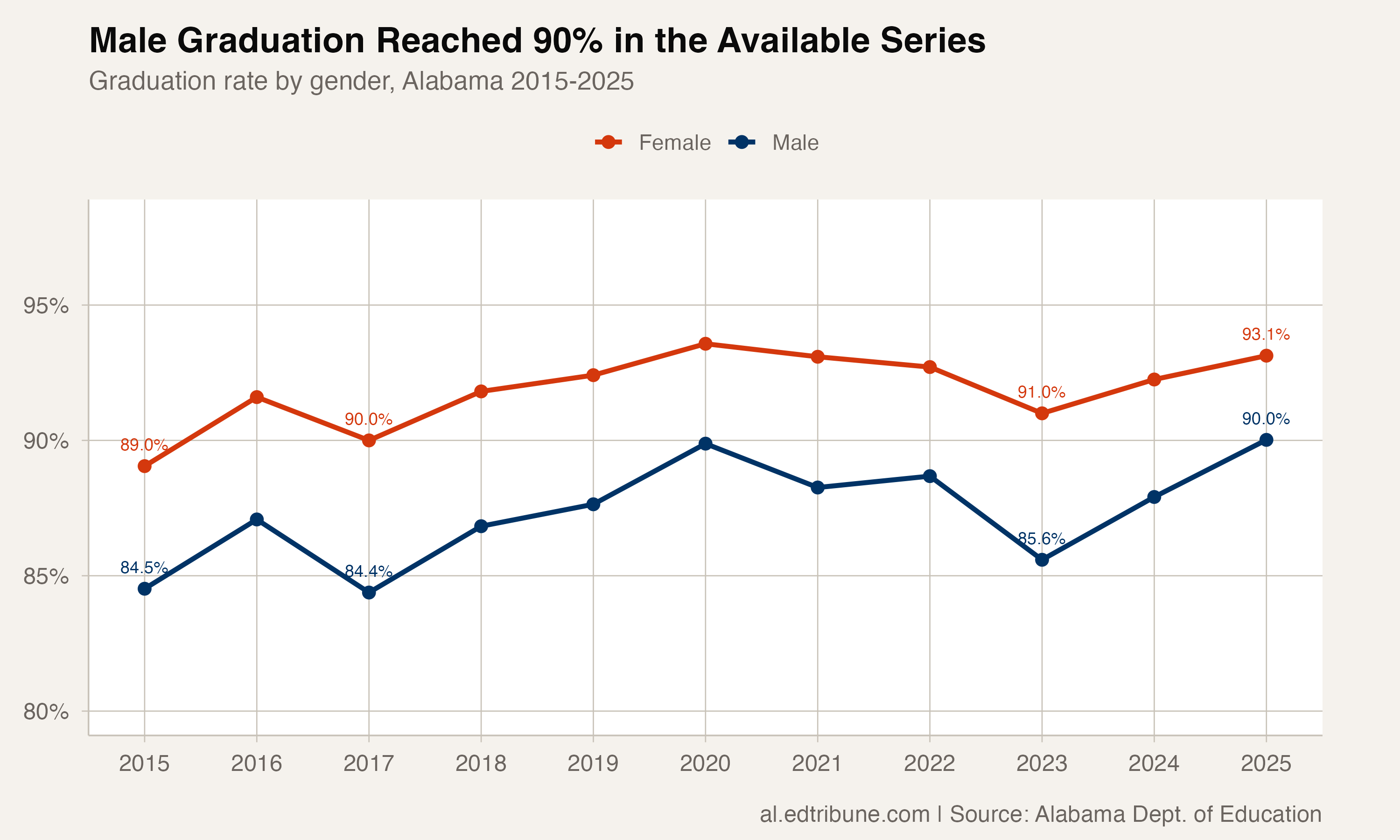
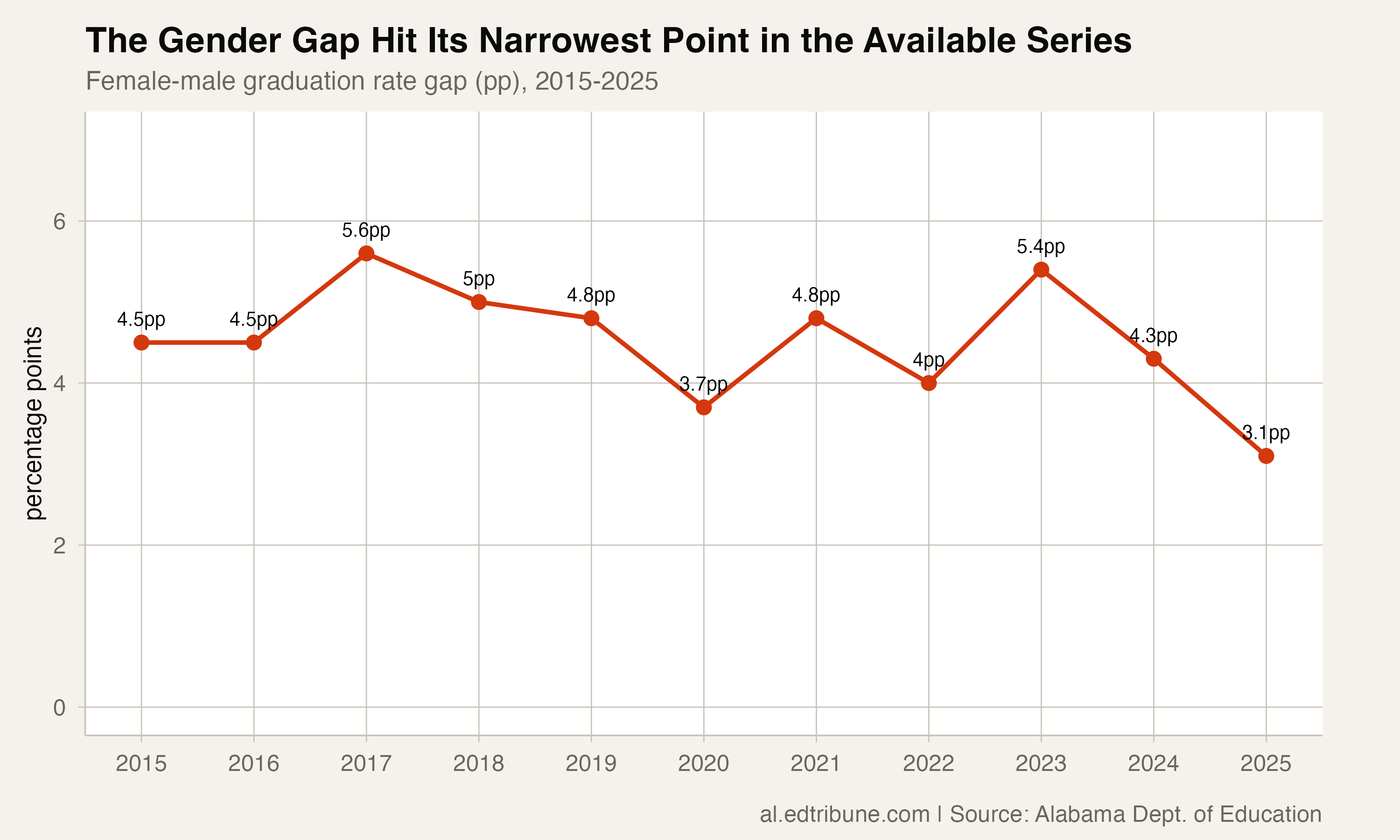
Alabama's male graduation rate reached 90.0 percent in 2025, its highest point in the available 2015-2025 series. The female rate rose to 93.1 percent. The gap between them, 3.1 percentage points, is the narrowest in that series.
That may not sound like headline material. A 3-point gap is small in absolute terms, and gender gaps in graduation rates rarely dominate education policy debates. But for a state where the gap had been as wide as 5.6 points as recently as 2017, the narrowing represents a meaningful shift: male students are improving faster than female students, and the gap is closing because of progress, not regression.
The pattern: males gaining, females steady
The story of Alabama's gender gap narrowing is almost entirely a story of male improvement. Males gained 5.5 percentage points over the decade, from 84.5 percent to 90.0 percent. Females gained 4.1 points, from 89.0 percent to 93.1 percent.
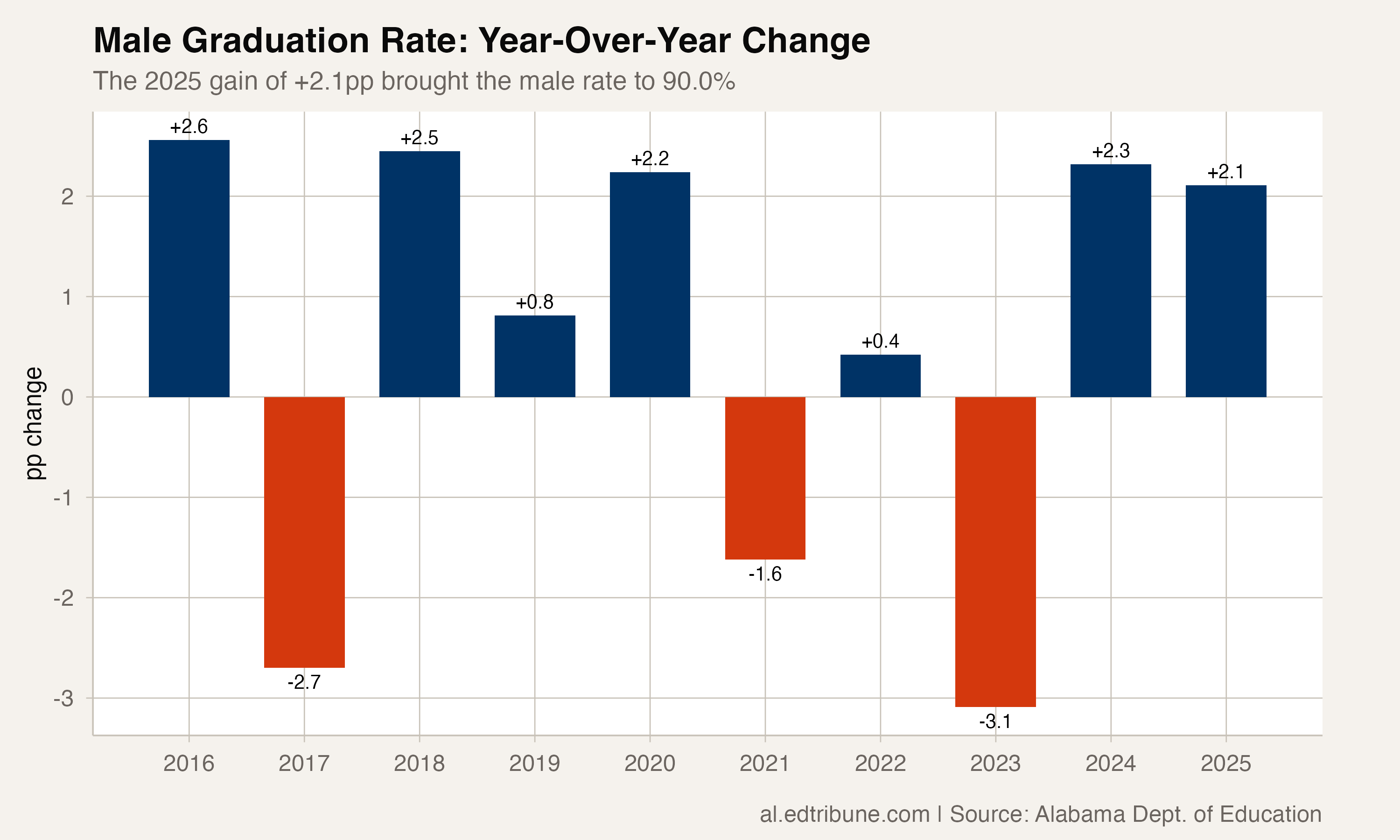
The gap has fluctuated: widening to 5.6 points in 2017 and 5.4 points in 2023, then narrowing. The 2023 widening coincided with a larger drop for males than for females. The 2025 closing paired a 2.1-point male gain with a 0.9-point female increase.
Male improvement ranked sixth among reported comparison groups
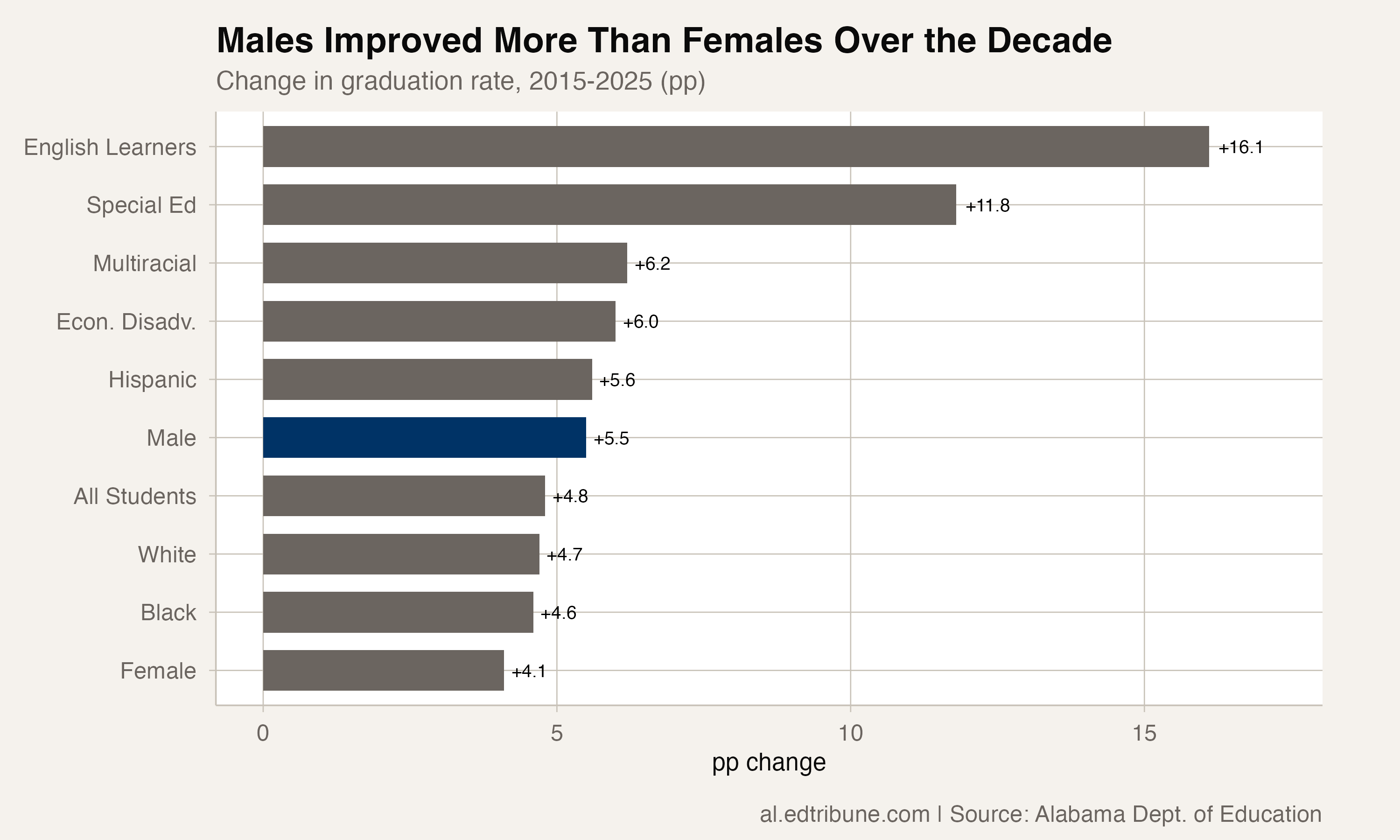
The 5.5-point male improvement over the decade ranks sixth among reported comparison groups with rates at both endpoints, behind English learners (+16.1), students receiving special education services (+11.8), multiracial students (+6.2), students who are economically disadvantaged (+6.0), and Hispanic students (+5.6). Males outpaced Black students (+4.6), white students (+4.7), and females (+4.1).
The 90 percent threshold is symbolically important. It places male students above the 2015 state average for all students (86.7 percent), meaning male graduates in 2025 performed better than the overall student body did a decade earlier.
What the data cannot explain
The state graduation series shows that the gap narrowed because the male rate rose more than the female rate. It does not identify a program, policy, or demographic change that caused the difference. Any explanation involving career pathways, credit recovery, cohort composition, or local practice remains unresourced in this analysis.
The next test
The latest year establishes a new low for the gap within the available panel, not a permanent change. Later cohorts will show whether the male rate holds near its latest level and whether the female rate continues to rise.
By the numbers: 3.1pp, the male-female graduation gap in 2025, the narrowest in the available 2015-2025 series. The male rate reached a series high of 90.0%, gaining 5.5 points over the decade.
Detailed code that reproduces the analysis and figures in this article is available exclusively to EdTribune subscribers.
Discussion
Sign in to join the discussion.
Loading comments...